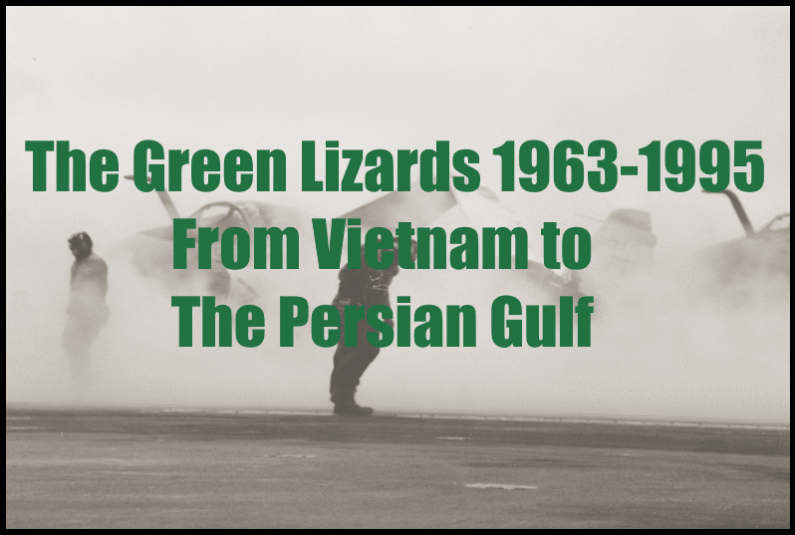
The history of the VA-95 Green Lizards 1963-1995 spans more than three decades of change in U.S. Naval Aviation. During those years, sailors and aircrews carrying the Green Lizard name flew from some of America’s most famous aircraft carriers and operated three legendary attack aircraft: the Douglas A-1 Skyraider, Douglas A-4 Skyhawk, and Grumman A-6 Intruder.
Their missions reflected the changing world around them.
VA-95 flew combat missions during the Vietnam War, protected reconnaissance aircraft over Laos, participated in Operation Flaming Dart and Rolling Thunder, supported the evacuation of Saigon during Operation Frequent Wind, fought during the SS Mayaguez crisis, supported Persian Gulf operations, and played a major combat role in Operation Praying Mantis in 1988.
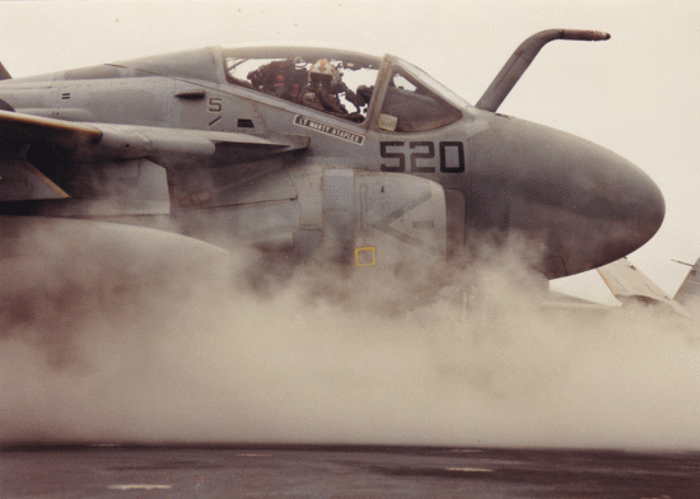
By the time the last VA-95 was disestablished in 1995, the Green Lizards had gone from propeller-driven Skyraiders to sophisticated A-6E Intruders capable of precision attack in almost any weather.
Green Lizards 1963-1995: Two Squadrons, One Green Lizard Tradition
The VA-95 Green Lizards 1963-1995 were not one continuously active squadron.
The second Navy squadron designated VA-95 had been established on March 26, 1952. It fought in Korea, later became known as the Skyknights, and adopted the Green Lizards nickname in 1963. That VA-95 was disestablished on April 1, 1970.
Two years later, on April 1, 1972, the Navy established another VA-95 at NAS Whidbey Island, Washington. This was officially the third Navy squadron to carry the VA-95 designation. It was a new squadron rather than a continuation of the unit disestablished in 1970, but it carried forward the Green Lizard traditions.
Green Lizards 1963-1995: The Green Lizards Are Born
From 1957 through 1963, the second VA-95 had been known as the Skyknights. The squadron flew Douglas AD-6 and AD-7 Skyraiders, redesignated A-1H and A-1J in 1962. However, in 1963, VA-95 began using the Green Lizards nickname.
American involvement in Southeast Asia was increasing. Laos was unstable, Communist infiltration was expanding, and South Vietnam faced growing military pressure. VA-95 was aboard USS Ranger (CVA-61) with Carrier Air Group Nine during a 1962–1963 Western Pacific deployment.
In May 1963, Ranger moved into the South China Sea when military losses suffered by neutralist forces in Laos raised fears of a larger crisis. VA-95 was ready if needed. The immediate crisis eased without requiring Green Lizard combat strikes.
That would soon change.
Green Lizards 1963-1995: VA-95 and the A-1 Skyraider
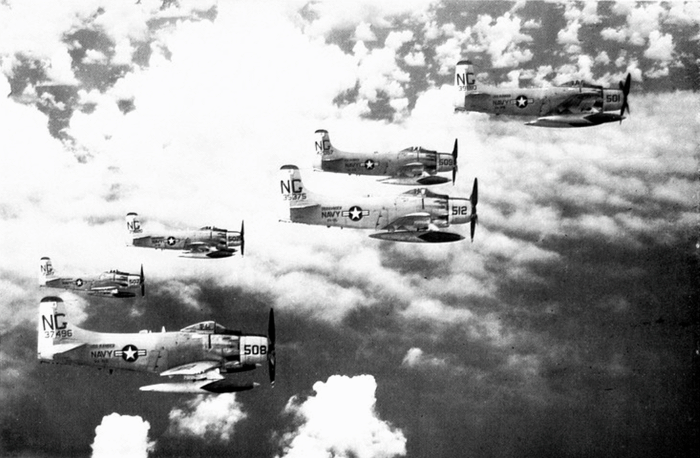
The first aircraft of the Green Lizard era was the Douglas A-1 Skyraider.
VA-95 operated the A-1H and A-1J.
By the early 1960s, the Skyraider seemed almost out of place on a carrier deck increasingly dominated by jets. It was powered by a massive Wright R-3350 radial engine and could trace its design to the final months of World War II.
Yet the Skyraider remained an excellent attack aircraft. It could carry a heavy weapons load, stay airborne for long periods, operate effectively at low altitude, and absorb considerable punishment. Those qualities made it particularly useful in Southeast Asia.
Green Lizards 1963-1995: USS Ranger and the Vietnam War
VA-95 returned to USS Ranger in August 1964, this time with Carrier Air Wing Nine.
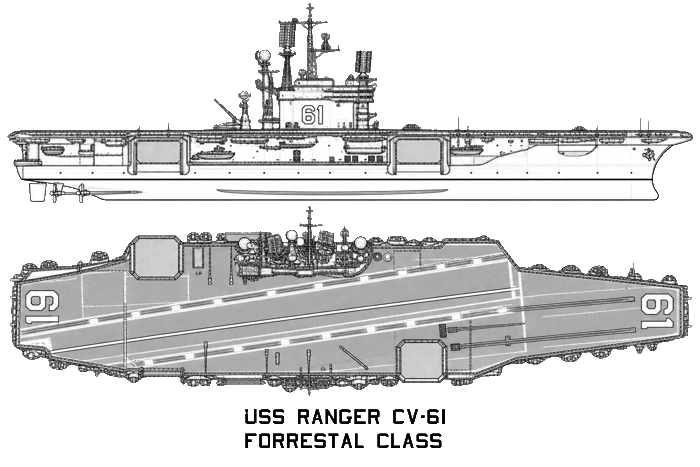
The deployment placed the Green Lizards directly into the growing conflict in Southeast Asia. From November 1964 through April 1965, VA-95 supported photo-reconnaissance missions and conducted strikes against targets in Laos.
These missions occurred during the period of Operation Yankee Team and other American reconnaissance and interdiction efforts over Laos.
Green Lizards 1963-1995: Operation Flaming Dart
The war escalated dramatically in February 1965. Following Communist attacks on American facilities in South Vietnam, President Lyndon Johnson ordered retaliatory air strikes against North Vietnam.
VA-95 was assigned a mission during Operation Flaming Dart I on February 7. The Green Lizards were tasked with attacking the Vit Thu Lu barracks, but poor weather prevented the strike from being completed.
On February 11, Operation Flaming Dart II followed. This time VA-95 participated in the attack against the Chanh Hoa military barracks near Dong Hoi. The Green Lizards were now flying combat missions against North Vietnam.
Green Lizards 1963-1995: Operation Rolling Thunder
In March 1965, the United States began Operation Rolling Thunder, a sustained air campaign against North Vietnam.
The squadron’s official operational history records strikes against the Phu Qui ammunition depot during the opening phase of the campaign. For the sailors and pilots of VA-95, the change was dramatic. The training, exercises, and Cold War readiness of the previous years had become actual combat.
The A-1 Skyraider had carried the Green Lizards into war. But VA-95 was about to enter the jet age.

Green Lizards 1963-1995: VA-95 Transitions to the A-4 Skyhawk
VA-95 began receiving the Douglas A-4C Skyhawk in July 1965.
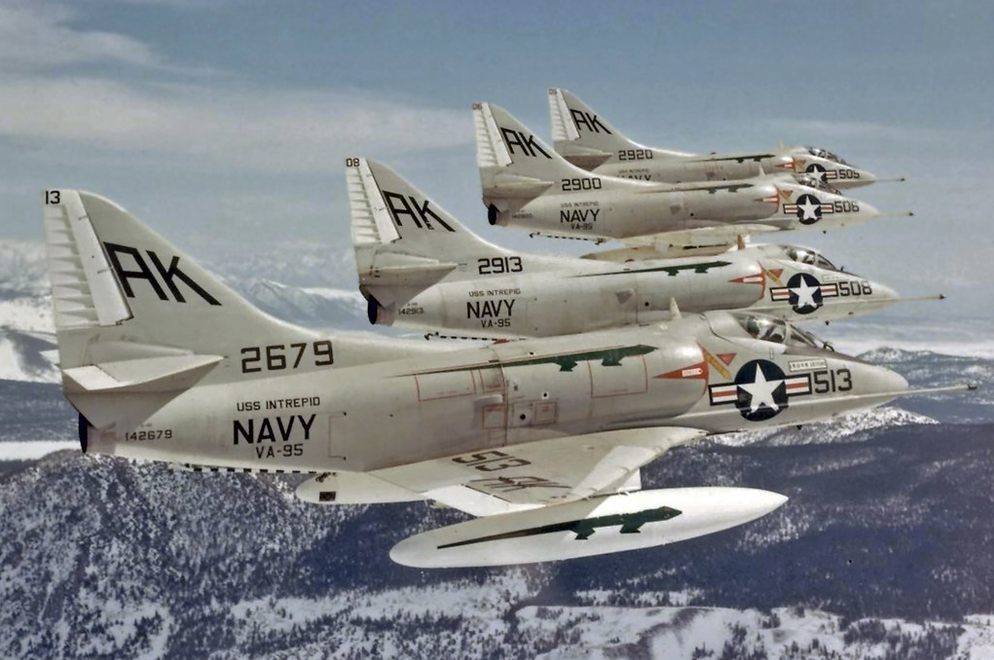
A-4B Skyhawks followed in December.
The transition represented a major technological change. Where t=The A-1 was a large piston-powered aircraft. The A-4 was a compact jet attack aircraft designed around simplicity, speed, and the ability to deliver a useful weapons load from an aircraft carrier.
The change affected everyone in VA-95.
- Pilots learned a completely different aircraft.
- Maintainers learned new engines, electrical systems, hydraulics, flight controls, and troubleshooting procedures.
- Ordnancemen adapted weapons-loading procedures.
- Plane captains learned new inspections and servicing requirements.
Within months, VA-95 was ready to take its Skyhawks to war.
Green Lizards 1963-1995: USS Intrepid and Vietnam, 1966
VA-95 deployed aboard USS Intrepid (CVS-11) with Carrier Air Wing Ten from April 4 through November 21, 1966.
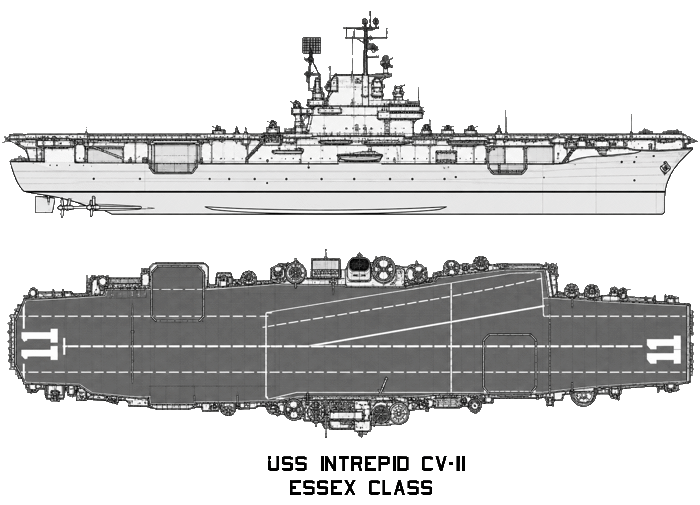
The Green Lizards flew the A-4B Skyhawk.
Although Intrepid carried the CVS antisubmarine-carrier designation, she had been adapted for an attack role because of the demand for carrier aviation in Vietnam. The carrier initially operated from Dixie Station, supporting operations in South Vietnam.
In May 1966 alone, Intrepid flew hundreds of sorties supporting forces ashore. VA-95’s Skyhawks became part of a demanding cycle of launching, striking targets, recovering, rearming, repairing, refueling, and launching again.
Green Lizards 1963-1995: An Extraordinary Carrier Launch
One event illustrates the tempo aboard Intrepid. During the 1966 deployment, the carrier launched nine A-4 Skyhawks and six A-1 Skyraiders loaded with bombs and rockets in only seven minutes.
The aircraft left the catapults at approximately 28-second intervals. A few days later, aircraft were being launched at 26-second intervals.
Green Lizards 1963-1995: USS Shangri-La, 1967–1968
The next major Green Lizard cruise took VA-95 aboard USS Shangri-La (CVA-38).
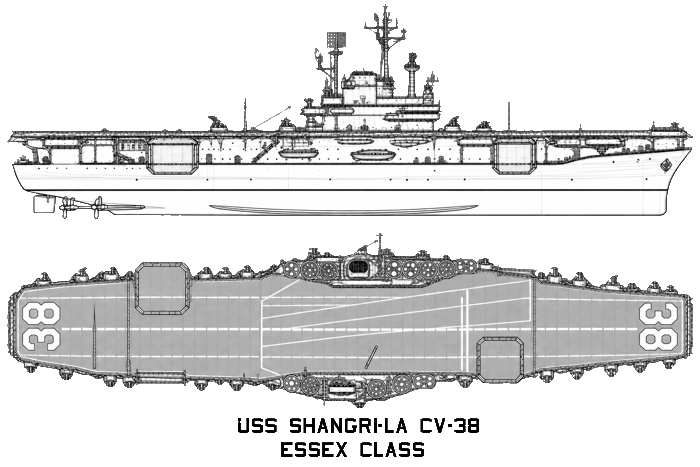
VA-95 deployed with Carrier Air Wing Eight from November 1967 through August 1968. The squadron operated A-4C Skyhawks.
Unlike the 1966 Intrepid cruise, this was a Mediterranean deployment with the Sixth Fleet rather than a Vietnam combat deployment. VA-95’s mission had shifted back toward Cold War deterrence and readiness.
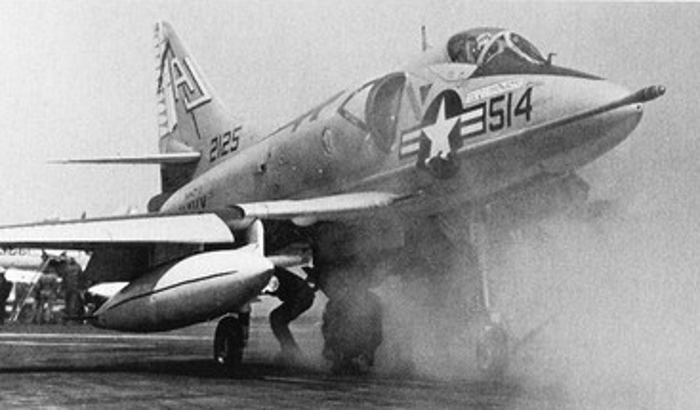
The Green Lizards had to be prepared to respond quickly if political tensions became military conflict.
Green Lizards 1963-1995: USS John F. Kennedy, 1969
VA-95 next deployed aboard the new USS John F. Kennedy (CVA-67) with Carrier Air Wing One in 1969.
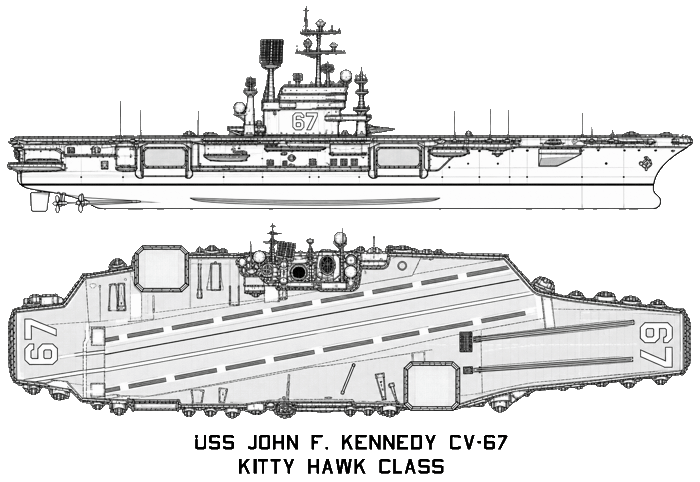
Again, the destination was the Mediterranean. One important event occurred in September.
A military coup overthrew Libya’s King Idris and brought Muammar Gaddafi and his fellow officers to power. Kennedy cut short a port visit and moved into the Ionian Sea as American leaders watched events in Libya.

The carrier and its air wing instead provided a powerful American military presence during an uncertain political crisis. This was carrier diplomacy backed by combat readiness.
Green Lizards 1963-1995: The Second VA-95 Is Disestablished
On April 1, 1970, the second VA-95 was disestablished. Its Green Lizard era had lasted from 1963 through 1970.
During that period, VA-95 had gone from the A-1 Skyraider to the A-4 Skyhawk and from Cold War contingency operations to combat in Southeast Asia.
For two years, the VA-95 designation disappeared. Then the would Green Lizards return.
Green Lizards 1963-1995: 1972: A New VA-95
On April 1, 1972, the Navy established Attack Squadron 95 at NAS Whidbey Island. It was officially the third squadron to carry the VA-95 designation. The new squadron carried on the Green Lizard traditions of the previous VA-95.
But it received an entirely different aircraft. The new Green Lizards became an Intruder squadron.
VA-95 initially operated:
- A-6A Intruder
- A-6B Intruder
- KA-6D Intruder tanker
The squadron joined Carrier Air Wing Fifteen. The Grumman A-6 would define VA-95 for the remaining 23 years of its history.
Green Lizards 1963-1995: The Grumman A-6 Intruder
The A-6 Intruder was designed to perform a mission that had challenged naval aviators for decades: finding and attacking targets at night and in bad weather.
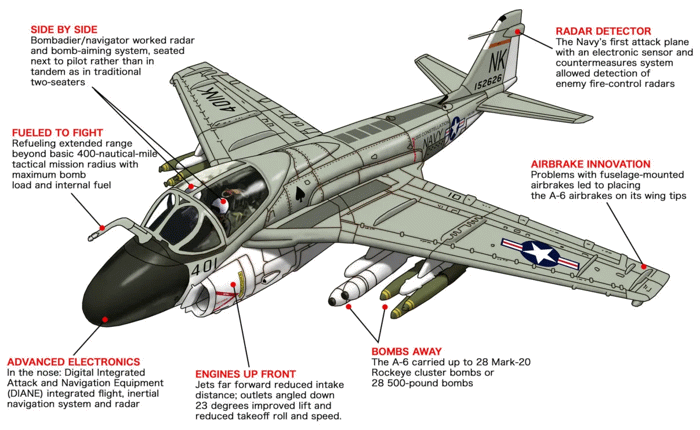
- It carried two crew members seated side by side.
- The pilot concentrated on flying the aircraft.
- The bombardier-navigator operated navigation, attack, radar, and weapons systems.
- The Intruder could carry a heavy weapons load over substantial distances.
The KA-6D version provided aerial refueling, allowing VA-95 to support other aircraft in the carrier air wing as well as conduct attack operations.
Later, the A-6E gave the Green Lizards even greater all-weather and precision-strike capability.
Green Lizards 1963-1995: USS Coral Sea and Operation End Sweep
VA-95 deployed aboard USS Coral Sea (CVA-43) with CVW-15 from March 9 through November 8, 1973. The squadron operated the A-6A, A-6B, and KA-6D. Its first major operational assignment involved Operation End Sweep.
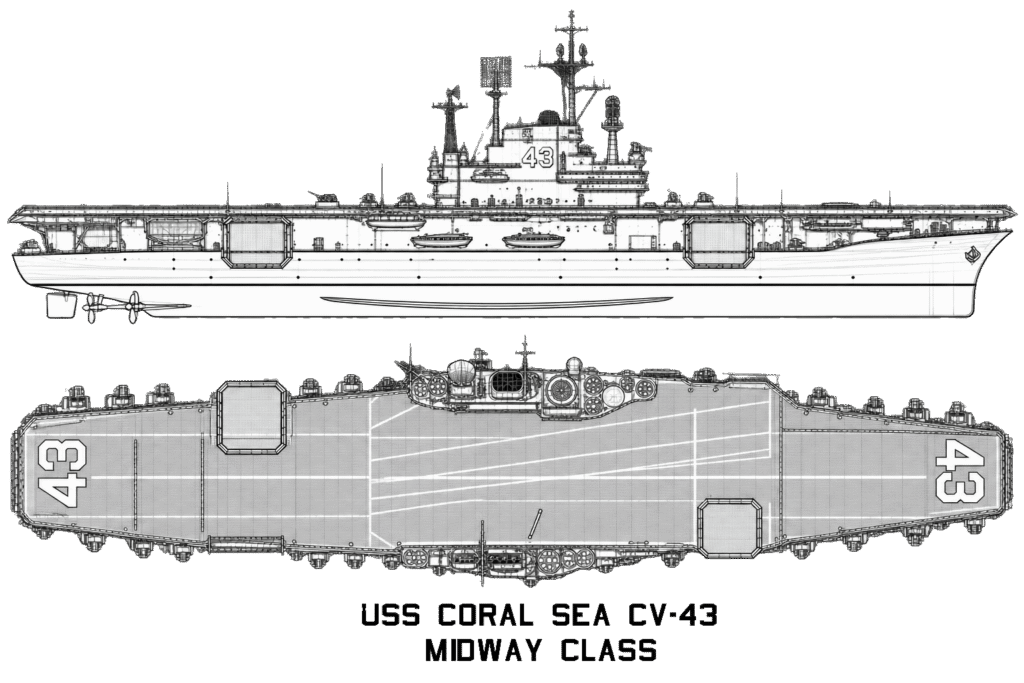
Following the Paris Peace Accords, the United States undertook the removal of mines from North Vietnamese waters. VA-95 supported the mine-clearance effort in April 1973. For a squadron established only a year earlier, it was an important milestone.
The Green Lizards were operational. And they were already serving off Vietnam.
Green Lizards 1963-1995: USS Coral Sea and Operation Frequent Wind
VA-95 returned to Coral Sea for another deployment beginning December 5, 1974. This time the squadron’s deployed aircraft included the A-6A and KA-6D. By spring 1975, South Vietnam was collapsing. North Vietnamese forces advanced rapidly toward Saigon. American carriers moved into position offshore.
On April 29, Operation Frequent Wind began. Helicopters evacuated Americans and endangered Vietnamese from Saigon to Navy ships offshore. Coral Sea and Enterprise provided fixed-wing air cover.

VA-95 participated directly. Green Lizard aircraft flew armed escort missions over the Saigon area to protect helicopters conducting the evacuation. For VA-95, it was an extraordinary historical moment. The squadron was helping protect the final American evacuation from South Vietnam.
Green Lizards 1963-1995: VA-95 and the SS Mayaguez
Less than two weeks after Saigon fell, another crisis erupted. On May 12, 1975, Cambodian Khmer Rouge forces seized the American merchant ship SS Mayaguez. The United States responded with military force. Coral Sea was diverted toward Cambodia, and with it went the Green Lizards of VA-95
On May 15, the carrier launched strikes against Cambodian military facilities. VA-95 A-6A Intruders participated in attacks against Ream Airfield and related military installations. The squadron’s KA-6Ds also provided tanker support.
The Mayaguez operation became the final major American combat action associated with the Vietnam era. For VA-95, it marked the end of one chapter and the beginning of another.
Green Lizards 1963-1995: The A-6E Arrives
VA-95 began receiving the A-6E Intruder in February 1976.
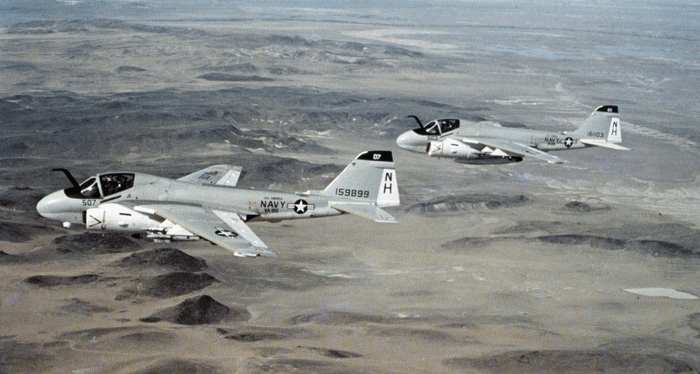
The Green Lizards did not fly the A-6E during Operation Frequent Wind or the Mayaguez operation in 1975. Those missions were flown with the earlier A-6A, supported by KA-6D tankers.
The A-6E would dominate the remainder of VA-95 history. Improved avionics and later upgrades gave it increasingly sophisticated navigation, targeting, and weapons-delivery capability. The Intruder eventually could carry weapons including laser-guided bombs, Harpoon antiship missiles, HARM antiradiation missiles, and other precision weapons.
Green Lizards 1963-1995: USS Coral Sea, 1977
VA-95 returned to USS Coral Sea in 1977. Now the Green Lizards were operating the A-6E along with the KA-6D tanker. The cruise represented VA-95’s transition into the mature Intruder era. The Vietnam War was over. The Cold War was not.
The Navy increasingly needed carriers capable of responding to crises far from the United States. VA-95’s long-range, all-weather attack capability made the squadron an important part of that power projection should it be needed.
Green Lizards 1963-1995: USS America, 1979 and 1981
The Green Lizards later joined Carrier Air Wing Eleven.
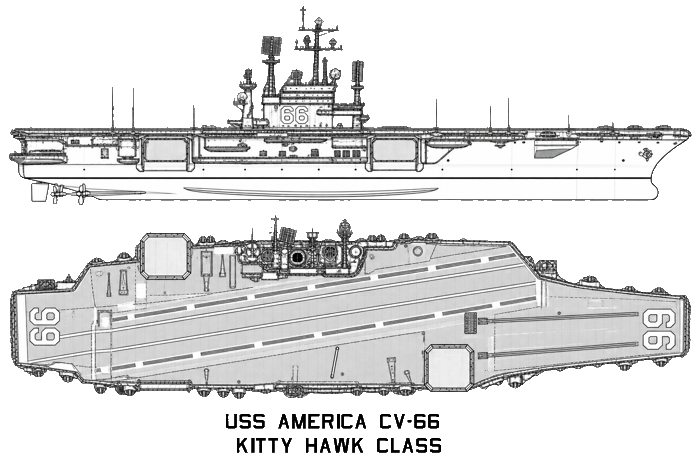
VA-95 deployed aboard USS America (CV-66) in 1979 and again in 1981. The A-6E provided the air wing with heavy all-weather strike capability. The KA-6D provided another essential service: fuel.
Green Lizards 1963-1995: The USS Enterprise Years
During the 1980s, VA-95 developed a long relationship with USS Enterprise (CVN-65).
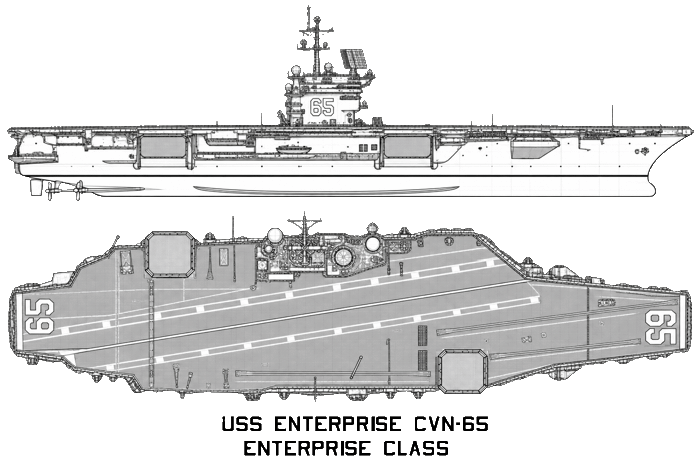
The Green Lizards deployed aboard the nuclear-powered carrier multiple times with CVW-11. These cruises took VA-95 across the Pacific and Indian Ocean and into waters connected with the Middle East.
Enterprise offered enormous range and endurance, and with that, VA-95 provided a powerful all-weather attack capability.
Together they became part of America’s forward naval presence during some of the most dangerous years of the late Cold War.
Green Lizards 1963-1995: VA-95 and the 1986 Libya Crisis
VA-95 was aboard Enterprise during the 1986 deployment, but one historical myth needs correcting. The Green Lizards did not participate in the March 1986 Gulf of Sidra combat or the April 14–15 Operation El Dorado Canyon strikes against Libya.
Those operations involved other carriers and squadrons. Enterprise was operating outside the Mediterranean when those attacks occurred.
After the strikes, Enterprise transited the Suez Canal on April 28. She became the first nuclear-powered aircraft carrier to pass through the canal. VA-95 and CVW-11 entered the Mediterranean aboard Enterprise following the retaliatory strikes against Libya.
While the Green Lizards therefore participated in the American naval presence following the crisis, but they did not bomb Libya.

Green Lizards 1963-1995: Operation Earnest Will
The Persian Gulf became increasingly dangerous during the Iran-Iraq War. Both Iran and Iraq were attacking commercial shipping. The United States responded by escorting reflagged Kuwaiti tankers under Operation Earnest Will.
Enterprise deployed to the region in 1988. VA-95 was aboard with CVW-11. Then, on April 14, USS Samuel B. Roberts struck an Iranian mine. The explosion nearly sank the frigate and injured members of her crew.
The United States decided to retaliate. Four days later, VA-95 entered one of the most important battles in its history.
Green Lizards 1963-1995: Operation Praying Mantis — April 18, 1988
Operation Praying Mantis was a coordinated American attack against Iranian military targets. And VA-95’s A-6E Intruders were to play a major role in the operation.
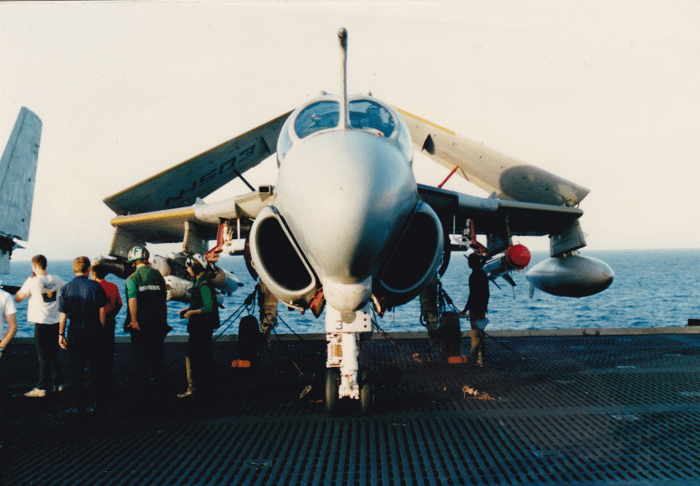
Green Lizard Intruders first attacked Iranian Revolutionary Guard Boghammar speedboats using Mk 20 Rockeye weapons.
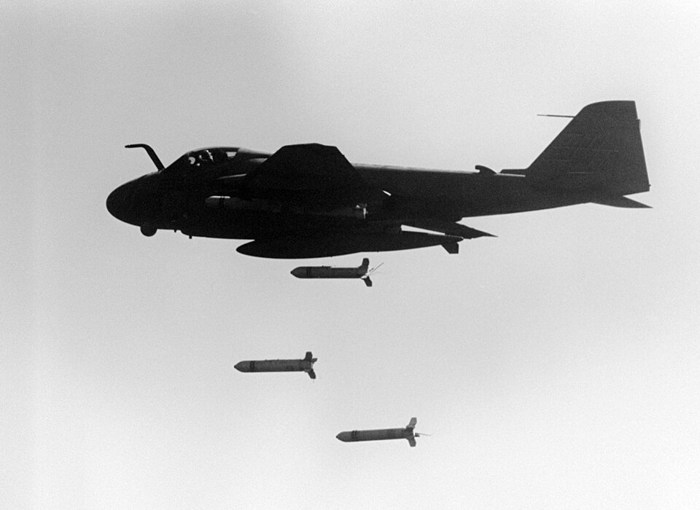
One speedboat was sunk and another damaged according to the Navy’s official VA-95 history. The battle soon escalated as the Iranian frigate Sahand was about to enter the fight.
Green Lizards 1963-1995: VA-95 Versus Sahand
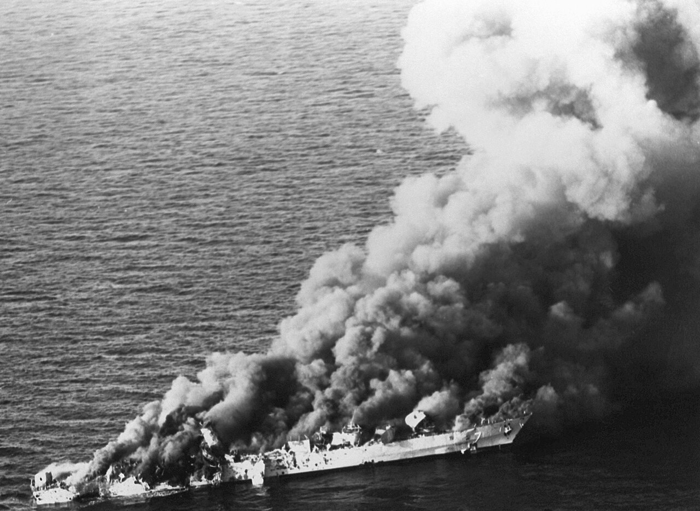
Two VA-95 A-6Es were flying surface combat air patrol for USS Joseph Strauss when they encountered IRIS Sahand. The Iranian frigate fired on the American aircraft. The Green Lizards responded. VA-95 attacked with two Harpoon missiles and four laser-guided Skipper bombs. USS Joseph Strauss also fired a Harpoon.
Sahand was devastated. Fires spread through the frigate until they reached her magazines where they exploded. Sahand eventually sank.
However, the battle was not over.
Green Lizards 1963-1995: VA-95 Versus Sabalan
Sahand’s sister ship, the Iranian frigate the IRIS Sabalan, also entered the fighting.
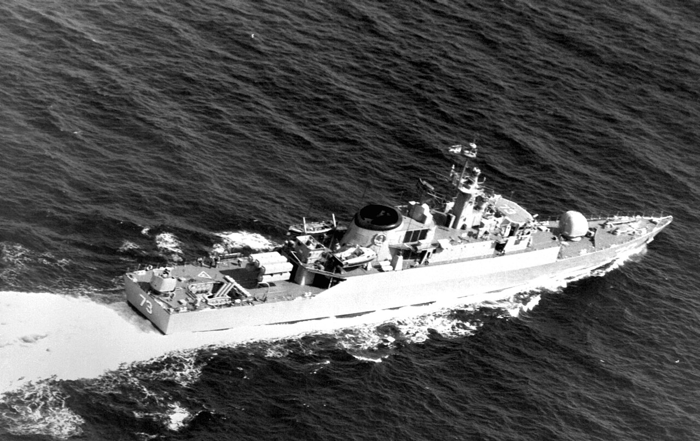
Sabalan fired at American aircraft. A VA-95 A-6E then dropped a Mark 82 laser-guided bomb into Sabalan‘s stack, crippling the ship and leaving it burning. The Iranian frigate, stern partially submerged, was taken in tow by an Iranian tug, and was repaired and eventually returned to service. VA-95’s aircraft, as ordered, did not continue the attack. The A-6 pilot who crippled Sabalan, Lieutenant Commander James Engler, was awarded the Distinguished Flying Cross by Admiral William J. Crowe, Chairman of the Joint Chiefs of Staff, for the actions against Sabalan and the Iranian gunboats.
American commanders decided against destroying the crippled vessel. Sabalan was later taken under tow.
The action demonstrated what the A-6E and a well-trained attack squadron could accomplish against an armed surface warship. Operation Praying Mantis became one of the largest U.S. Navy surface engagements since World War II.
For the Green Lizards, it became a defining moment.
Green Lizards 1963-1995: Distinguished Flying Crosses
Four VA-95 aviators received Distinguished Flying Crosses for their actions during Operation Praying Mantis:
- CDR Arthur N. Langston
- LCDR James H. Engler
- LCDR Joseph E. Nortz
- LT Robert P. Papadakis
Green Lizards 1963-1995: The Final Enterprise Deployments
VA-95 continued deploying aboard Enterprise after Praying Mantis. The squadron remained part of CVW-11 and continued operating the A-6E. By the end of the 1980s, the Cold War itself was changing. The Soviet Union was weakening and in 1989 the Berlin Wall came down.
American military attention increasingly shifted toward regional conflicts and the Middle East.
VA-95 would soon move to another carrier.
Green Lizards 1963-1995: USS Abraham Lincoln
The final carrier associated with the Green Lizards was USS Abraham Lincoln (CVN-72).
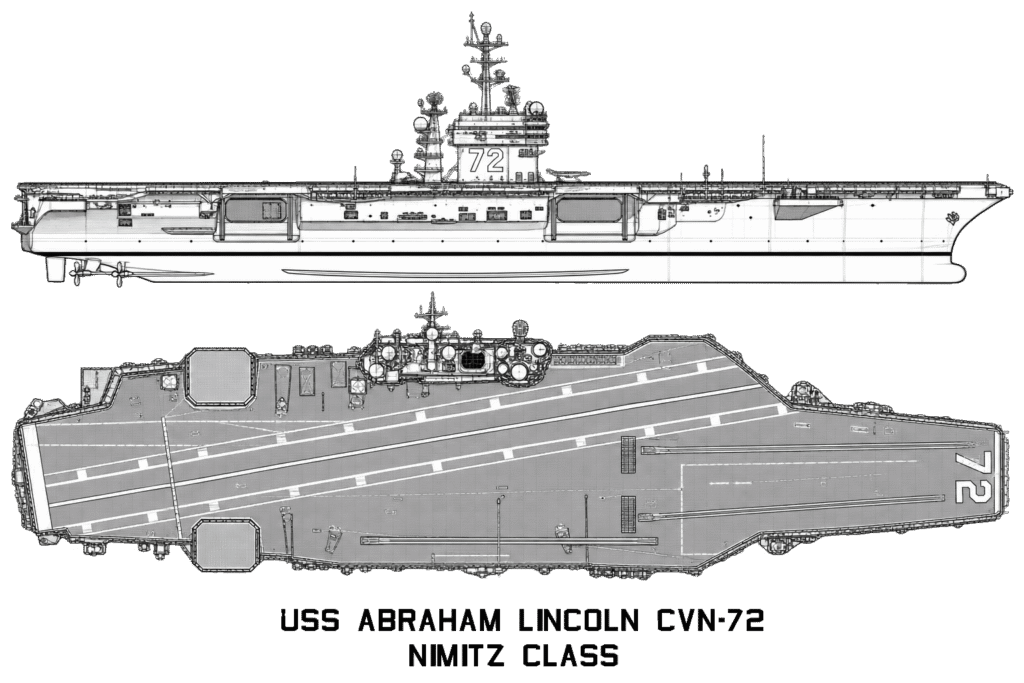
VA-95 and CVW-11 deployed aboard Lincoln during the early 1990s.
The carrier represented a new generation of naval power. The Green Lizards, however, were still flying the A-6E Intruder.
By this time, upgraded A-6Es SWIP could deliver increasingly sophisticated precision and stand-off weapons. The SWIP upgrade enabled the Intruder to use the latest precision-guided munitions, including AGM-65 Mavericks, AGM-84E SLAMs, AGM-62 Walleyes and the AGM-88 HARM anti-radiation missile as well as additional capability with the AGM-84 Harpoon.
The aircraft remained one of the carrier air wing’s most capable long-range strike platforms.
Green Lizards 1963-1995: Operation Fiery Vigil – June 1991
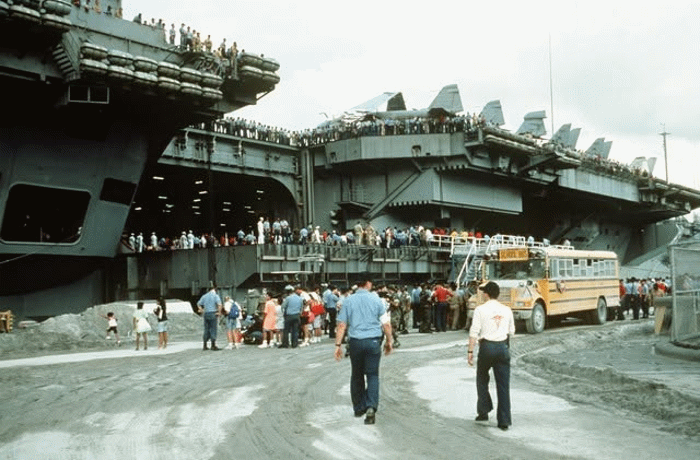
In June 1991 while deployed on a WESTPAC, Attack Squadron 95 (VA-95), the Green Lizards, participated in Operation Fiery Vigil while deployed aboard USS Abraham Lincoln (CVN-72) with Carrier Air Wing 11 (CVW-11) . The carrier was originally heading toward the Arabian Gulf when the eruption of Mount Pinatubo, combined with Typhoon Yunya, caused widespread destruction around Naval Station Subic Bay, NAS Cubi Point, and Clark Air Base in the Philippines. The Abraham Lincoln and its battle group were diverted to help with the emergency evacuation.
Green Lizards 1963-1995: Operation Southern Watch & A Dangerous Day September 8, 1993
During the 1993 cruise, VA-95 operated in the Persian Gulf in support of Operation Southern Watch. Southern Watch enforced the no-fly zone over southern Iraq following the 1991 Gulf War. American aircraft patrolled where Iraqi air defenses could present a threat. VA-95 brought the Intruder’s range, endurance, and all-weather attack capability to the mission.
Not every dangerous mission involved enemy fire. On September 8, 1993, two VA-95 A-6 Intruders collided while returning from a routine patrol over the northern Arabian Gulf. While both aircraft were lost, the good news is all four crew members were rescued. Night operations, formation flying, aerial refueling, weather, mechanical failures, carrier landings, and the crowded flight-deck environment all carry risks. The incident illustrated a fact familiar to generations of naval aviators: Carrier aviation is dangerous even when no one is shooting.
In October 1993, Attack Squadron 95 (VA-95), the Green Lizards, was called from the Arabian Gulf to the coast of Somalia as the crisis around Mogadishu intensified. The Abraham Lincoln had been supporting Operation Southern Watch over Iraq when the carrier received orders to make a high-speed transit to Somalia following the deadly fighting in Mogadishu in early October for Operation Continue Hope.
As part of CVW-11, VA-95 helped provide the carrier-based air presence supporting U.S. and United Nations forces ashore. The carrier’s presence gave commanders a powerful offshore aviation force that could respond quickly if American or coalition troops required assistance.
Green Lizards 1963-1995: Operation Operation Vigilant Sentinel & The Final VA-95 Deployment 1995
The Green Lizards made their final deployment aboard USS Abraham Lincoln in 1995. By then, the A-6 Intruder was approaching retirement.
In 1995, Attack Squadron 95 (VA-95), the Green Lizards, participated in Operation Vigilant Sentinel during the squadron’s final deployment. VA-95 was embarked aboard USS Abraham Lincoln (CVN-72) with Carrier Air Wing 11 (CVW-11), flying the Grumman A-6E Intruder. The carrier deployed in April 1995 to the Arabian Gulf, where CVW-11 supported Operation Southern Watch and helped enforce the no-fly zone over southern Iraq.
The A-6 had served the Navy for decades. Its retirement also meant the disappearance of all the Intruder squadrons. VA-95 was officially disestablished on October 31, 1995. A formal ceremony was held at NAS Whidbey Island on November 18.
CDR Pieter VandenBergh was the final commanding officer. The third VA-95 had served for more than 23 years. The VA-95 designation disappeared from active Naval Aviation.
The Green Lizard story had covered an extraordinary period of American history.
Green Lizards 1963-1995: Aircraft of the VA-95 Green Lizards, 1963–1995
Three aircraft families defined the Green Lizard era.
Green Lizards 1963-1995: Douglas A-1H and A-1J Skyraider
Period: 1963–1965
Major missions included reconnaissance support over Laos, Operation Flaming Dart, and early Operation Rolling Thunder strikes. The Skyraider carried VA-95 into Vietnam combat.
Green Lizards 1963-1995: Douglas A-4B and A-4C Skyhawk
Period: 1965–1970
The Skyhawk brought VA-95 fully into the jet age. The A-4B went to war aboard USS Intrepid in 1966. The A-4C later served during Mediterranean deployments aboard Shangri-La and John F. Kennedy.
Green Lizards 1963-1995: Grumman A-6 Intruder and KA-6D
Period: 1972–1995
The third VA-95 began with A-6A and A-6B Intruders and KA-6D tankers. The squadron began receiving the A-6E in 1976.
The A-6E became the aircraft most closely identified with the later Green Lizards and carried VA-95 through the Cold War, Persian Gulf operations, Operation Praying Mantis, Southern Watch, and the squadron’s final cruise.
Green Lizards 1963-1995: Aircraft Carriers of the VA-95 Green Lizards
The Green Lizards operated from an impressive collection of U.S. Navy carriers between 1963 and 1995.
Green Lizards 1963-1995: USS Ranger (CVA-61)
VA-95 operated A-1 Skyraiders from Ranger during the early Green Lizard years and entered combat in Southeast Asia during the 1964–1965 cruise.
Green Lizards 1963-1995: USS Intrepid (CVS-11)
VA-95 deployed aboard Intrepid with A-4B Skyhawks in 1966 and conducted Vietnam combat operations.
Green Lizards 1963-1995: USS Shangri-La (CVA-38)
VA-95 operated A-4C Skyhawks aboard Shangri-La during the 1967–1968 Mediterranean deployment.
Green Lizards 1963-1995: USS John F. Kennedy (CVA-67)
The Green Lizards deployed with CVW-1 aboard Kennedy during the 1969 Mediterranean cruise.
Green Lizards 1963-1995: USS Coral Sea (CVA-43)
The third VA-95 deployed aboard Coral Sea with its Intruders. Major operations included End Sweep, Frequent Wind, and the Mayaguez crisis.
Green Lizards 1963-1995: USS America (CV-66)
VA-95 operated A-6Es and KA-6Ds aboard America during deployments in 1979 and 1981.
Green Lizards 1963-1995: USS Enterprise (CVN-65)
Enterprise became one of the most important carriers in later Green Lizard history. VA-95 made repeated deployments aboard her during the 1980s, including the 1988 cruise during Operation Praying Mantis.
Green Lizards 1963-1995: USS Abraham Lincoln (CVN-72)
Lincoln became VA-95’s final carrier. The Green Lizards deployed aboard her during the 1990s and made their final cruise in 1995.
Green Lizards 1963-1995: VA-95 Green Lizards 1963–1995 Timeline
Important milestones in Green Lizard history include:
- 1963 — Green Lizards nickname begins with the second VA-95.
- 1963 — VA-95 aboard Ranger responds to the Laos crisis.
- 1964–1965 — Reconnaissance support and strikes over Laos.
- February 1965 — Operation Flaming Dart.
- March 1965 — Operation Rolling Thunder.
- July 1965 — VA-95 begins transition to the A-4 Skyhawk.
- 1966 — A-4B combat deployment aboard USS Intrepid.
- 1967–1968 — Mediterranean deployment aboard USS Shangri-La.
- 1969 — Mediterranean deployment aboard USS John F. Kennedy.
- April 1, 1970 — Second VA-95 disestablished.
- April 1, 1972 — Third VA-95 established at NAS Whidbey Island.
- 1973 — Operation End Sweep aboard USS Coral Sea.
- April 1975 — Operation Frequent Wind and the evacuation of Saigon.
- May 1975 — SS Mayaguez crisis.
- February 1976 — VA-95 begins receiving the A-6E Intruder.
- 1977 — A-6E/KA-6D deployment aboard Coral Sea.
- 1979 and 1981 — Deployments aboard USS America.
- 1980s — Multiple deployments aboard USS Enterprise.
- 1986 — Enterprise and VA-95 enter the Mediterranean following the U.S. strikes against Libya.
- 1987–1988 — Operation Earnest Will period.
- April 18, 1988 — Operation Praying Mantis.
- 1988 — VA-95 attacks Iranian speedboats, Sahand, and Sabalan.
- 1990s — VA-95 operates aboard USS Abraham Lincoln.
- 1993 — Operation Southern Watch period and loss of two A-6s in a midair collision.
- 1995 — Final Green Lizard deployment.
- October 31, 1995 — VA-95 officially disestablished.
- November 18, 1995 — Disestablishment ceremony at NAS Whidbey Island.
From Skyraider to Intruder
Few Navy attack-squadron histories illustrate the transformation of carrier aviation as clearly as the VA-95 Green Lizards.
When the Green Lizard name appeared in 1963, VA-95 was flying a propeller-driven attack aircraft whose design dated from World War II.
Two years later, it was transitioning to the A-4 Skyhawk.
When the VA-95 designation returned in 1972, the new Green Lizards entered the all-weather attack world of the A-6 Intruder.
The carriers changed as dramatically as the aircraft. Ranger, Intrepid, and Shangri-La represented an earlier generation of American carrier aviation. Coral Sea connected World War II carrier design with Vietnam-era warfare.
Enterprise introduced nuclear power. Abraham Lincoln represented the modern supercarrier.
VA-95 served aboard them all during the Green Lizard years.
Green Lizards 1963-1995: The Legacy of the VA-95 Green Lizards
The history of the VA-95 Green Lizards 1963-1995 covers some of the most important decades in modern U.S. Naval Aviation.
The Green Lizard name appeared as America moved toward deeper involvement in Vietnam. VA-95 Skyraiders went into combat over Southeast Asia.Skyhawks followed.
The second VA-95 disappeared in 1970, but the Green Lizard tradition returned with a new squadron in 1972. Intruders then carried the name through the closing years of the Vietnam era.
- VA-95 supported Operation End Sweep.
- It protected the evacuation of Saigon during Operation Frequent Wind.
- It went into combat during the Mayaguez crisis.
- It served through the tense final decades of the Cold War.
- Then, in 1988, Green Lizard A-6Es attacked Iranian forces during Operation Praying Mantis and helped destroy Sahand and disable Sabalan.
- The squadron continued into the post-Cold War world, supporting operations in the Persian Gulf before making its final deployment in 1995.
From the A-1 Skyraider over Southeast Asia to the A-6E Intruder over the Persian Gulf, the Green Lizards spent more than three decades ready to answer the call.
Once a Lizard, always a Lizard.

Want more Green Lizard articles like this? Subscribe to our VA-95 All Weather Attack newsletter today and get VA-95-focused news, announcements, and website updates delivered straight to your inbox.