
VA-95 In The A-4 Skyhawk Era, 1965–1970
VA-95 In The A-4 Skyhawk era marked one of the biggest changes in the history of Attack Squadron 95. Between 1965 and 1970, VA-95 left behind the large, propeller-driven A-1 Skyraider and entered the jet age with the Douglas A-4 Skyhawk. The squadron would fly the small but powerful attack jet from USS Intrepid, USS Shangri-La, and USS John F. Kennedy.
The transition came at an important time. VA-95 had already entered the Vietnam War aboard USS Ranger in 1964 and 1965. Its A-1 Skyraiders had supported photo-reconnaissance missions over Laos, struck targets in Laos, participated in Operation Flaming Dart II, and joined Operation Rolling Thunder.
Now the squadron needed a faster attack aircraft. The answer was the A-4 Skyhawk.
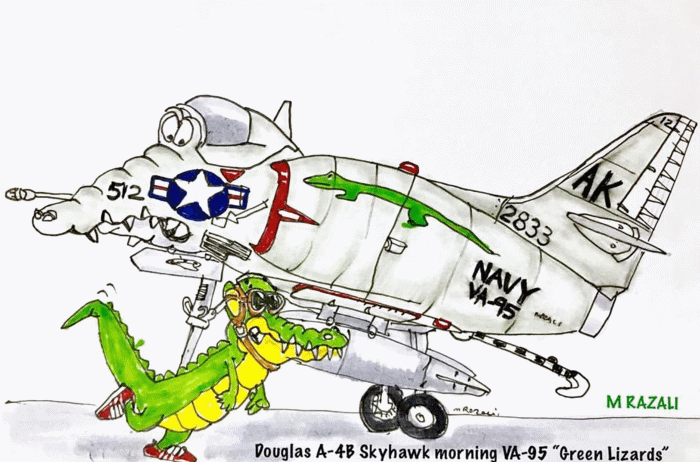
VA-95 flew two variants of the Skyhawk:
- A-4B – Strengthened aircraft and added air-to-air refueling capabilities, improved navigation and flight control systems, provision for AGM-12 Bullpup missile; redesignated A-4B in 1962, 542 built.
- A-4C – Night/adverse weather version of A-4, with AN/APG-53A radar, autopilot, LABS low-altitude bombing system. Wright J65-W-20 engine with 8,200 lbf (36 kN) of takeoff thrust; redesignated A-4C in 1962, 638 built.
VA-95 In The A-4 Skyhawk: From the A-1 Skyraider to the A-4 Skyhawk
VA-95 had flown the Douglas AD Skyraider for more than a decade. The Skyraider had served the squadron well. It could carry a large weapons load and stay airborne for long periods. VA-95 flew Skyraiders during Cold War deployments and in the opening stages of the Vietnam War. But Naval Aviation was changing quickly. Jets were becoming the standard aircraft aboard attack carriers. The Douglas A-4 Skyhawk was almost the opposite of the A-1. The Skyraider was large and powered by a radial piston engine.
The Skyhawk was small, compact, and powered by a jet engine.
The A-4 had been designed by Douglas Aircraft engineer Ed Heinemann (Heinemann designed more than 20 combat aircraft, primarily for the U.S. Navy) as a lightweight carrier attack aircraft. Its small size allowed it to operate without folding wings, saving weight and reducing complexity. Despite its size, the Skyhawk could carry a useful load of bombs, rockets, fuel tanks, and other weapons.
Pilots soon gave it nicknames such as the “Scooter.”
For VA-95, it represented the future.
VA-95 In The A-4 Skyhawk: VA-95 Receives the A-4
VA-95 started receiving it first A-4’s in July 1965. This meant VA-95 had to make a major transition.
- Pilots had to learn an entirely different aircraft.
- Maintainers had to move from the Skyraider’s large Wright R-3350 radial engine to a jet-powered attack aircraft.
- New maintenance procedures were needed.
- Different tools and support equipment were required.
- Flight characteristics changed.
- Weapons delivery changed.
- Carrier operations became faster.
VA-95 had entered the jet age.
VA-95 In The A-4 Skyhawk: USS Intrepid and the Vietnam War
VA-95’s most important A-4 combat deployment came aboard USS Intrepid (CVS-11).
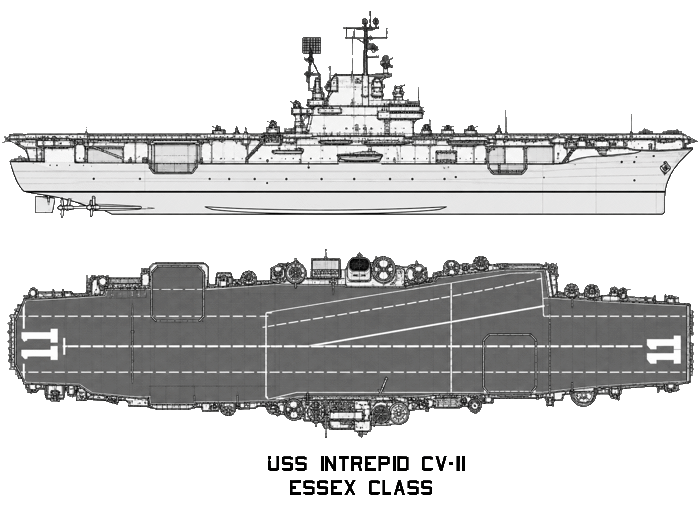
The deployment ran from April 4 through November 21, 1966. VA-95 was assigned to Carrier Air Wing Ten, or CVW-10. For the 1966 Intrepid combat deployment, the official deployment appendix identifies the squadron specifically with the A-4B. Intrepid had been classified as an antisubmarine warfare support carrier, but the Navy adapted the ship for attack operations in Vietnam.
Her air wing was unusual. Instead of a normal fighter-and-attack mix, CVW-10 relied heavily on attack aircraft. VA-95 became part of that hard-working force. The main attack squadrons aboard Intrepid during the 1966 deployment included:
- VA-95 — A-4B Skyhawk
- VA-15 — A-4B Skyhawk
- VA-165 — A-1H Skyraider
- VA-176 — A-1H Skyraider
Helicopters from HC-2 also supported the air wing.
This gave Intrepid a combination of fast A-4 Skyhawks and long-endurance A-1 Skyraiders.
VA-95 In The A-4 Skyhawk: VA-95 Returns to Vietnam
The A-4B was well suited to the light-attack role. It was fast, maneuverable, and small. Its compact size also meant that more aircraft could be placed aboard a carrier. The Skyhawk could carry bombs and rockets beneath its wings and fuselage. Its two 20mm cannon gave the aircraft an internal gun capability.
In Vietnam, A-4s were used against many kinds of targets. These included transportation routes, military positions, supply areas, bridges, buildings, vehicles, and other targets supporting North Vietnamese and Viet Cong forces.
The Intrepid departed the United States in April 1966 and headed for Southeast Asia. VA-95 was going back to war. The squadron’s previous Vietnam combat experience had been aboard Ranger with the A-1 Skyraider.
Intrepid joined the U.S. Seventh Fleet off Vietnam. Her aircraft began flying strikes against Communist targets. The Navy air campaign was now far larger than it had been when VA-95 first entered combat in 1964 and early 1965.
Operation Rolling Thunder was underway against North Vietnam. And VA-95’s A-4Bs became part of this daily carrier air war.
VA-95 In The A-4 Skyhawk: Intrepid’s Fast Launches
One of the most interesting milestones from Intrepid’s 1966 cruise demonstrates how hard the carrier and air wing could work. together
According to the Naval History and Heritage Command, Intrepid once launched nine A-4 Skyhawks and six A-1 Skyraiders loaded with bombs and rockets in only seven minutes. Aircraft were leaving the ship at intervals of only 28 seconds. A few days later, launches were made at 26-second intervals.
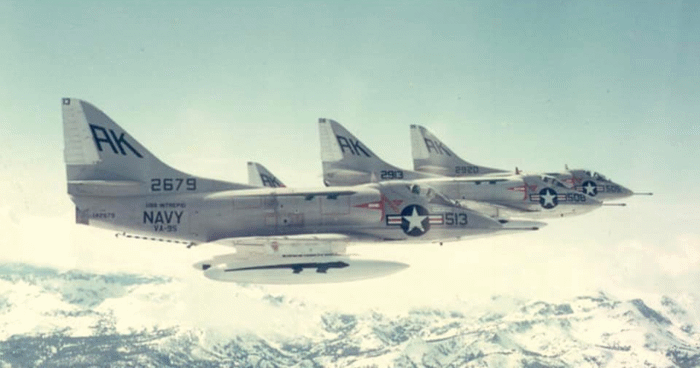
Her aircraft flew missions against targets in Southeast Asia as part of the larger naval air campaign. Yankee Station in the Gulf of Tonkin served as the operating area for carriers launching missions against North Vietnam. VA-95 A-4Bs were now part of the larger Vietnam carrier strike force.
VA-95 In The A-4 Skyhawk: Where Intrepid and VA-95 Deployed
The 1966 Intrepid deployment provides a useful picture of the places visited by VA-95 sailors. Official Navy deployment records list port visits including:
- Subic Bay, Philippines — May 7–12
- Yokosuka, Japan — June 21–30
- Sasebo, Japan — August 15–23
- Hong Kong — August 27–31
- Subic Bay — September 25–29
- Subic Bay — October 21–24
Between those visits came operations at sea.
Subic Bay was especially important. The large American naval facility in the Philippines served as a major support point for carriers operating off Vietnam. Carriers could replenish supplies, conduct maintenance, and prepare for another period on the line.
Then it was back to sea.
VA-95 In The A-4 Skyhawk: Returning from Vietnam
After seven months of service with the Seventh Fleet, Intrepid returned home in November 1966. The official Navy history describes the carrier’s operations as an outstanding period of combat service in Southeast Asia. Earning the Vietnam Service Medal for the dates: 14 May–15 Jun; 8 Jul–10 Aug; 1–23 Sep; 2–18 Oct 1966
For VA-95, the deployment had proven that the squadron could make the difficult transition from the A-1 Skyraider to the A-4 Skyhawk and take the new aircraft directly into combat. The squadron was now a fully established jet attack unit.
But its next deployment would be very different.
VA-95 In The A-4 Skyhawk: VA-95 Acquires The A-4C
The A-4C became an important aircraft during the later VA-95 Skyhawk period. VA-95 had first received the Skyhawk in July 1965 before operating A-4Bs during its Intrepid deployment. Navy aircraft-location records show VA-95 with A-4Cs during its Shangri-La and Kennedy periods. The A-4C was an improved version of the Skyhawk. It included better avionics and an all-weather bombing system compared with earlier models.
Improvement from the A-4B model included: Night/adverse weather version of A-4, with AN/APG-53A radar, autopilot, LABS low-altitude bombing system. Wright J65-W-20 engine with 8,200 lbf (36 kN) of takeoff thrust; redesignated A-4C in 1962, 638 built.
These improvements made the little Skyhawk increasingly useful as an attack aircraft. VA-95 would continue operating the A-4C into the final years of the second squadron’s existence.
VA-95 In The A-4 Skyhawk: USS Shangri-La And The Mediterranean
VA-95 later moved to USS Shangri-La (CVA-38). The squadron was assigned to Carrier Air Wing Eight, or CVW-8.
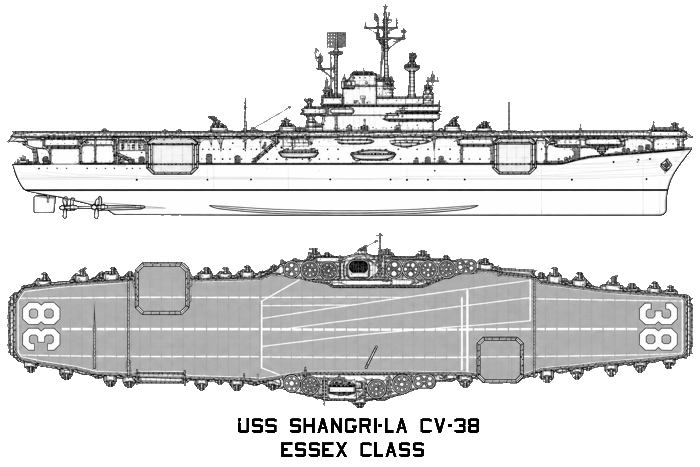
VA-95 deployed aboard Shangri-La from November 15, 1967, through August 4, 1968. Unlike the 1966 Intrepid cruise, this was not a Vietnam combat deployment. Shangri-La operated primarily with the U.S. Sixth Fleet in the Mediterranean.

VA-95 was still a combat-ready attack squadron, but its job was now Cold War deterrence and fleet readiness rather than bombing North Vietnam. Navy aircraft allowance records from late 1967 identify VA-95 aboard Shangri-La with the A-4C Skyhawk.
VA-95 In The A-4 Skyhawk: VA-95 in the Mediterranean
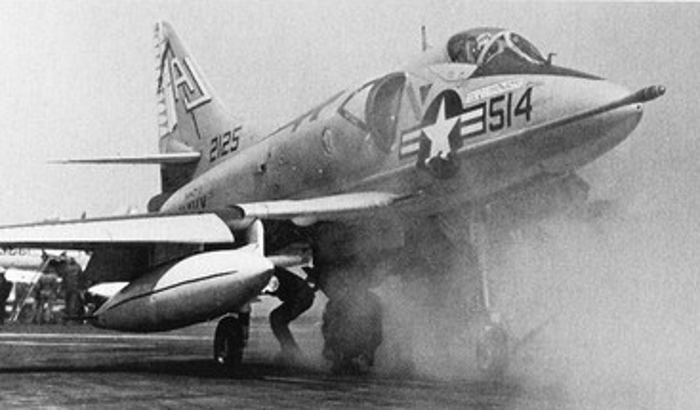
The Mediterranean was one of the Cold War’s most important naval theaters.
- The Soviet Navy was becoming more active.
- The Middle East remained unstable.
- NATO forces needed a strong American naval presence.
A carrier such as Shangri-La gave the Sixth Fleet a mobile airfield that could move quickly in response to a crisis. VA-95’s A-4s gave the carrier an attack capability. The squadron could train for conventional attack missions, weapons delivery, carrier operations, and other tasks needed to remain ready.
There were no Rolling Thunder strikes on this deployment. There did not have to be, as deterrence was the primary mission now.
VA-95 In The A-4 Skyhawk: The USS John F. Kennedy
The final carrier chapter of the second VA-95 and the A-4 Skyhawk came aboard USS John F. Kennedy (CVA-67). The Kennedy was a new attack carrier and one of the most modern ships in the fleet.
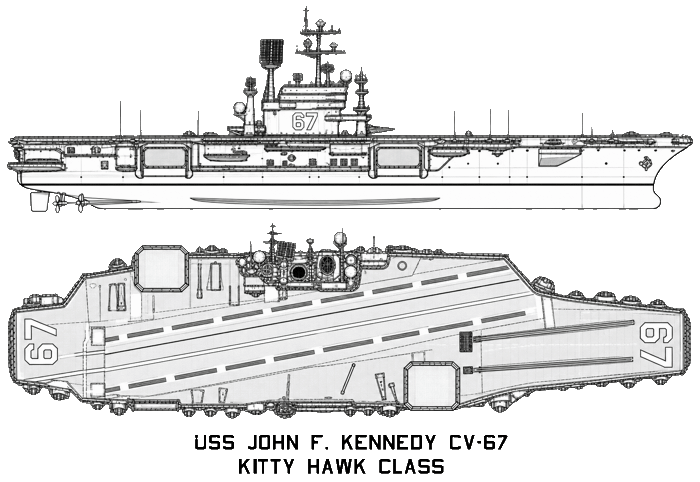
VA-95 joined Carrier Air Wing One, CVW-1, for Kennedy’s 1969 Mediterranean deployment. The carrier departed for the Mediterranean on April 14, 1969.
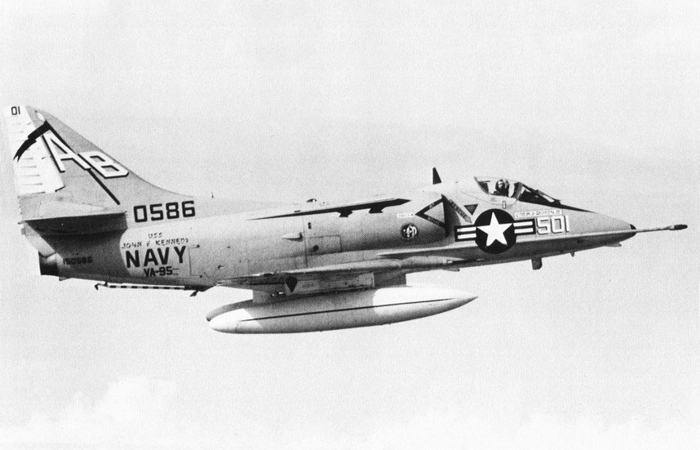
Kennedy reported to the Sixth Fleet on April 21. This deployment again placed VA-95 in the Mediterranean rather than Vietnam.
But the Cold War was very visible.
VA-95 In The A-4 Skyhawk: September 1969: Crisis in Libya
One of the most important events of Kennedy’s deployment occurred after a military coup in Libya. On September 1, 1969, officers led by Muammar Gaddafi overthrew King Idris. The political situation created uncertainty across the Mediterranean.
Kennedy cut short a port visit to Cannes, France, and moved into the Ionian Sea. Kennedy and CVW-1 provided the United States with a powerful military force that could remain nearby without depending on a foreign air base.
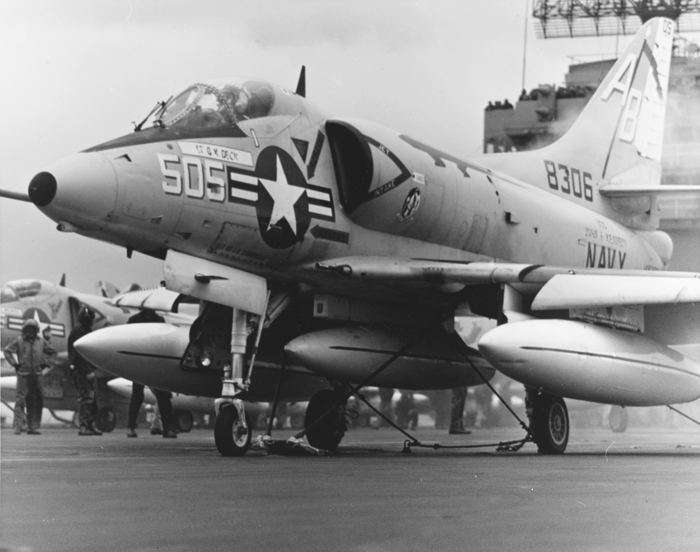
The situation eventually stabilized, and the United States recognized the new Libyan government.
Ironically 17 years later, VA-95 would transition the Suez Canal on April 28, 1986, becoming the first nuclear-powered aircraft carrier to do so. Enterprise and CVW-11, and VA-95’s A-6E Intruders, entered the Mediterranean to reinforce the U.S. Sixth Fleet and relieved the USS Coral Sea after Operation El Dorado Canyon the bombing of Libya.
VA-95 In The A-4 Skyhawk: Three Carriers Define the Skyhawk Era
VA-95’s major A-4 carrier deployments can be summarized clearly.
- USS Intrepid (CVS-11), 1966
- Air Wing: CVW-10
- Aircraft: A-4B Skyhawk
- Deployment area: Western Pacific and Vietnam
- Major role: Vietnam combat operations
- USS Shangri-La (CVA-38), 1967–1968
- Air Wing: CVW-8
- Aircraft: A-4C Skyhawk
- Deployment area: Mediterranean
- Major role: Sixth Fleet Cold War operations and readiness
- USS John F. Kennedy (CVA-67), 1969
- Air Wing: CVW-1
- Aircraft: A-4 Skyhawk
- Deployment area: Mediterranean
- Major role: Sixth Fleet operations, Cold War presence, and response to the Libyan crisis
These three carriers tell the story of VA-95 In The A-4 Skyhawk era.
VA-95 In The A-4 Skyhawk: VA-95 Skyhawk Era Milestones
Several events stand out between 1965 and 1970:
- July 1965 — VA-95 began receiving the A-4C Skyhawk.
- December 1965 — The squadron began receiving A-4B Skyhawks.
- April 1966 — VA-95 deployed aboard USS Intrepid with CVW-10.
- 1966 — VA-95 flew A-4B combat missions during Intrepid’s Vietnam deployment.
- November 1966 — Intrepid completed its seven-month Seventh Fleet deployment.
- November 1967 — VA-95 deployed aboard USS Shangri-La with CVW-8.
- 1967–1968 — VA-95 operated A-4Cs with the Sixth Fleet in the Mediterranean.
- August 1968 — VA-95’s home port changed from NAS Lemoore to NAS Alameda.
- April 1969 — VA-95 deployed aboard USS John F. Kennedy with CVW-1.
- September 1969 — Kennedy responded to the political crisis following the coup in Libya.
- April 1, 1970 — The second VA-95 was disestablished.
VA-95 In The A-4 Skyhawk: The End of the Second VA-95
On April 1, 1970, VA-95 was disestablished. The squadron had existed for 18 years.
- It had been established on March 26, 1952, during the Korean War.
- It flew AD Skyraiders from USS Philippine Sea in Korea.
- It spent the 1950s aboard Hornet, Oriskany, Ticonderoga, and Ranger.
- It entered the Vietnam conflict with A-1H and A-1J Skyraiders.
- Then came the A-4.
- The Skyhawk carried VA-95 through its final Vietnam combat deployment and into its last Mediterranean cruises.
But this was not the end of the VA-95 designation.
VA-95 In The A-4 Skyhawk: Why VA-95 In The A-4 Skyhawk Era Matters
VA-95 In The A-4 Skyhawk era lasted only a few years, but those years tell an important story.
- The squadron changed aircraft in the middle of a war.
- Its pilots moved from the large piston-powered Skyraider to a compact jet attack aircraft.
- Its maintainers had to learn new engines, new systems, and new maintenance procedures.
- Then VA-95 took its A-4Bs aboard USS Intrepid and returned to Vietnam.
- After Vietnam came the Mediterranean.
VA-95’s A-4s served aboard Shangri-La and the new John F. Kennedy during a period of growing Soviet naval power and political instability around the Mediterranean.
- The missions changed.
- The aircraft changed.
- The carriers changed.
- The sailors made it work.
For veterans who served in Navy attack aviation, that may be the most important part of the story. An aircraft does not launch itself. Every combat sortie required maintainers, ordnancemen, plane captains, troubleshooters, flight-deck crews, support personnel, and aircrew working together.
From the flight deck of Intrepid off Vietnam to the Mediterranean aboard John F. Kennedy, the little Douglas A-4 Skyhawk carried VA-95 through the final chapter of the squadron’s 1952–1970 history.
On April 1, 1970, that chapter closed. Two years later, another VA-95 would open a new one with the A-6 Intruder.
Once a Lizard, always a Lizard.

Want more Green Lizard articles like this? Subscribe to our VA-95 All Weather Attack newsletter today and get VA-95-focused news, announcements, and website updates delivered straight to your inbox.