
The history of the VA-95 Skyknights from 1957 through 1963 tells the story of a U.S. Navy attack squadron adapting to a rapidly changing Cold War. Attack Squadron 95 flew the powerful Douglas AD Skyraider from the decks of USS Ticonderoga and USS Ranger while serving with Carrier Air Group Nine.
It was an interesting time in Naval Aviation. Jet aircraft were rapidly taking over carrier flight decks, yet the propeller-driven Skyraider remained one of the Navy’s most capable attack aircraft.
VA-95’s Skyknights flew the AD-6 and AD-7, later redesignated the A-1H and A-1J. They trained for conventional and special-weapons attack missions, operated with the Seventh Fleet, participated in major fleet exercises, worked with allied navies, and stood ready during periods of international tension.
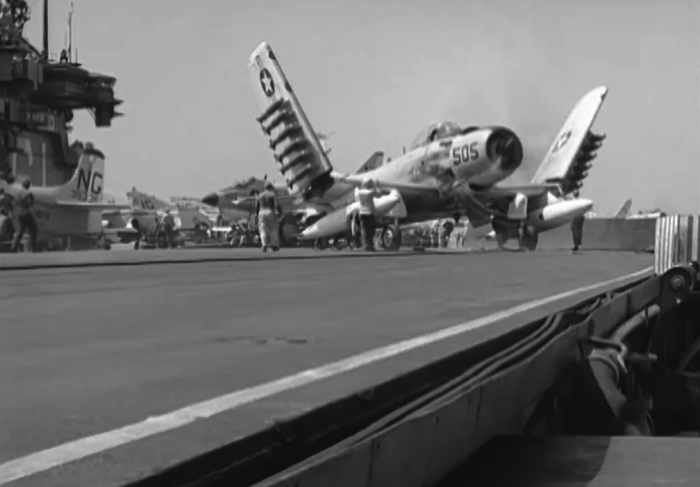
By 1963, that tension was moving toward Southeast Asia. During the squadron’s final year as the VA-95 Skyknights, USS Ranger moved into the South China Sea during a crisis in Laos. The squadron did not enter combat during the 1957–1963 Skyknights period, but the missions and training of those years prepared VA-95 for what was coming.
VA-95 Skyknights: The Second VA-95
The VA-95 Skyknights discussed here belonged to the second U.S. Navy squadron to carry the VA-95 designation. This is an important distinction. The first VA-95 traced its lineage through VT-20 and VA-10A and was disestablished on November 30, 1949.
The Navy established a new Attack Squadron 95 on March 26, 1952. Although it carried the same VA-95 designation, it was officially a different squadron. This second VA-95 fought in the Korean War and remained active through the 1950s and 1960s.
By 1957, the squadron was entering a new chapter. It became known as the Skyknights.
VA-95 Skyknights: The Birth of the VA-95 Skyknights
The VA-95 Skyknights identity was closely connected with a new squadron insignia. The Chief of Naval Operations approved VA-95’s new insignia on January 16, 1957.
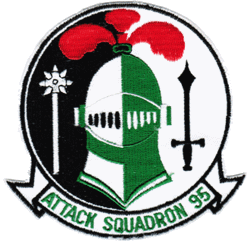
At the center was a knight’s plumed helmet. The design used black, silver, green, and red. A sword and mace added to the medieval warrior theme.
It was a fitting image for an attack squadron. The official Navy history lists the squadron’s nickname as:
Skyknights — 1957–1963.
The Green Lizards nickname followed in 1963 and continued until the second VA-95 was disestablished in 1970.
That makes the years 1957 through 1963 a distinct chapter in VA-95 history.
VA-95 Skyknights: Major Changes During The Skynight Era
Tail Group Code Change
The air group’s new tail code was NG. The change from N to NG had taken effect in July 1957, replacing the earlier N tail code. For sailors who served in VA-95 during these years, those large NG markings became a familiar sight on the squadron’s Skyraiders.
The AD Becomes the A-1
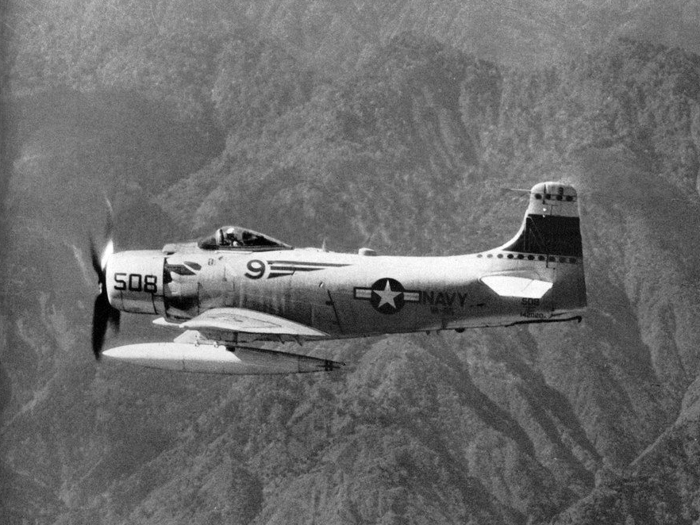
One of the most visible changes during the VA-95 Skyknights period came in 1962. The Department of Defense introduced a standardized aircraft designation system for Naval aircraft.
The Navy’s AD designation disappeared. VA-95’s aircraft were redesignated:
- AD-6 became A-1H.
- AD-7 became A-1J.
This did not mean VA-95 suddenly received an entirely new aircraft. The Skyraider remained. This can cause confusion when researching Skyraider records. A document from 1961 might refer to an AD-6, while a document from 1963 calls essentially the same model an A-1H.
Both are essential to the VA-95 Skyraider story.
VA-95 Skyknights: The Aircraft of the VA-95 Skyknights
The aircraft most closely associated with the VA-95 Skyknights was the Douglas AD Skyraider. VA-95 had begun receiving AD-6 Skyraiders in October 1953. And then began receiving the newer AD-7 in September 1956, shortly before the Skyknights period began.
During the following years, VA-95 operated both versions. The AD-6 and AD-7 were among the most advanced versions of the Skyraider.
- They were large, single-engine attack aircraft powered by the Wright R-3350 radial engine.
- The Skyraider could carry bombs, rockets, mines, external fuel tanks, and other stores on numerous external stations.
- It also carried four 20mm cannon.
For a propeller-driven aircraft designed during the closing months of World War II, the Skyraider had remarkable staying power.
VA-95 Skyknights: Why the Navy Still Needed the Skyraider
By 1957, American carrier decks were filling with jets. Aircraft such as the F-8 Crusader, F11F Tiger, A-4 Skyhawk, and later the F-4 Phantom II represented a new generation of Naval Aviation.
The Skyraider looked old-fashioned beside them. The AD had qualities that were difficult to replace. It could carry a heavy weapons load, fly long distances, remain airborne for extended periods, and operate effectively at lower speeds.
It was also a rugged aircraft. These qualities would eventually make the Skyraider famous in Vietnam. For the VA-95 Skyknights, however, the aircraft’s immediate mission was Cold War attack readiness.
VA-95 Skyknights: 1957–1958: The USS Ticonderoga (CVA-14)
One of the first major deployments of the VA-95 Skyknights began on September 16, 1957. VA-95 deployed aboard USS Ticonderoga (CVA-14) with Carrier Air Group Nine, CVG-9.
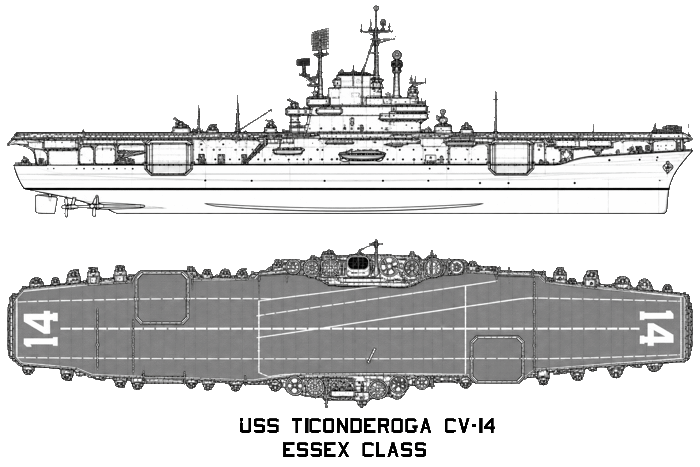
The cruise continued until April 25, 1958. The destination was the Western Pacific. VA-95 operated the AD-6 during this cruise, with the AD-7 also entering the squadron during this period.
The Cold War Mission
The 1957–1958 deployment was not a combat cruise like VA-95’s Korean War deployment several years earlier. The Seventh Fleet was one of America’s most visible military forces in the Pacific.
- Communist China was a growing concern.
- The Korean Peninsula remained divided.
- Taiwan was under threat.
- The Soviet Union was expanding its military power.
American carriers gave national leaders a force that could move into a crisis area without waiting for permission to use a foreign airfield. And VA-95 was part of that force.
The Skyknights had to remain ready to launch in a crisis.
VA-95 Skyknights: A New Carrier: The USS Ranger (CV-61)
The next major chapter for the VA-95 Skyknights came aboard USS Ranger (CVA-61). Ranger was a Forrestal-class attack carrier and represented a major step forward from the World War II-designed Essex-class carriers.
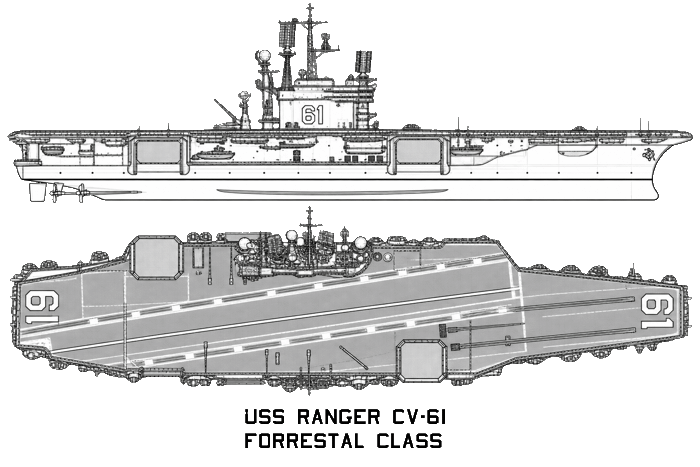
She was more than 1,000 feet long and had been designed from the beginning for modern carrier aviation. Most of Ranger’s aircraft were jets. Yet VA-95’s Skyraiders still had a place on her flight deck.
The Navy was entering the jet age, but it had not abandoned the capabilities of the Skyraider.
VA-95 Aboard Ranger in 1960
VA-95 deployed aboard Ranger with CVG-9 on February 6, 1960. The carrier returned to Alameda on August 30.
The Skyknights operated AD-6 and AD-7 Skyraiders during the Western Pacific cruise. Ranger and her air group conducted Seventh Fleet operations throughout the deployment.
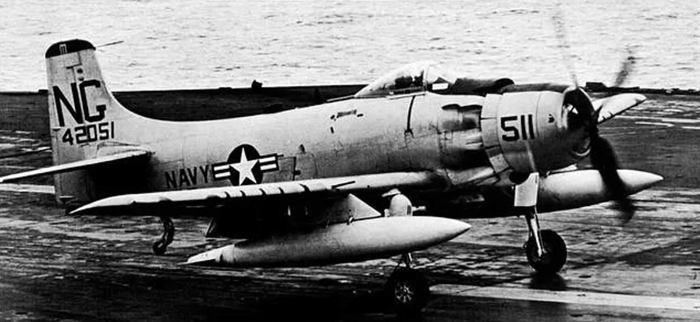
For VA-95, the cruise involved maintaining combat readiness in an environment where a regional crisis could develop quickly.
The squadron had to be prepared for attack missions even though no major combat operation occurred.
VA-95 Skyknights: Back to the Western Pacific in 1961
VA-95 returned to Ranger for another major Western Pacific deployment beginning August 11, 1961.
The carrier remained deployed until March 8, 1962.
Again, VA-95 flew AD-6 and AD-7 Skyraiders with CVG-9.
The Cold War remained tense.
The United States faced Soviet pressure around the world while Communist China remained an important concern in Asia.
The Navy maintained a strong Seventh Fleet presence.
VA-95 helped provide its attack capability.
Operation Bandsaw
One notable milestone came in January 1962 when Ranger participated in Operation Bandsaw. This was a major fleet exercise involving offensive strikes, antiair warfare, and antisubmarine warfare.
Ranger and USS Lexington operated as opposing forces. Each carrier force attempted to locate and “destroy” the other. Crews practiced locating enemy ships while also trying to prevent the opposing force from finding them.
The exercise gave aircrews experience attacking mobile naval forces and gave carrier commanders practice in concealment and defense. Ranger’s official Navy history describes Bandsaw as valuable preparation for the tactics that might be needed against a real enemy.
VA-95 Skyknights: 1962: VA-95 Moves to Moffett Field
VA-95 had been based at NAS Alameda since the squadron was established in 1952. That changed on March 8, 1962 when the squadron moved to NAS Moffett Field, California. However, that move did not last long.
On April 1, 1963, VA-95 moved again, this time to NAS Lemoore. Both changes came during the final years of the Skyknights era.
Official Navy squadron records confirm all three home-port assignments:
- Alameda from 1952,
- Moffett Field beginning March 8, 1962,
- and Lemoore beginning April 1, 1963.
VA-95 Skyknights: The Final Skyknights Deployment
VA-95’s final major deployment under the Skyknights identity began November 9, 1962. Once again, the squadron deployed aboard Ranger with Carrier Air Group Nine. It became one of the most interesting cruises of the VA-95 Skyknights period.
Cross-Deck Operations with HMS Hermes
In January 1963, VA-95 participated in cross-deck operations with the British aircraft carrier HMS Hermes. Cross-deck operations allowed allied navies to practice working together.
Pilots, flight-deck crews, and carrier personnel had to understand different procedures and operating conditions. Such exercises were valuable during the Cold War because the United States expected to fight alongside allied naval forces if a major conflict occurred. For VA-95, the event demonstrated that the squadron’s training extended beyond routine operations with American carriers.
1963: Trouble in Laos
The most serious operational event of the Skyknights period occurred in May 1963. Laos had become a major Cold War trouble spot. Neutralist forces suffered military losses to the Communist Pathet Lao in the Plain of Jars.
American leaders feared that the situation might become worse.
Ranger was ordered toward the South China Sea. On May 1, 1963, the carrier moved into position to support possible operations connected with the Laos crisis. The political situation eased within days and the Skyknights stood-down. Ranger resumed normal Seventh Fleet operations on May 4. While no combat strike occured, the event was important. The Skyknights had moved into position for possible military action in Southeast Asia.
VA-95 Skyknights: VA-95 Skyknights Timeline: 1957–1963
Key milestones of the era included:
- January 16, 1957 — CNO approved VA-95’s knight’s helmet insignia.
- 1957 — VA-95 began using the Skyknights nickname.
- July 1957 — CVG-9’s tail code changed from N to NG.
- September 16, 1957 — VA-95 began a WestPac deployment aboard USS Ticonderoga.
- April 25, 1958 — Ticonderoga deployment ended.
- February 6, 1960 — VA-95 deployed aboard USS Ranger.
- August 30, 1960 — Ranger returned from WestPac.
- August 11, 1961 — VA-95 again deployed aboard Ranger.
- January 1962 — Ranger participated in Operation Bandsaw.
- March 8, 1962 — VA-95 moved from NAS Alameda to NAS Moffett Field.
- 1962 — AD-6 and AD-7 designations changed to A-1H and A-1J.
- November 9, 1962 — VA-95 began another Ranger WestPac deployment.
- January 1963 — VA-95 conducted cross-deck operations with HMS Hermes.
- April 1, 1963 — VA-95 moved to NAS Lemoore.
- May 1963 — Ranger moved into the South China Sea during the Laos crisis.
- June 14, 1963 — Ranger returned from WestPac.
- 1963 — The Skyknights era ended and the Green Lizards era began.
VA-95 Skyknights: VA-95 Skyknights Commanding Officers
Several commanding officers led VA-95 during the Skyknights years.
They included:
- CDR Martin J. Stack — September 1956 to March 1958
- CDR F. L. Brady — March to April 1958
- CDR Rollin E. Gray Jr. — April 1958 to March 1959
- CDR Carl Weisse — March 1959 to September 1960
- CDR R. R. Renaldi — September 1960 to June 1961
- CDR Stanley F. Abele — June 1961 to July 1962
- CDR H. G. Silliman — July 1962 to July 1963
- CDR Harold J. Zenner — assumed command in July 1963
These command dates are recorded in the Navy’s official squadron history.
VA-95 Skyknights: The Skyknights Become the Green Lizards
The year 1963 marked another major change. Now a new identity was emerging. At some point in 1963, the Skyknights became the Green Lizards
VA-95 Skyknights: Were the VA-95 Skyknights a Combat Squadron?
Yes as VA-95, but not as Skynights.
VA-95 was unquestionably a combat-capable attack squadron, and the second VA-95 had already fought in Korea before adopting the Skyknights nickname. However, I have found no official Navy evidence showing that VA-95 flew actual combat missions during the specific 1957–1963 Skyknights period.
Its major cruises during these years were Cold War deployments, exercises, deterrence missions, and contingency operations. The May 1963 Laos crisis brought the squadron close to possible combat, but the crisis eased before strikes were required. VA-95’s return to combat came after the Skyknights era.
VA-95 Skyknights: The Legacy of the VA-95 Skyknights
The VA-95 Skyknights era can easily be overlooked because it falls between two wars. VA-95 had already fought in Korea. Vietnam was still ahead. Yet the years from 1957 through 1963 were far from quiet.
The squadron operated from two major aircraft carriers, USS Ticonderoga and USS Ranger. It flew the AD-6 and AD-7 Skyraider and then watched those same aircraft become the A-1H and A-1J under the new designation system.
The squadron practiced long-range attack operations, participated in major fleet exercises, worked with allied naval forces, changed home stations twice, and maintained readiness during a dangerous period of the Cold War.
Finally, in May 1963, VA-95 and Ranger moved toward a potential crisis in Laos. Within two years, many of the skills developed during the VA-95 Skyknights era would be used in actual combat over Laos and North Vietnam. That may be the greatest importance of the Skyknights years.
And from 1957 through 1963, VA-95 stood ready for whatever came next.
Once a Lizard, always a Lizard.

Want more Green Lizard articles like this? Subscribe to our VA-95 All Weather Attack newsletter today and get VA-95-focused news, announcements, and website updates delivered straight to your inbox.