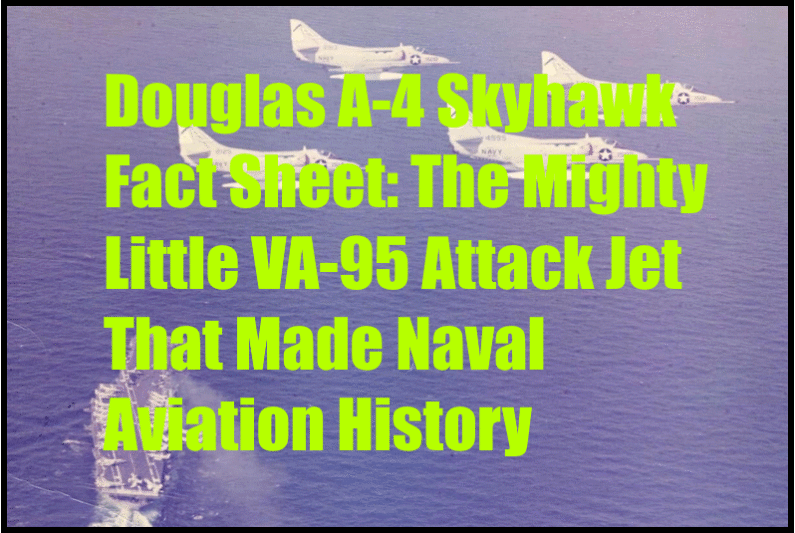
The Douglas A-4 Skyhawk was small, fast, simple, and deadly. It became one of the most important attack aircraft ever flown from a U.S. Navy aircraft carrier.
Designed by legendary Douglas engineer Ed Heinemann, the Skyhawk went against the trend of the 1950s. Military aircraft were becoming larger, heavier, more complicated, and more expensive. Heinemann believed the Navy could have an effective attack aircraft without all that weight. The result was a compact jet that could carry a surprisingly heavy weapons load.
The Douglas A-4 Skyhawk served in Vietnam, flew from numerous U.S. aircraft carriers, trained generations of naval aviators, served with the Blue Angels, and remained in Navy service for decades.
For veterans and students of naval aviation, the A-4 is also an important part of the story of Attack Squadron 95 (VA-95). The Green Lizards flew both the A-4B and A-4C Skyhawk during the 1960s.
I consider myself fortunate that in my Navy career, I got to work on two of the most iconic Navy aircarft. The A-4F Skyhawk with VA-127 and the A-6E Intruder with VA-95.
Birth of the Douglas A-4 Skyhawk
The Navy awarded Douglas a contract for the new attack aircraft in September 1952.
The aircraft was originally designated the A4D Skyhawk. Its first flight took place on June 22, 1954. The designation changed to A-4 under the standardized military aircraft designation system introduced in 1962.
The Skyhawk was designed mainly for:
- Light attack
- Close air support
- Interdiction
- Carrier-based strike missions
Heinemann’s team kept the aircraft as simple and light as possible. One of the most obvious features was its small delta wing. It was compact enough that the Navy did not need a complicated folding-wing system for carrier storage. That saved weight.
The designers found savings elsewhere as well. Even the cockpit, landing gear, electrical system, and air-conditioning system were examined for ways to reduce weight. The result was an aircraft far lighter than the Navy’s original maximum-weight requirement.
A Small Aircraft With a Big Punch
Do not let the Skyhawk’s size fool you. It was a serious attack aircraft. Depending on the variant, a Skyhawk could carry bombs, rockets, missiles, external fuel tanks, and other equipment.
Later versions had five external stations. The aircraft also carried two 20mm cannon.
The Douglas A-4 Skyhawk could be configured for many different missions. A pilot might launch from a carrier with external fuel tanks and bombs for a long-range strike. Another aircraft could carry rockets or other weapons for close air support.
Its small size also made it easier to handle aboard crowded carrier decks. The Skyhawk became known by several nicknames, including “Scooter” and “Tinker Toy.” There was nothing toy-like about what it could do in combat.
The Major Douglas A-4 Skyhawk Variants
The Douglas A-4 Skyhawk remained useful because Douglas kept improving it.
Important American variants included:
A-4A
The early production version, originally known as the A4D-1.
A-4B
Originally designated the A4D-2, the A-4B improved upon the early Skyhawk and became an important fleet attack aircraft. This variant is especially important to the history of VA-95. The A-4B became VA-95’s primary combat Skyhawk during its 1966 Vietnam deployment.
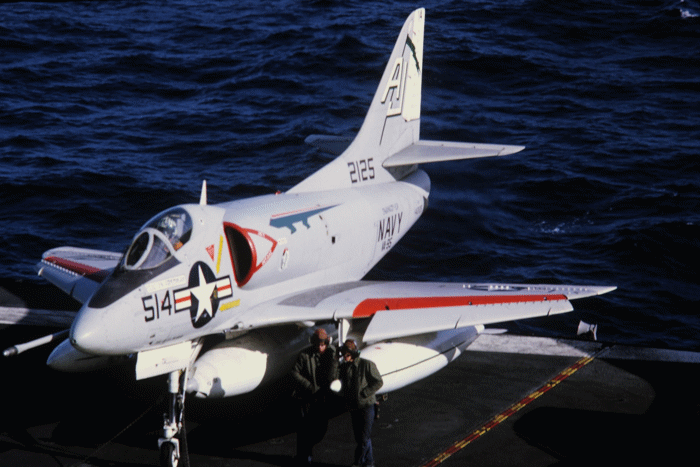
Historical records identify VA-95 A-4B’s including aircraft with Bureau Numbers:
- 145059
- 142103
- 142125
- 142679
- 142781
- 142783
- 142913
- 142920
- 144985
- 144989
- 145030
- 145037
- 145050
- 145057
A-4C
Originally designated A4D-2N, the A-4C offered improved all-weather capability and avionics. VA-95 also operated this version. Historical records identify VA-95 A-4C’s including aircraft with Bureau Numbers:
- 147706
- 147739
- 147787
- 147796
- 147798
- 147802
- 147827
- 147843
- 148306
- 148581
- 149508
- 149516
- 149532
A-4E
The A-4E introduced important improvements, including a more powerful Pratt & Whitney J52 engine and increased weapons-carrying capability.
A-4F
The A-4F further improved the design and became one of the best-known Navy Skyhawks.
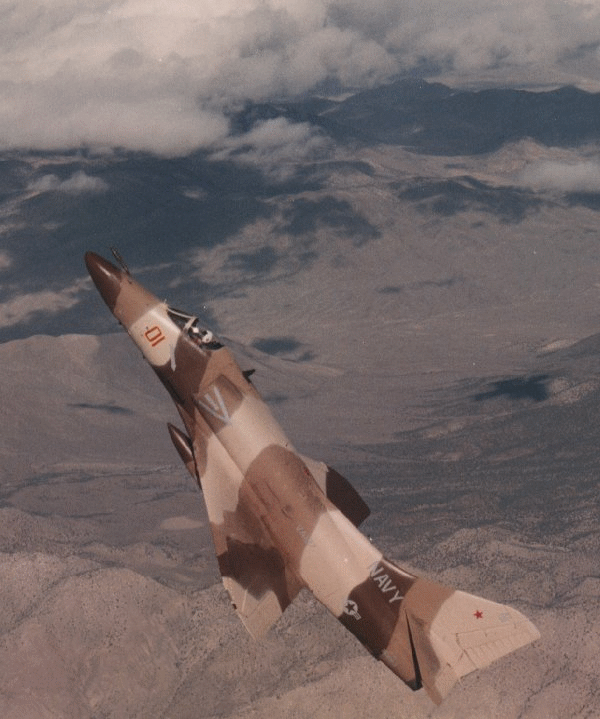
A-4M
The A-4M was developed primarily for the U.S. Marine Corps and represented one of the most advanced American versions of the basic Skyhawk design.
TA-4
Two-seat TA-4 variants became important training aircraft and helped keep the Skyhawk in U.S. military service long after its frontline attack career declined.
More than 20 versions of the Skyhawk eventually appeared, and nearly 3,000 aircraft were built.
VA-95 and the Douglas A-4 Skyhawk
The Douglas A-4 Skyhawk occupies an important chapter in the history of VA-95. This was the second U.S. Navy squadron to carry the VA-95 designation. It had previously flown the powerful piston-engine Douglas AD/A-1 Skyraider.
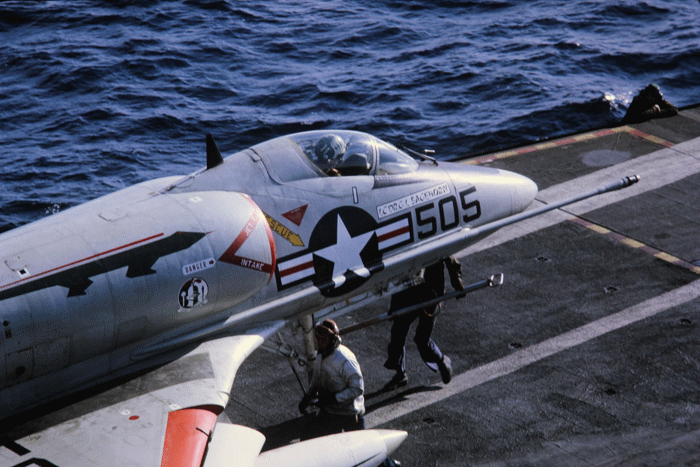
In 1965, that changed. VA-95 began receiving A-4C Skyhawks in July 1965 and subsequently received the A-4B late that year. The change represented a major technological jump. The squadron moved from a large, propeller-driven attack aircraft to a small jet.
The Douglas AD Skyraider and Douglas A-4 Skyhawk were very different machines, but both were built around the same basic idea:
Deliver weapons accurately against enemy targets and bring the pilot home.
The Douglas A-4 Skyhawk Over Vietnam
Vietnam became the war most closely associated with the Navy’s Douglas A-4 Skyhawk. Skyhawk’s took part in the first U.S. Navy strikes against North Vietnam in August 1964. As the war expanded, the little attack jets became a common sight over North and South Vietnam.
Their missions included:
- Bombing military installations
- Attacking bridges
- Striking transportation networks
- Close air support
- Attacking supply areas
- Suppressing enemy defenses
- Armed reconnaissance
According to the Naval History and Heritage Command, the A-4 flew more combat missions over Vietnam than any other U.S. Navy aircraft.
The price was high. The Navy lost 195 carrier-based Skyhawks to enemy fire during the Vietnam War.
VA-95 Aboard USS Intrepid
VA-95’s most important Skyhawk combat deployment came aboard USS Intrepid (CVS-11). The squadron deployed from April 4 to November 21, 1966, as part of Carrier Air Wing Ten (CVW-10). VA-95 flew A-4B Skyhawks during this deployment.
Intrepid had originally been commissioned during World War II. By the 1960s, she had been converted to an antisubmarine carrier.
But Vietnam created new demands. Intrepid was adapted to operate a light attack air group. Her relatively small flight deck was well suited to compact aircraft such as the A-4.
VA-95’s Skyhawks flew combat missions from the ship against targets in Southeast Asia.
VA-95 Aboard USS Shangri-La
VA-95’s next major Skyhawk carrier assignment took the squadron aboard USS Shangri-La (CVA-38).
The squadron was assigned to Carrier Air Wing Eight (CVW-8). VA-95 continued flying the A-4B Skyhawk.
Unlike the 1966 Intrepid cruise, the Shangri-La deployment was primarily a Mediterranean operation rather than a Vietnam combat deployment.
Historical aircraft records show VA-95 A-4Bs aboard Shangri-La, including BuNos 142122, 144983, and 144995.
VA-95 Aboard USS John F. Kennedy
The final major carrier chapter of VA-95’s Skyhawk period involved the new USS John F. Kennedy (CVA-67). By this period, VA-95 was operating the A-4C Skyhawk as part of Carrier Air Wing One (CVW-1).
The squadron made Mediterranean deployments aboard the carrier.
Records identify numerous VA-95 A-4Cs aboard John F. Kennedy, including BuNos 147706, 147739, 147787, 147796, 147798, 147802, 147827, 147843, 148306, 148581, 149508, 149516, and 149532.
VA-95’s Skyhawk Carriers
The main carriers associated with VA-95’s A-4 period were:
| Carrier | A-4 Variant | Air Wing | Period/Role |
| USS Intrepid (CVS-11) | A-4B | CVW-10 | 1966 Vietnam combat |
| USS Shangri-La (CVA-38) | A-4B | CVW-8 | 1967–68 Mediterranean |
| USS John F. Kennedy (CVA-67) | A-4C | CVW-1 | 1968–69 Mediterranean |
This period lasted only a few years, but it represents a distinctive part of VA-95 history.
VA-95 Before and After the Skyhawk
The Douglas A-4 Skyhawk becomes even more interesting when placed in the larger VA-95 story. Before converting to the A-4, the second VA-95 operated the Douglas AD/A-1 Skyraider.
That VA-95 was disestablished on April 1, 1970.
Two years later, a new VA-95 was established. This third squadron did not return to the A-4. Instead, it received the Grumman A-6A Intruder.
The later Green Lizards became famous for their A-6 operations, including Operation Frequent Wind, the Mayaguez incident, and eventually Operation Praying Mantis in 1988. That makes the VA-95 aircraft progression especially interesting:
A-1 Skyraider → A-4 Skyhawk → A-6 Intruder
It is almost a timeline of the changing U.S. Navy attack mission.
Famous Douglas A-4 Skyhawk Pilots
Several famous naval aviators flew A-4s in Vietnam.
They included Everett Alvarez Jr., James Stockdale, John McCain, and Michael Estocin.
- Alvarez was shot down during the August 1964 strikes and became the first U.S. naval aviator captured during the Vietnam War.
- Stockdale was also shot down in an A-4 and became one of the best-known American prisoners of war.
- John McCain was flying an A-4E from USS Oriskany when he was shot down over Hanoi in October 1967.
- Lieutenant Commander Michael Estocin received the Medal of Honor posthumously for actions that included attacking surface-to-air missile positions while flying the Skyhawk.
Why the Douglas A-4 Skyhawk Mattered To VA-95
The Douglas A-4 Skyhawk proved that an effective combat aircraft did not have to be enormous or complicated. Ed Heinemann and his team built a small attack jet around a straightforward idea: eliminate unnecessary weight and concentrate on the mission.
The Douglas A-4 Skyhawk flew from aircraft carriers, attacked heavily defended targets, supported troops on the ground, trained pilots, served as an aggressor aircraft, and eventually became a Blue Angels demonstration aircraft. Nearly 3,000 Skyhawks were produced, and more than 20 versions were delivered to American and foreign operators. The Navy’s last Skyhawk was retired in 2003, more than 50 years after the service ordered the prototype.
For VA-95, the Skyhawk period was relatively short but historically important. The squadron transitioned to the A-4 in 1965, took the A-4B into combat aboard USS Intrepid in 1966, later operated from USS Shangri-La, and finished its Skyhawk carrier period flying the A-4C from USS John F. Kennedy.
Small, tough, fast, and capable of carrying a serious weapons load, the Skyhawk earned its place in naval aviation history. For veterans who worked around them, pilots who flew them, and students discovering naval aviation today, the Douglas A-4 Skyhawk remains one of the great carrier attack aircraft of the jet age.
Douglas A-4 Skyhawk Specifications
Specifications varied greatly between all the Douglas A-4 Skyhawk versions. A representative later Skyhawk illustrates how much performance Douglas packed into the small airframe.
The National Naval Aviation Museum lists a later Douglas A-4 Skyhawk configuration at a maximum speed of 673 mph at sea level, with two 20mm cannon and up to 8,200 pounds of ordnance. Specifications for early A-4B and A-4C aircraft differed, so figures should always be matched to the particular model being discussed.
General characteristics
- Crew: 1
- Length: 40 ft 1.5 in (12.230 m)
- Wingspan: 27 ft 6 in (8.38 m)
- Height: 15 ft 2 in (4.62 m)
- Wing area: 260 sq ft (24 m2)
- Airfoil: root: NACA 0008-1.1-25; tip: NACA 0005-.825-50[162]
- Empty weight: 9,853 lb (4,469 kg)
- Gross weight: 16,216 lb (7,355 kg)
- Max takeoff weight: 24,500 lb (11,113 kg)
- Powerplant: 1 × Pratt & Whitney J52-P-6A turbojet engine, 8,500 lbf (38 kN) thrust
Performance
- Maximum speed: 585 kn (673 mph, 1,083 km/h) at sea level
- Range: 1,008 nmi (1,160 mi, 1,867 km)
- Ferry range: 2,194 nmi (2,525 mi, 4,063 km)
- g limits: +8 -3
- Rate of climb: 5,750 ft/min (29.2 m/s)
- Wing loading: 62.4 lb/sq ft (305 kg/m2)
- Thrust/weight: 0.526 (at gross weight)
Armament
Guns: 2× 20 mm (0.79 in) Colt Mk 12 cannon, 100 rounds/gun
Hardpoints: 4× under-wing & 1× under-fuselage pylon stations with a capacity of 8,500 lb (3,900 kg), with provisions to carry combinations of:
Rockets: 4× LAU-10 rocket pods (each with 4× 127 mm Mk 32 Zuni rockets)
Bombs:
- 6× Rockeye-II Mark 20 Cluster Bomb Unit (CBU)
- 6× Rockeye Mark 7/APAM-59 CBU
- Mark 80 series of unguided bombs (including 3 kg and 14 kg practice bombs)
- B43 nuclear bomb
- B57 nuclear bomb
- B61 nuclear bomb
- Other: up to 3× 370 US gallons (1,400 L) Sargent Fletcher drop tanks for ferry flight/extended range/loitering time
- Missiles:
Air-to-air missiles:
- 4× AIM-9 Sidewinder
- Air-to-surface missiles:
- 2× AGM-12 Bullpup
- 2× AGM-45 Shrike anti-radiation missile
- 2× AGM-62 Walleye TV-guided glide bomb
- 2× AGM-65 Maverick
Avionics
Typical avionics fitted to A-4s
- Bendix AN/APN-141 Low altitude radar altimeter (refitted to C and E, standard in the F)[163]
- Stewart-Warner AN/APQ-145 Mapping & Ranging radar (mounted on A-4F, also found on A-4E/N/S/SU)[164]
Information Resources
For additional research, start with the Naval History and Heritage Command / National Naval Aviation Museum A-4 Skyhawk history, which provides specifications, production information, Vietnam combat history, and background on the aircraft’s development.
The Navy’s Dictionary of American Naval Aviation Squadrons includes a detailed A4D/A-4 aircraft appendix covering the Skyhawk’s development, designation history, weapons, and Navy service.
The Skyhawk Association’s VA-95 archive is particularly useful for aircraft-level research because it records individual VA-95 A-4B and A-4C Bureau Numbers and assignments aboard Intrepid, Shangri-La, and John F. Kennedy.
Research links:
Naval History and Heritage Command — A-4 Skyhawk
Navy Dictionary of American Naval Aviation Squadrons — A-4 Appendix
Skyhawk Association — VA-95 Aircraft and Squadron History
Once a Lizard, always a Lizard.

Want more Green Lizard articles like this? Subscribe to our VA-95 All Weather Attack newsletter today and get VA-95-focused news, announcements, and website updates delivered straight to your inbox.