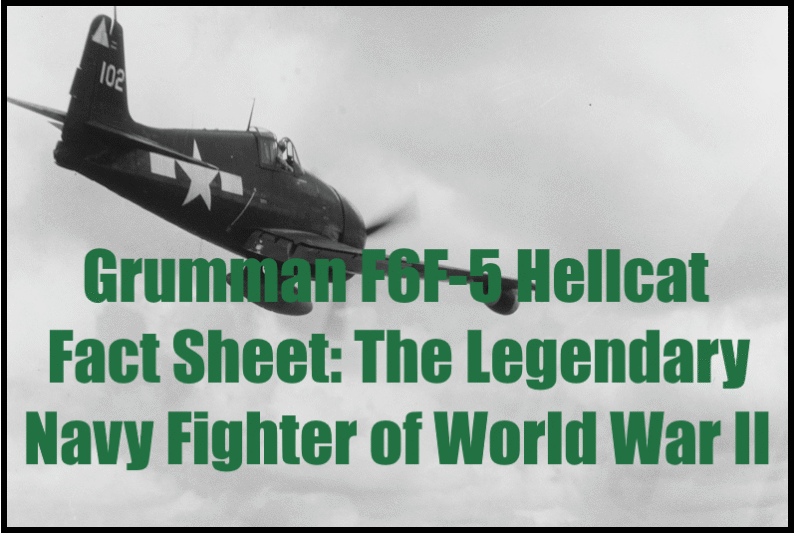
The Grumman F6F-5 Hellcat was one of the most successful carrier fighters ever flown by the U.S. Navy. Big, rugged, heavily armed, and powered by the Pratt & Whitney R-2800 Double Wasp engine, the Hellcat gave American naval aviators the aircraft they needed to gain control of the skies over the Pacific.
The numbers tell part of the story. The U.S. Navy credits Hellcats with destroying more than 5,000 enemy aircraft. Hellcat pilots achieved an extraordinary combat record, and the aircraft produced more fighter aces than any other American aircraft of World War II.
Yet the F6F-5 was more than a fighter. It could escort bombers, protect the fleet, attack airfields, fire rockets at ground targets, and carry bombs against enemy ships and installations.
By the final year of World War II, the F6F-5 had become one of the most versatile weapons aboard an American aircraft carrier.
Why the Navy Needed the Grumman F6F-5 Hellcat
When the United States entered World War II, the Navy’s primary carrier fighter was the Grumman F4F Wildcat.
The Wildcat was tough and dependable, but American pilots soon learned to respect Japan’s Mitsubishi A6M Zero. The Zero was light, maneuverable, and dangerous in the hands of an experienced pilot. The Navy needed something better.
Development of what became the Hellcat began in 1941. The aircraft was initially conceived as an improved Wildcat, but the changes became so extensive that Grumman essentially created a new fighter.
The first XF6F-1 prototype flew in June 1942.
Early development used the Wright R-2600 engine, but Grumman soon installed the much more powerful Pratt & Whitney R-2800 Double Wasp.That decision helped transform the Hellcat.
The first production F6F-3 was accepted by the Navy in January 1943. Hellcats soon reached combat squadrons and quickly demonstrated that the balance of power in the Pacific skies was changing.
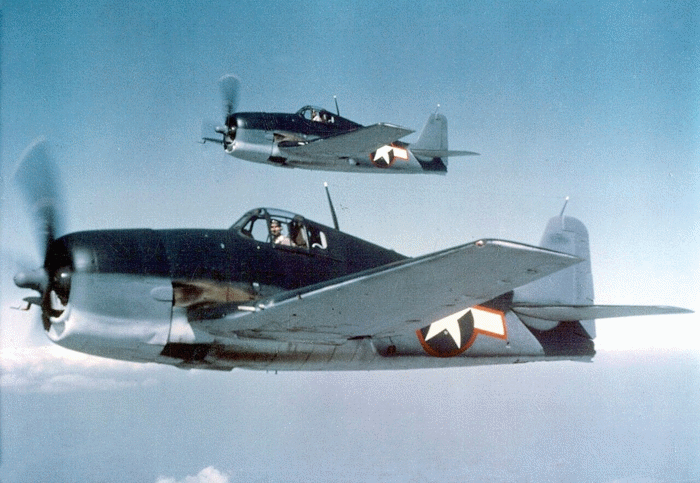
Enter the Grumman F6F-5 Hellcat
The original F6F-3 was already an excellent fighter, but Grumman continued improving it. The result was the F6F-5, introduced during 1944.
At first glance, an F6F-5 looked much like an F6F-3. The important improvements were beneath the surface.
Changes included:
- Increased armor protection
- Strengthened tail structure
- Improved ailerons
- Revised windshield
- Improved engine installation
- Greater ability to carry bombs and rockets
- Pratt & Whitney R-2800-10W engine with water injection
The improvements made an already successful fighter even more useful. This was important because the Navy’s needs were changing.
By 1944 and 1945, American carrier forces increasingly controlled the skies. Fighters could therefore spend more time attacking targets on the ground and at sea. The F6F-5 was well suited for the job.
The Pratt & Whitney R-2800 Double Wasp
At the heart of the Grumman F6F-5 Hellcat was one of the great piston engines of World War II.
The Pratt & Whitney R-2800 Double Wasp was an air-cooled, 18-cylinder radial engine displacing approximately 2,800 cubic inches.
Versions of the R-2800 powered several famous American aircraft, including the:
- F6F Hellcat
- F4U Corsair
- P-47 Thunderbolt
The Grumman F6F-5 Hellcat used an R-2800-10W installation with water injection that provided additional power for short periods during combat.
This gave a Hellcat pilot extra performance when it mattered most.
Grumman TBF Avenger Fact Sheet: VT-20 And The Powerful Torpedo Bomber That Helped Win the Pacific War
Six .50-Caliber Machine Guns
The standard Grumman F6F-5 Hellcat carried six Browning .50-caliber machine guns, with three mounted in each wing.
This provided tremendous firepower. A pilot who could bring all six guns onto an enemy fighter could inflict devastating damage in seconds.
The Hellcat’s firepower also proved valuable against trucks, small ships, parked aircraft, and other ground targets.
Some specialized Hellcats received a different gun arrangement. Certain F6F-5N night fighters, for example, could carry two 20 mm cannon and four .50-caliber machine guns.
From Fighter to Fighter-Bomber
One of the Grumman F6F-5 Hellcat’s greatest strengths was versatility. As American air superiority increased, Hellcats were increasingly employed as fighter-bombers.
Depending upon the mission, a Grumman F6F-5 Hellcat could carry bombs, rockets, or external fuel tanks. Hellcats attacked:
- Japanese airfields
- Ships
- Harbor installations
- Vehicles
- Defensive positions
- Troop concentrations
- Supply areas
The Naval History and Heritage Command notes that Hellcats fired about 60,000 rockets against land targets and enemy shipping during the war.
That makes the Hellcat’s reputation as simply a “Zero killer” incomplete. It was also an effective attack aircraft.
Hellcat Versus the Japanese Zero
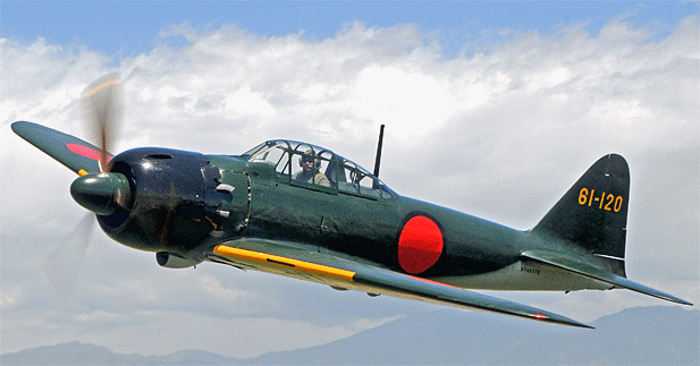
The Grumman F6F-5 Hellcat was developed with the Japanese fighter threat very much in mind. It was not designed to beat the Zero by copying it. Instead, American designers played to their own strengths.
The Zero remained highly maneuverable at lower speeds. A Grumman F6F-5 Hellcatpilot who tried to fight a Zero entirely on the Japanese fighter’s terms could still get into trouble.
But the Hellcat offered other major advantages. It was fast, powerful, heavily armed, armored, and rugged. Hellcat pilots could use speed, altitude, teamwork, and diving attacks rather than simply trying to out-turn their opponents.
The Smithsonian notes that the Hellcat was superior to its primary Japanese opponent in most performance categories, particularly at higher altitude. Just as important, it could absorb punishment.
Built Tough for Carrier Operations
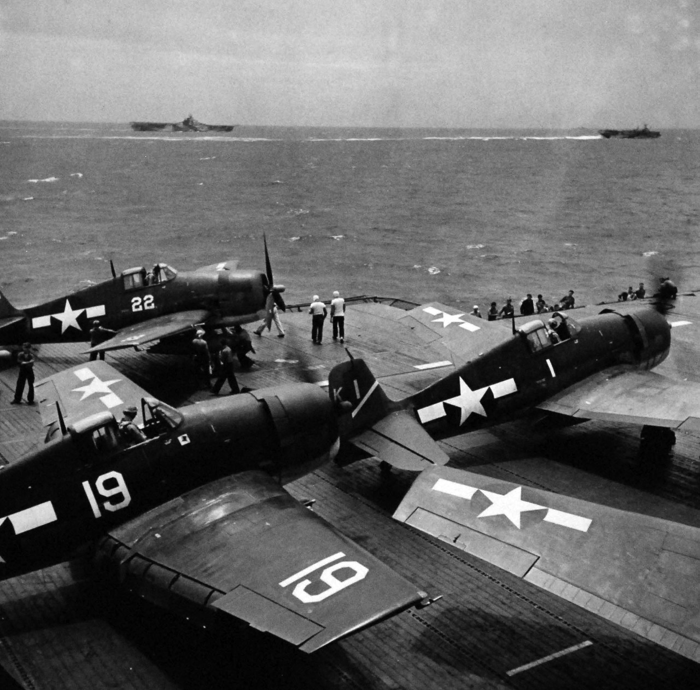
A naval fighter had to do more than perform well in the air. It had to survive life aboard an aircraft carrier.
Carrier landings could be brutal. Aircraft were exposed to salt water, hard landings, deck handling, maintenance in confined spaces, and constant operational use. Grumman built the Hellcat accordingly.
The company became famous for producing rugged naval aircraft. The Hellcat’s strength contributed to the nickname often associated with Grumman aircraft:
“The Grumman Iron Works.”
That toughness mattered to pilots. An aircraft capable of bringing a damaged pilot back to his carrier was worth more than numbers on a specification sheet.
The Great Marianas Turkey Shoot
One of the Hellcat’s greatest moments came during the Battle of the Philippine Sea in June 1944. American carrier aircraft faced large Japanese air attacks attempting to strike the U.S. fleet. Hellcats intercepted them.
The resulting air battles became known as the “Great Marianas Turkey Shoot.”
Japanese naval aviation suffered catastrophic losses. Nearly 300 Japanese aircraft were shot down in a single day during the battle, according to the National Naval Aviation Museum.
The battle demonstrated just how much the balance of naval air power had changed since 1942.
The Zero had once been feared. But, by 1944, formations of Grumman F6F-5 Hellcat flown by well-trained American naval aviators had become the dominant force.
David McCampbell and the Hellcat
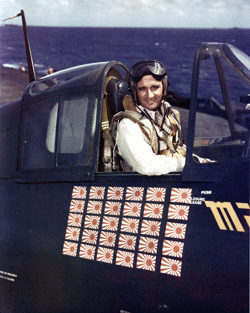
No discussion of the Hellcat is complete without mentioning Commander David McCampbell.
McCampbell became the U.S. Navy’s leading fighter ace of World War II with 34 aerial victories.
On October 24, 1944, during the Battle of Leyte Gulf, McCampbell achieved one of the most remarkable fighter performances of the war, receiving credit for shooting down nine Japanese aircraft in a single mission.
He was later awarded the Medal of Honor. Today, the National Naval Aviation Museum’s Grumman F6F-5 Hellcat is displayed in McCampbell’s markings.
An Extraordinary Combat Record
The Hellcat’s wartime record was remarkable.
The National Naval Aviation Museum credits F6Fs with destroying 5,216 Axis aircraft in 24 months and achieving approximately a 19-to-1 kill ratio. Different historical sources vary slightly depending upon how victories are counted, but they agree on the basic conclusion:
The Hellcat was extraordinarily successful. Hellcats accounted for roughly three-quarters of U.S. Navy aerial victories during the period in which they served. The aircraft also produced more fighter aces than any other aircraft of World War II.
Why the Grumman F6F-5 Hellcat Hellcat Mattered
The Grumman F6F-5 Hellcat was not famous because of one remarkable feature. It was successful because the entire package worked.
- It was fast enough.
- It was maneuverable enough.
- It carried heavy firepower.
- It could take punishment.
- It could operate reliably from an aircraft carrier.
- It could shoot down fighters in the morning and attack ground targets in the afternoon.
Perhaps most importantly, it was an aircraft that American industry could build by the thousands and naval aviators could use effectively. The Hellcat arrived when the U.S. Navy needed it most. From the Philippine Sea to Leyte Gulf and the final carrier strikes against Japan, the Hellcat helped American naval aviation gain and maintain control of the skies.
The Grumman F6F-5 Hellcat represented the mature version of that concept—a rugged, heavily armed carrier fighter that could also perform the fighter-bomber missions increasingly demanded during the final stages of the Pacific War.
More than 80 years later, the Hellcat remains one of the defining aircraft of American naval aviation.
For veterans, aviation historians, model builders, and anyone interested in World War II aircraft, the F6F-5 offers an outstanding example of what happens when good engineering, combat experience, mass production, and skilled pilots come together at exactly the right time.
Grumman F6F-5 Hellcat Specifications
Specifications varied somewhat depending upon equipment and configuration, but a typical Grumman F6F-5 Hellcat had an impressive performance for a large carrier fighter.
Its wings folded upward, reducing the amount of valuable hangar and flight-deck space needed aboard an aircraft carrier.
General characteristics
- Crew: 1
- Length: 33 ft 7 in (10.24 m)
- Wingspan: 42 ft 10 in (13.06 m)
- Height: 13 ft 1 in (3.99 m)
- Wing area: 334 sq ft (31.0 m2)
- Aspect ratio: 5.5
- Airfoil: root: NACA 23015.6; tip: NACA 23009[104]
- Empty weight: 9,238 lb (4,190 kg)
- Gross weight: 12,598 lb (5,714 kg)
- Max takeoff weight: 15,415 lb (6,992 kg)
- Fuel capacity: 250 US gal (208 imp gal; 946 L) internal; up to 3 × 150 US gal (125 imp gal; 568 L) external drop tanks
- Zero-lift drag coefficient: 0.0211
- Drag area: 7.05 sq ft (0.655 m2)
- Powerplant: 1 × Pratt & Whitney R-2800-10W Double Wasp 18-cylinder air-cooled radial piston engine, 2,200 hp (1,600 kW) with a two-speed two-stage supercharger and water injection
- Propellers: 3-bladed Hamilton Standard, 13 ft 1 in (3.99 m) diameter constant-speed propeller
Performance
- Maximum speed: 391 mph (629 km/h, 340 kn)
- Stall speed: 84 mph (135 km/h, 73 kn)
- Combat range: 945 mi (1,521 km, 821 nmi)
- Ferry range: 1,530 mi (2,460 km, 1,330 nmi)
- Service ceiling: 37,300 ft (11,400 m)
- Rate of climb: 2,600 ft/min (13 m/s)
- Time to altitude: 20,000 ft (6,096 m) in 7 minutes 42 seconds
- Lift-to-drag: 12.2
- Wing loading: 37.7 lb/sq ft (184 kg/m2)
- Power/mass: 0.16 hp/lb (0.26 kW/kg)
- Take-off run: 799 ft (244 m)
Armament
- Guns:
- 6 × 0.50 in (12.7 mm) M2 Browning machine guns, with 400 rounds per gun, (All F6F-3, and most F6F-5) or
- 2 × 0.79 in (20 mm) AN/M2 cannon, with 225 rounds per gun and 4 × 0.50 in (12.7 mm) Browning machine guns with 400 rounds per gun
- Rockets:
- Bombs: up to 4,000 lb (1,800 kg) full load, including:
- Centerline rack:
- 1 × 2,000 lb (910 kg) bomb or
- 1 × Mark 13 torpedo;
- Underwing bombs: (F6F-5 had two additional weapons racks either side of fuselage on wing center-section)
- 2 × 1,000 lb (450 kg), 500 lb (230 kg), 250 lb (110 kg), or
- 6 × 100 lb (45 kg) (Mk.3 Bomb Cluster)
- Centerline rack:
Information Resources
U.S. Naval History and Heritage Command
F6F-5 Hellcat — National Naval Aviation Museum
Excellent starting point for specifications, armament, production figures, combat record, and photographs.
F6F-5 Hellcat — Naval History and Heritage Command
Dictionary of American Naval Aviation Squadrons
The Naval History and Heritage Command’s aircraft appendices provide historical background, specifications, model designations, and Navy acceptance information.
Naval Aviation Squadron Dictionary — F6F Hellcat
Smithsonian National Air and Space Museum
The Smithsonian’s Hellcat collection provides an especially useful account of the aircraft’s development from the Wildcat, the introduction of the R-2800 engine, production, and differences between the F6F-3 and F6F-5.
Grumman F6F Hellcat — Smithsonian Air and Space Museum
National Naval Aviation Museum
The museum at NAS Pensacola maintains an F6F-5 displayed in the markings of Commander David McCampbell and provides extensive exhibits covering World War II carrier aviation.
National Naval Aviation Museum Aircraft Collection
Research Notes
The Naval History and Heritage Command lists the F6F-5 with a 2,200-hp R-2800-10W engine, maximum speed of 388 mph at 25,000 feet, 37,300-foot ceiling and 1,530-mile range. It also credits the Hellcat with 5,216 Axis aircraft destroyed in 24 months and a 19:1 kill ratio.
The Smithsonian provides valuable detail on the transition from the F6F-3 to F6F-5, including increased armor, reinforced empennage, water-injected R-2800-10W engine and improved aileron controls.
The National Naval Aviation Museum reports 6,681 F6F-5s produced, including 1,189 F6F-5N night fighters, out of 12,275 total Hellcats.
Information Resources
For further research, start with the Naval History and Heritage Command and the National Naval Aviation Museum. Their aircraft histories and squadron records provide useful background on Avenger development, specifications, combat use, and Navy service.
The Navy’s Dictionary of American Naval Aviation Squadrons is especially valuable for researching VT-20, VA-10A, and the first VA-95. It helps connect the Avenger directly to squadron lineage and carrier deployments.
The Smithsonian National Air and Space Museum also maintains useful material on the Avenger’s design and wartime importance.
Additional research resources include:
- Naval History and Heritage Command
- National Naval Aviation Museum
- Smithsonian National Air and Space Museum
- U.S. National Archives
- Navy cruise books and war diaries
- Aircraft History Cards
- squadron action reports
- carrier deck logs
- wartime photographs and Bureau Number records
Once a Lizard, always a Lizard.

Want more Green Lizard articles like this? Subscribe to our VA-95 All Weather Attack newsletter today and get VA-95-focused news, announcements, and website updates delivered straight to your inbox.