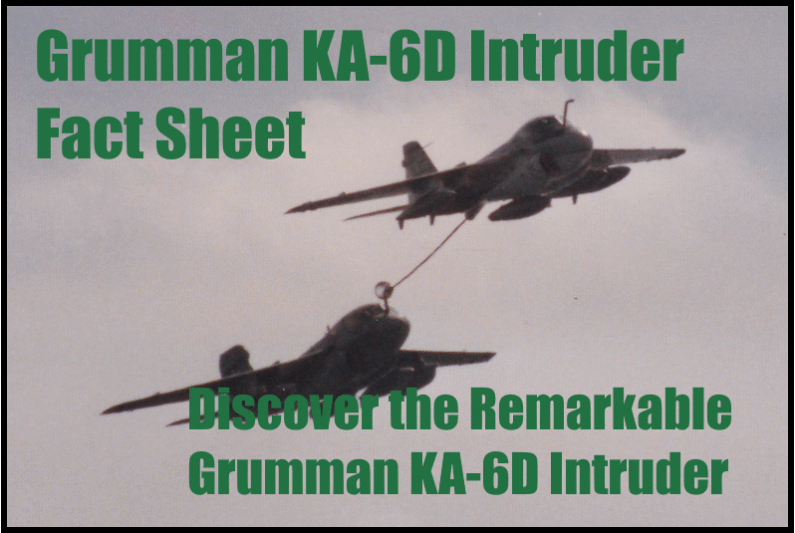
The Grumman KA-6D Intruder was the U.S. Navy’s carrier-based tanker version of the A-6 Intruder. It filled an important gap: carrier strike aircraft needed fuel not just after launch, but sometimes hundreds of miles from the ship. The KA-6D could fly with a strike package and refuel aircraft along the way.
How The Grumman KA-6D Intruder Began
The idea grew from the basic A-6 Intruder. The A-6 was designed as an all-weather attack aircraft, with the first prototype flying in 1960 and the A-6A entering Navy service in the early 1960s. In May 1966, an A-6 equipped with hose-and-drogue refueling equipment demonstrated that an Intruder could work as an airborne tanker.
By the late 1960s, the Navy needed a replacement for older carrier-based tankers such as the KA-3B Skywarrior. Grumman received approval to develop the tanker Intruder, designated the Grumman KA-6D Intruder.
Rather than build an entirely new airplane, the Navy converted existing Intruders. A total of 90 aircraft were converted to KA-6Ds. U.S. Naval Institute records list the Grumman KA-6D Intruder program as 90 conversions rather than new-build aircraft.
Turning an A-6 Intruder Into A Grumman KA-6D Intruder Tanker
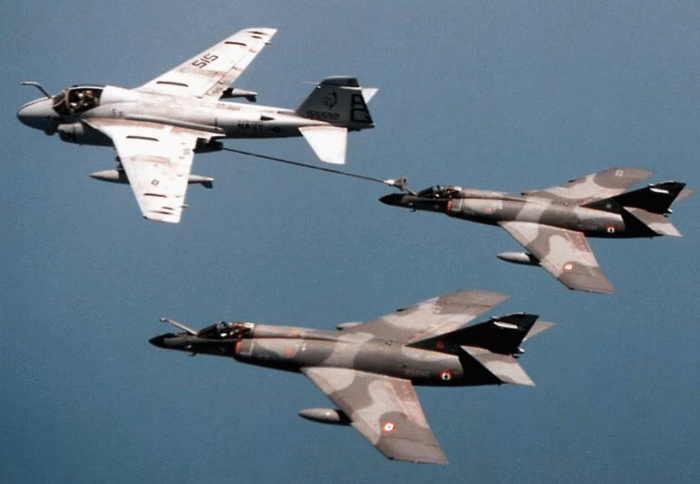
Converting an attack aircraft into a tanker required major changes.
Much of the A-6’s attack avionics was removed. Space in the rear fuselage was used for the tanker equipment, including the hose-and-reel refueling system. The refueling drogue extended from underneath the rear fuselage. KA-6Ds could also use a D-704 hose-and-drogue refueling pod.
External fuel tanks were carried beneath the aircraft to increase the amount of fuel available for transfer.
According to the U.S. Naval Institute, the Grumman KA-6D Intruder could carry up to five 300-gallon external tanks. Under favorable conditions shortly after launch, it could make more than 21,000 pounds of fuel available for transfer. At a loiter point roughly 150 nautical miles from the carrier, about 15,000 pounds could be available.
That made the Grumman KA-6D Intruder much more than a flying gas station circling close to the carrier. It was the mission tanker for carrier operations.
Why mission tanking with the Grumman KA-6D Intruder mattered
Imagine a carrier strike launching for a target hundreds of miles away. The attack aircraft were carrying bombs and missiles. Fighters were protecting them. Electronic-warfare aircraft might be supporting them. All were burning fuel.
A KA-6D could accompany those aircraft and provide fuel when and where it was needed. That could mean the difference between an aircraft reaching its target or turning back.
The tanker could also support aircraft returning to the carrier short on fuel. Carrier aviation leaves little room for error when an aircraft is low on gas and still has to make a successful arrested landing.
The KA-6D therefore became an important part of the carrier air wing even though it rarely received the attention given to fighters and attack aircraft.
The KA-6D went where the Intruders went
Another advantage was organization. The Navy did not need a completely separate KA-6D squadron aboard each carrier. Tankers were normally incorporated into existing A-6 Intruder attack squadrons.
A few KA-6Ds could deploy with an Intruder squadron, and A-6 crews were trained to operate the tanker. This meant KA-6Ds served alongside regular Intruders aboard American carriers throughout the Cold War.
They could refuel aircraft such as the A-6 Intruder, A-7 Corsair II, F-4 Phantom II, F-14 Tomcat, and other probe-equipped Navy and Marine Corps aircraft.
The Grumman KA-6D Intruder and VA-95
The KA-6D has a particularly important place in VA-95 Green Lizards history.
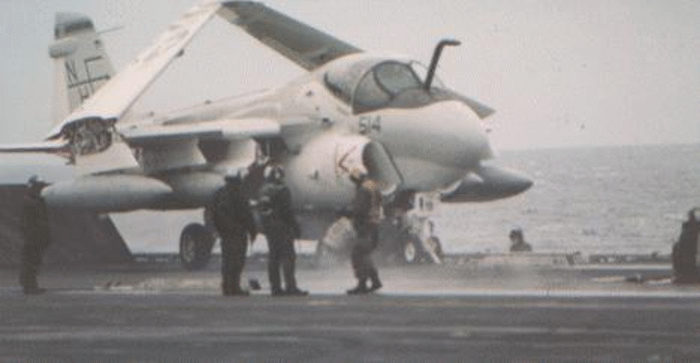
When the third VA-95 was established at NAS Whidbey Island in 1972, the squadron operated Intruders that included the Grumman KA-6D Intruder.
The Green Lizards took their tanker Intruders to sea alongside their attack aircraft. During the 1970s, VA-95 operated from USS Coral Sea (CVA/CV-43) with Carrier Air Wing 15. After moving to Carrier Air Wing 11, VA-95 subsequently operated from carriers including USS America (CV-66), USS Enterprise (CVN-65), and later USS Abraham Lincoln (CVN-72).
For VA-95, the KA-6D was the quiet partner to the A-6 attack force. The A-6Es delivered the weapons. The KA-6Ds helped give them the fuel to get there—and get home.
The Grumman KA-6D Intruder In The 1980s
By the 1980s, the KA-6D had become an established part of carrier operations.
This period also placed heavy demands on the aging tanker fleet. KA-6Ds accumulated large numbers of carrier catapult launches and arrested landings. Sources describing their later service note that the aircraft were often in short supply and sometimes transferred between deploying carrier air wings to keep enough tankers available.
VA-95’s operations aboard USS Enterprise are a good example of why tankers mattered.
During the 1988 deployment that included Operation Praying Mantis, VA-95’s A-6Es had to conduct long-range operations over the Persian Gulf and Gulf of Oman. Tanker support was an essential part of sustaining carrier air operations, although the combat fame naturally went to the A-6Es that attacked Iranian forces.
Was the Grumman KA-6D Intruder still a bomber?
Technically, the KA-6D retained a limited day/visual attack capability. In practice, aerial refueling was its job. The aircraft normally carried external fuel tanks instead of a combat bomb load. Sources describing the variant indicate that although bombing remained theoretically possible, it apparently was not employed operationally in that role.
The answer is No! The Grumman KA-6D Intruder was not a bomber. An A-6E was primarily an attack aircraft. A KA-6D was primarily a tanker supporting the air wing.
while sharing the Intruder airframe, but they performed very different missions.
The Grumman KA-6D Intruder’s usefulness also became one of its problems.
These aircraft were worked hard. Carrier operations put enormous stress on an airframe. Every catapult shot accelerated the aircraft rapidly. Every arrested landing placed another heavy load on the structure.
Tankers also tended to fly frequently because almost every major flight operation required fuel support. By the later years of the KA-6D program, aging airframes and structural limitations were becoming increasingly important concerns.
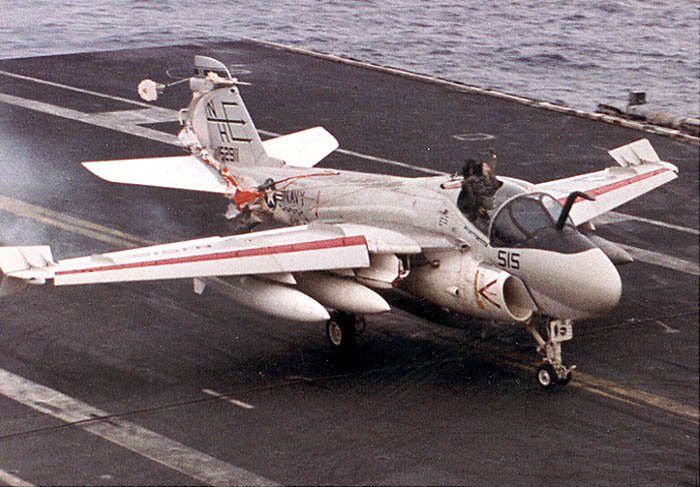
Surviving Partial Ejection from a Grumman KA-6D Intruder; The Keith Gallagher Story
Check out the incredible story of LT Keith Gallaghers partial ejection form a VA-95 KA-6D Tanker
How the Martin-Baker GRU-7 Ejection Seat Worked in the A-6 Intruder
The Martin-Baker GRU-7 ejection seat was a critical safety system used in the Grumman A-6E Intruder and KA-6D Intruder. Built by Martin-Baker in England, the seat was designed to quickly remove an aircrew member from the aircraft during an emergency and then automatically deploy the parachute.
One important part of the GRU-7 installation was the top latch mechanism. This small component had a major job: it helped secure the ejection seat inside the aircraft. A failure involving this mechanism played a key role in the unusual accident involving LT Gallagher.
The GRU-7 Top Latch Mechanism
The GRU-7 seat was secured at the top by a spring-loaded top latch plunger. The plunger extended from the seat between its two main structural beams. When the seat was properly installed, the plunger passed through a window-shaped opening in a tab located at the top of the ejection gun, which was attached to the aircraft’s cockpit structure.
Under normal conditions, spring pressure kept the plunger engaged. This arrangement meant that the integrity of the top latch and its attachment point was extremely important. The latch kept the upper portion of the seat secured until an ejection was initiated.
During a normal ejection, activation of the ejection gun caused the top latch mechanism to release. Once released, the seat could begin traveling upward along the ejection rails and out of the aircraft.
What Happened to LT Gallagher’s Seat?
Investigators determined that the top latch area associated with LT Gallagher’s GRU-7 ejection seat had suffered a structural failure. The window through which the top latch plunger engaged had cracked. The suspected cause was repeated stress over time.
During negative-G flight, the combined weight and forces acting on the aircrew member and ejection seat could place loads on the latch area. Repeated loading may have gradually weakened the metal around the window. The aircraft’s repeated porpoising maneuver during Gallagher’s mishap appears to have provided the final load needed to cause the already weakened section to fail.
In simple terms, the part had probably been weakened over time. The maneuver placed additional stress on it, and the damaged section finally broke. The upper portion of the window sheared away, with fractures running from the upper corners of the opening toward the top corners of the structure. Once that happened, the seat was no longer secured in the normal manner.
Why the GRU-7 Thought an Ejection Had Started
The next part of the accident involved the GRU-7’s automatic ejection sequence. On the back of the GRU-7 ejection seat were two trip rods. These rods activated timing mechanisms responsible for controlling important events during an ejection.
Normally, the trip rods were triggered as the seat began moving upward along the ejection gun rails. One system controlled the drogue parachute and under-seat rocket motor. The other controlled the aircrewman’s harness release and main parachute deployment. This sequence was designed to happen automatically during an emergency. Once the aircrew member initiated an ejection, the seat took over much of the work. The system did not need to understand why the seat was moving. It only responded to the mechanical sequence.
That distinction became extremely important in Lt. Gallagher’s accident.
The Seat Began Its Automatic Sequence
When the damaged latch structure failed, Gallagher’s seat moved enough to activate the trip mechanisms. From the seat’s point of view, the expected conditions associated with an ejection were now occurring. The two trip rods were pulled.
Once that happened, the GRU-7 began performing the functions it had been designed to perform during an actual ejection. The seat’s automatic systems began sequencing. Gallagher had not intentionally commanded a normal ejection, but the seat’s mechanical systems responded as though he had.
Why Gallagher Couldn’t Pull the Lower Ejection Handle
Another confusing part of the accident was Gallagher’s inability to operate his lower ejection handle. This was also connected to the GRU-7’s safety systems.
The ejection sequencing mechanism was linked to automatic locks on the ejection control handles. These locks were incorporated into the system as a safety feature, including protection during certain ground-escape situations. Once the seat had moved and the sequencing system had been activated, the condition of those locks changed as part of the automatic process.
That helps explain why Gallagher could not simply pull the lower handle and initiate what he understood as a normal ejection.
Gallagher Was Released From the Seat
With both trip rods activated, the GRU-7 continued responding as though a normal ejection had occurred. The automatic systems operated in sequence, including the functions associated with separating the aircrew member from the seat and deploying the main parachute.
Gallagher was therefore released from the GRU-7 seat, and his main parachute deployed. This is one of the most remarkable aspects of the incident.
The ejection seat had not begun its sequence in the normal way. A structural failure had allowed the seat to move and activate systems normally triggered only after an intentional ejection. Yet once those systems were activated, the GRU-7 continued performing the automatic functions it had been designed to carry out.
In LT Gallagher’s extraordinary case, a structural failure started a sequence that was never supposed to begin on its own. But once the Martin-Baker GRU-7 detected the mechanical conditions associated with an ejection, its automatic systems continued doing what they had been designed to do: separate the aircrewman from the seat and deploy his parachute.
Irish Luck – Surviving Partial Ejection from A-6 Aircraft
The end of the Grumman KA-6D Intruder
The Grumman KA-6D Intruder disappeared as part of the larger retirement of the Intruder family during the 1990s. The Navy was reducing the number of different aircraft types operated by its carrier air wings, and the A-6/KA-6D community was gradually phased out.
That created a problem. The carrier air wing still needed tankers.Other carrier aircraft therefore assumed more of the buddy-tanking mission, including A-6Es equipped with refueling stores during the transition period. Eventually other aircraft took over the carrier-based refueling role.
The final A-6 family aircraft left front-line Navy service in 1997, closing a career that had stretched from Vietnam through the final years of the Cold War and into the post-Cold War period.
Why the Grumman KA-6D Intruder mattered
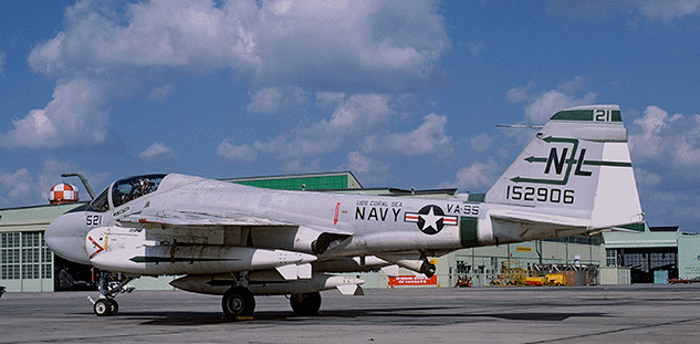
For squadrons such as VA-95, the tanker was an important companion to the attack Intruders. While the bomb-carrying A-6Es received most of the attention, the KA-6Ds quietly extended the reach and endurance of the entire carrier air wing.
That makes the KA-6D Intruder an important—and sometimes overlooked—part of U.S. naval aviation history.
Grumman KA-6D Intruder Information Resources
For further research, the best starting point for VA-95 is the U.S. Navy’s Dictionary of American Naval Aviation Squadrons. It documents VA-95’s receipt of the A-6A, A-6B, KA-6D and A-6E and specifically identifies the KA-6D tanker role during the Mayaguez operation.
Naval History and Heritage Command — VA-95 Squadron History
The Naval History and Heritage Command’s A-6 material provides specifications and background on the Intruder family and confirms the KA-6D as the aerial-refueling member of that family.
Naval History and Heritage Command — A-6 Intruder History
For Operation Frequent Wind, the Navy’s official history of USS Enterprise provides detailed sortie figures, including KA-6D tanker sorties during the evacuation of Saigon.
NHHC — USS Enterprise and Operation Frequent Wind
The Skyhawk Association’s VA-95 history is also useful as a secondary reference for aircraft assignment dates, air wings, tail codes, deployments, and the transition from the A-6A/KA-6D combination to the A-6E era.
Skyhawk Association — VA-95 History
Once a Lizard, always a Lizard.

Want more Green Lizard articles like this? Subscribe to our VA-95 All Weather Attack newsletter today and get VA-95-focused news, announcements, and website updates delivered straight to your inbox.