The Grumman A-6 Intruder was built to do something few carrier aircraft could do in the early 1960s: find and attack a target at night, in bad weather, and at low altitude. It was not sleek like a fighter. It was not supersonic. With its wide nose and two crewmen sitting side by side, the Intruder had a look all its own.
But looks can be deceiving.
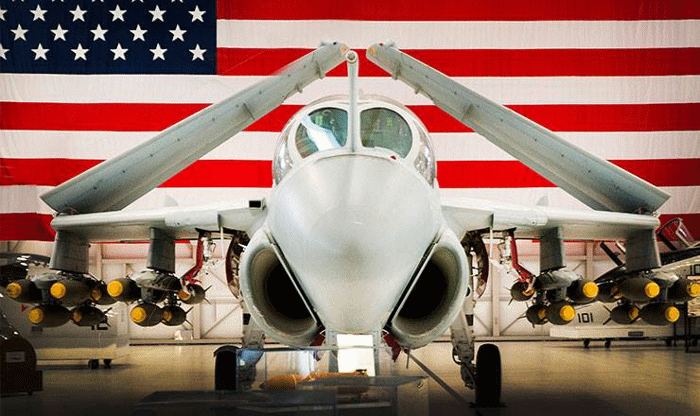
The Grumman A-6 Intruder became one of the most capable attack aircraft in U.S. Navy history. It fought in Vietnam, Lebanon, Libya, the Persian Gulf, and Operation Desert Storm. It could carry up to 18,000 pounds of weapons and attack targets that other aircraft had trouble even finding.
For veterans and students of naval aviation, the Intruder is also closely tied to VA-95, the Green Lizards. The squadron flew A-6s for more than two decades and took the A-6E into combat during Operation Praying Mantis in 1988.
Why the Navy Needed the Grumman A-6 Intruder
The Korean War taught the U.S. Navy an important lesson. Carrier aircraft needed a better way to attack targets when pilots could not see them.
Rain, clouds, darkness, and poor visibility could stop or limit many attack missions. The Navy wanted an aircraft able to fly long distances at low altitude and find targets in almost any weather.
In 1956, the Navy requested designs for a new all-weather attack aircraft.
Grumman won the competition.
The prototype was originally called the A2F-1 Intruder. It made its first flight on April 19, 1960.
When the military adopted a new aircraft designation system in 1962, the A2F became the Grumman A-6 Intruder.
The first production A-6s reached the Navy in 1963. The Intruder would remain in frontline service until 1997.
Two Men and a Lot of Electronics
One feature immediately separated the Grumman A-6 Intruder from many other attack jets.
Its two crewmen sat side by side.
The pilot sat on the left. The Bombardier/Navigator, commonly called the B/N, sat on the right. The B/N was not simply along for the ride. He operated the sophisticated navigation and attack equipment that made the Intruder special.
The original A-6A used a system known as DIANE — Digital Integrated Attack Navigation Equipment.
DIANE helped the crew navigate and attack targets even when clouds or darkness made it impossible to see the ground clearly.
The aircraft could approach a target at low altitude, attack, and leave without relying on good weather. That was a major advance.
The Navy describes the Intruder as the world’s first all-weather attack aircraft.
Major Grumman A-6 Intruder Variants
The A-6 served for more than 30 years, so it naturally went through several major versions.
Grumman A-6A Intruder
The A-6A was the original production attack version.
It entered fleet service in 1963 and introduced the Navy to a true all-weather, long-range carrier attack aircraft.
A-6As soon went to Vietnam.
Grumman A-6B Intruder
The A-6B was a specialized version intended to attack enemy radar and surface-to-air missile systems.
These aircraft helped suppress enemy air defenses, an extremely dangerous job during Vietnam.
Grumman A-6C Intruder
The A-6C was developed for specialized night operations and attacking targets such as trucks moving supplies along the Ho Chi Minh Trail.
Only a small number were produced.
KA-6D Intruder
The Grumman KA-6D Intruder gave the Intruder another important job. It was an aerial tanker. Instead of carrying bombs to a target, the KA-6D carried fuel that could be transferred to other Navy aircraft in flight.
This allowed strike aircraft to fly farther, remain airborne longer, or receive emergency fuel before attempting to land aboard the carrier. KA-6Ds became extremely valuable members of carrier air wings.
Grumman A-6E Intruder
The A-6E became the definitive attack version.
Improved electronics made the aircraft more reliable and capable.
Later A-6Es received TRAM — Target Recognition Attack Multisensor. It combined infrared and laser equipment with the aircraft’s computers.
The A-6E could employ weapons including:
- Conventional bombs
- Laser-guided bombs
- AGM-84 Harpoon anti-ship missiles
- AGM-88 HARM missiles
- AGM-123 Skipper missiles
- Air-dropped mines
The Intruder was becoming much more than a bomber. It was a precision maritime and land-attack aircraft.

The Grumman A-6 Intruder Goes to Vietnam
Vietnam proved what the Intruder could do.
The first Grumman A-6 Intruders to see combat belonged to VA-75 in 1965. The aircraft quickly showed its value. According to the Naval History and Heritage Command, VA-75’s Intruders dropped about 25 percent of their air wing’s ordnance during the squadron’s 1965 tour, even though the wing had more A-4s and F-4s.
One remarkable mission came on the night of April 18, 1966. Two A-6As from VA-85 attacked the Uong Bi thermal power plant near Haiphong.
The Intruders delivered about 26,000 pounds of ordnance using their radar attack systems.
The strike was so heavy that Hanoi Radio reportedly claimed B-52 bombers had attacked the target. It was actually two A-6s.
That tells you something about the aircraft’s striking power.
VA-95 and the Grumman A-6 Intruder
The Grumman A-6 Intruder became the defining aircraft of the third squadron to carry the VA-95 designation.
This VA-95 was established on April 1, 1972, at NAS Whidbey Island, Washington.
The squadron became known as the Green Lizards.
VA-95 initially operated aircraft from the early Intruder family, including:
- A-6A Intruder
- A-6B Intruder
- KA-6D Intruder
The squadron later converted to the A-6E Intruder.
From the 1970s through the 1990s, VA-95 took its Intruders aboard several famous U.S. aircraft carriers.
VA-95, Operation Frequent Wind, and the Mayaguez Era
April 1975 brought the final collapse of South Vietnam. American naval forces moved into position for Operation Frequent Wind, the evacuation of Americans and others from Saigon.
Carrier aircraft provided protection while helicopters carried evacuees to U.S. ships.
Grumman A-6 Intruder and Grumman KA-6D Intruder aircraft were among the types used by carrier forces during the evacuation period. The Navy records A-6A and KA-6D sorties among the fixed-wing support flown during Frequent Wind.
Only weeks later came another crisis. The American merchant ship SS Mayaguez was seized by Khmer Rouge forces in May 1975. USS Coral Sea and her air wing became involved in the American response. The episode became the final combat action associated with the long war in Southeast Asia.
VA-95 Converts to the A-6E
VA-95 began receiving the A-6E Intruder in 1976.
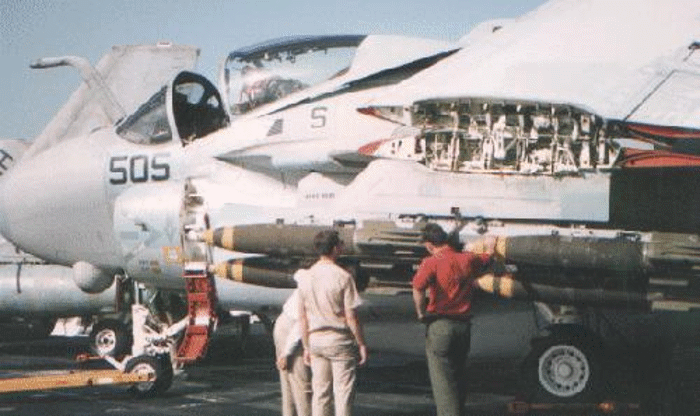
This changed the squadron’s capabilities.
The basic mission remained the same—find the target and hit it regardless of darkness or weather—but the A-6E had better electronics and weapons capabilities.
VA-95 would spend the rest of its existence flying versions of the A-6E.
The Green Lizards eventually joined Carrier Air Wing Eleven (CVW-11) and adopted the familiar NH tail code.
Their next ships would include some of the most famous carriers of the Cold War.
USS Enterprise and VA-95
VA-95 then developed a long association with USS Enterprise (CVN-65).
Enterprise was America’s first nuclear-powered aircraft carrier and one of the most famous ships in modern U.S. naval history.
VA-95 deployed aboard her repeatedly during the 1980s.
The squadron flew: A-6E Intruders for attack missions and the KA-6Ds for aerial refueling.
This partnership eventually led VA-95 to its most famous combat mission.
Operation Praying Mantis
On April 14, 1988, the guided missile frigate USS Samuel B. Roberts (FFG-58) struck an Iranian mine in the Persian Gulf. Four days later, the United States responded with Operation Praying Mantis.
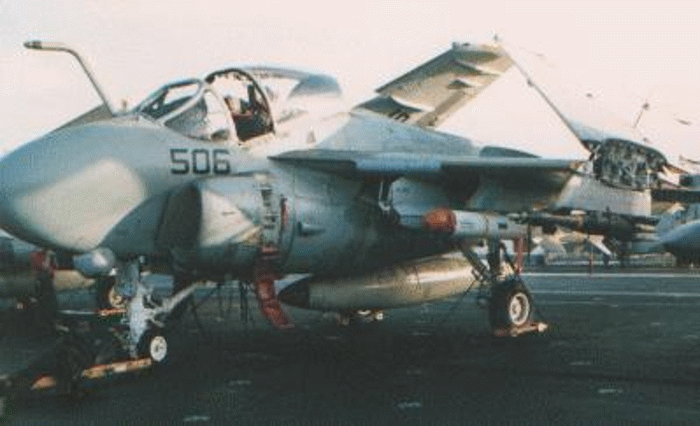
The Green Lizards were about to go to war.
On April 18, two VA-95 A-6E Intruders flying surface combat air patrol found the Iranian frigate Sahand. The A-6s made an identification pass. Sahand opened fire. The Intruders of VA-95 responded.
VA-95 and supporting U.S. forces hit Sahand with a devastating mixture of weapons that included Harpoon anti-ship missiles, AGM-123 Skipper weapons, laser-guided bombs, and other ordnance.
Sahand caught fire. The fires eventually reached her magazines. The frigate exploded and sank.
VA-95 Attacks Sabalan
The battle was not finished. Later that day, another Iranian frigate, Sabalan, left Bandar Abbas.
An A-6 flown by Lieutenant Commander James Engler and Lieutenant Commander John Schork located the ship. Sabalan fired a surface-to-air missile at the Intruder.
The A-6 crew responded.
Engler delivered a 500-pound Mk 82 laser-guided bomb down Sabalan’s stack. The hit caused severe damage and left the frigate dead in the water. American aircraft were prepared to continue attacking, but U.S. leaders decided enough damage had been done.
Sabalan survived.
Sahand did not.
Operation Praying Mantis became one of the largest U.S. Navy surface actions since World War II. Enterprise records credit her aircraft with sinking Sahand, a Boghammer boat and damaging Sabalan and another Boghammer.
For VA-95, it became the defining combat action of the squadron’s A-6E era.
USS Abraham Lincoln and the Final Years
After years aboard Enterprise, VA-95 eventually moved to USS Abraham Lincoln (CVN-72).
The Green Lizards continued flying A-6Es into the 1990s.
These later aircraft benefited from years of improvements to the Intruder’s sensors, weapons, and attack systems.
VA-95 participated in operations during the post-Gulf War period before making its final deployment in 1995.
The squadron was disestablished that year.
The Intruder itself lasted a little longer.
The final A-6s left frontline U.S. service in 1997.
VA-95 A-6 Carrier History
| Carrier | Aircraft | Period |
| USS Coral Sea (CVA/CV-43) | A-6A, KA-6D, A-6E | 1970s |
| USS America (CV-66) | A-6E, KA-6D | 1979, 1981 |
| USS Enterprise (CVN-65) | A-6E, KA-6D | 1980s–1990 |
| USS Abraham Lincoln (CVN-72) | A-6E | 1990s |
The A-6 in Desert Storm
VA-95 was not the only squadron that demonstrated what the Intruder could do. During Operation Desert Storm in 1991, Navy and Marine Corps A-6s flew more than 4,700 combat sorties.
Intruders attacked:
- Iraqi air defenses
- Naval targets
- Strategic targets
- Ground forces
- Other military installations
They also provided close air support. The aircraft was almost 30 years old by then, yet it remained a powerful frontline attack platform.
Why the Grumman A-6 Intruder Mattered
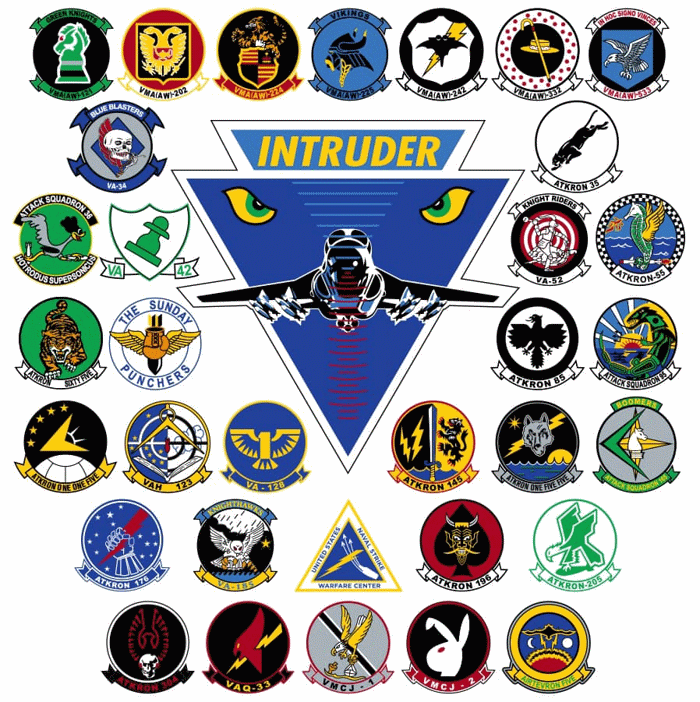
The Grumman A-6 Intruder was never built to win a beauty contest.
- It was built to find targets and destroy them.
- That meant flying at night.
- It meant flying through bad weather.
- It meant operating low over hostile territory.
- And it meant launching from a moving aircraft carrier hundreds of miles from the target.
The Grumman A-6 Intruder could carry a heavy weapons load, travel long distances, and strike when many other aircraft could not.
Its crew arrangement also showed the value of teamwork. The pilot flew the aircraft while the Bombardier/Navigator helped turn a dark cockpit full of radar screens and instruments into an effective weapons system.
The Navy ultimately received 687 A-6 family aircraft, including specialized versions such as the KA-6D tanker.
For VA-95, the Intruder became much more than another aircraft. The Green Lizards flew the A-6 family for more than two decades. They operated from Coral Sea, America, Enterprise, and Abraham Lincoln. They supported American operations during the final days of the Vietnam era and carried the A-6E into actual combat against Iranian naval forces.
On April 18, 1988, VA-95 showed exactly what the Grumman A-6 Intruder had been designed to do.
- Find the target.
- Attack it.
- And get the crew back to the carrier.
More than six decades after its first flight, the Grumman A-6 Intruder remains one of the most respected attack aircraft in American naval aviation history.
Grumman A-6 Intruder Final Flight
The final active-duty operational flight for the Grumman A-6 Intruder took place on December 19, 1996. The last remaining operational unit, Attack Squadron 75 (VA-75) “Sunday Punchers,” launched their final 14 Intruders from the deck of the USS Enterprise (CVN-65) and flew a 250-mile final hop to Naval Air Station Oceana in Virginia Beach, Virginia, ending 33 years of fleet service.
Grumman A-6 Intruder Specifications
Specifications varied between models, but the later A-6E shows just how capable the aircraft became. The Intruder was subsonic, but speed was never its main selling point. Its strength was the ability to carry a large weapons load over a useful distance and put that ordnance on target under difficult conditions.
General characteristics
- Crew: 2 (pilot, bombardier/navigator)
- Length: 54 ft 9 in (16.69 m)
- Wingspan: 53 ft 0 in (16.15 m)
- Width: 25 ft 2 in (7.67 m) wing folded
- Height: 16 ft 2 in (4.93 m)
- Wing area: 528.9 sq ft (49.14 m2)
- Aspect ratio: 5.31:1[78]
- Empty weight: 26,660 lb (12,093 kg)
- Max takeoff weight: 60,400 lb (27,397 kg) (shore-based operations)
- Fuel capacity: 2,385 US gal (1,986 imp gal; 9,030 L) (internal fuel)
- Zero-lift drag coefficient: 0.0144[78]
- Powerplant: 2 × Pratt & Whitney J52-P8B turbojets, 9,300 lbf (41 kN) thrust each
Performance
- Maximum speed: 560 kn (640 mph, 1,040 km/h) at sea level
- Cruise speed: 412 kn (474 mph, 763 km/h)
- Stall speed: 98 kn (113 mph, 181 km/h) (flaps down)
- Never exceed speed: 700 kn (810 mph, 1,300 km/h)
- Combat range: 919 nmi (1,058 mi, 1,702 km) hi-lo-hi mission with 6× Mark 83 bombs and 3× drop tanks, 536 nmi (617 mi; 993 km) hi-lo-lo-hi interdiction mission (300 n.mi. ingress and egress runs at sea level) with 12× Mk 20 Rockeye II cluster bombs and 3× drop tanks, 556 nmi (640 mi; 1,030 km) close air support (1 hour loiter at 5000 ft over target) with 18× Mark 82 bombs and 2× drop tanks
- Ferry range: 2,818 nmi (3,243 mi, 5,219 km)
- Service ceiling: 42,400 ft (12,900 m)
- g limits: -2.4 to 6.5
- Rate of climb: 7,620 ft/min (38.7 m/s)
- Lift-to-drag: 15.2[78]
- Take-off run to 50 ft (15 m): 4,530 ft (1,380 m)
- Landing run from 50 ft (15 m): 2,540 ft (770 m)
Armament
Hardpoints: Five hardpoints with a capacity of 3,600 lb (1,600 kg) each (4 under wings, 1 under fuselage), 18,000 lb (8,200 kg) total, with provisions to carry combinations of:
- Rockets:
- 12× LAU-10 4-round 5 inch (127 mm) Zuni pods
- 12× LAU-68 7-round 2.75 inch (70 mm) FFAR pods
- 12× LAU-61/LAU-68 19-round 2.75 inch (70 mm) FFAR pods
- Missiles:
- AGM-45 Shrike anti-radar missile × 2
- AGM-78 Standard ARM anti-radar missile × 2
- AGM-62 Walleye TV-guided glide bomb
- AGM-65 Maverick air-to-ground missile × 6
- AGM-84 Harpoon anti-ship missile/AGM-84E Standoff Land Attack Missile × 4
- AGM-88 HARM anti-radar missile
- AGM-123 Skipper air-to-ground missile
- AIM-9 Sidewinder air-to-air missile
- ADM-141 TALD decoy missiles
- Bombs:
- 28× Mk 82 500 lb (227 kg) GP bombs or Mk 20 Rockeye II cluster bomb
- 13× Mk 83 1,000 lb (454 kg) GP bombs
- 5× Mk 84 2,000 lb (907 kg) GP bombs
- 5× GBU-12/16/10 laser-guided bombs
- 5× CBU-72 Fuel-Air Explosives
- Up to three B43, B57 or B61 nuclear weapons
- Other:
- Mk 60 Captor Mine
- Up to 5× 300 US gal (250 imp gal; 1,100 L) drop tanks
- Various practice stores, chaff launchers, baggage pods, flares
Information Resources
For further research, the Naval History and Heritage Command and National Naval Aviation Museum are excellent starting points. The Navy’s A-6E history covers development, specifications, weapons, TRAM, Desert Storm service, and the aircraft’s retirement.
The Navy’s Dictionary of American Naval Aviation Squadrons includes a detailed aircraft appendix covering the A-6A, EA-6A, A-6B, A-6C, KA-6D and A-6E variants.
For Vietnam research, the Naval History and Heritage Command’s The U.S. Navy and the Vietnam War provides excellent background on DIANE, the pilot/Bombardier-Navigator relationship, early A-6 combat missions, maintenance problems, and major strikes.
For VA-95 and Operation Praying Mantis, NHHC’s H-Gram 018 provides a detailed account of the attacks on Sahand and Sabalan.
Research Links
Naval History and Heritage Command — A-6E Intruder
NHHC — A-6 Intruder Aircraft Appendix
NHHC — A-6 Intruder in the Vietnam War
NHHC — Operation Praying Mantis History
Once a Lizard, always a Lizard.

Want more Green Lizard articles like this? Subscribe to our VA-95 All Weather Attack newsletter today and get VA-95-focused news, announcements, and website updates delivered straight to your inbox.