
Operational History of VA-95: Operation Barrel Roll- Yankee Team Operations: 1964-1965
Attack Squadron 95 (VA-95), the Green Lizards, was part of the growing U.S. naval air presence in Southeast Asia during the Operation Barrel Roll/Yankee Team period of 1964–1965, although it is important to distinguish VA-95’s documented role from the squadrons that inaugurated the operation. Operation Yankee Team began on 21 May 1964 as a joint U.S. Navy and Air Force program of low-level photographic reconnaissance over Laos, intended to locate Communist forces and identify North Vietnamese infiltration and supply routes leading toward South Vietnam. The first Navy Yankee Team missions were flown by RF-8A Crusader reconnaissance aircraft from USS Kitty Hawk (CVA-63), and fighter escorts were soon added after reconnaissance aircraft came under antiaircraft fire.
VA-95 itself deployed aboard USS Ranger (CVA-61) with Carrier Air Wing 9 (CVW-9) beginning in August 1964, flying the Douglas A-1H and A-1J Skyraider. Ranger rushed to the Western Pacific following the Gulf of Tonkin crisis and subsequently joined Seventh Fleet’s Fast Carrier Task Force 77, becoming the task force flagship in October 1964. From the South China Sea and Gulf of Tonkin, VA-95’s rugged Skyraiders were well suited for armed reconnaissance, strike, escort, and close-support work over Southeast Asia. Yankee Team reconnaissance had already demonstrated the importance of the infiltration network through Laos, and the intelligence gained through these missions helped shape the expanding U.S. air campaign against Communist supply routes.
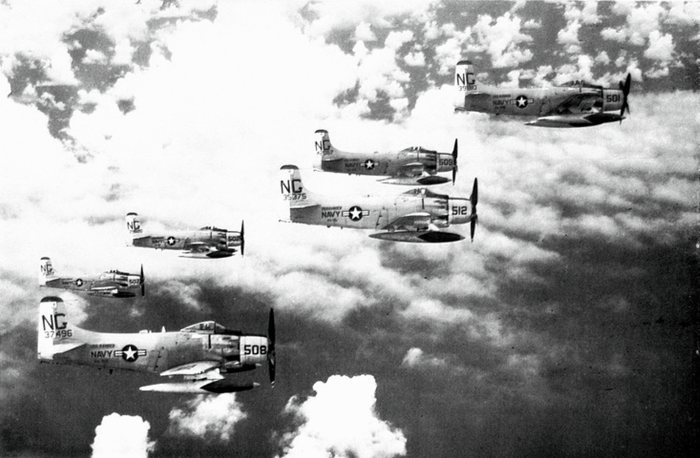
By early 1965, VA-95’s mission had expanded well beyond the original reconnaissance-support purpose of Yankee Team. Operating from Ranger on Yankee Station, the Green Lizards took part in the growing air war over Laos and North Vietnam, including retaliatory and interdiction strikes associated with Operation Flaming Dart and the opening phase of Operation Rolling Thunder.
Ranger remained on Yankee Station for a then-record 59 continuous days in March 1965, and VA-95 suffered combat losses during this increasingly dangerous period. Thus, Yankee Team represents an important bridge in VA-95 history: the reconnaissance effort that began in 1964 helped expose the North Vietnamese infiltration system through Laos, while VA-95 and CVW-9 soon became part of the much larger carrier air campaign that followed in 1965
Operational History of VA-95: Operation Flaming Dart II – 1965
Attack Squadron 95 (VA-95), the Green Lizards, participated in Operation Flaming Dart while deployed aboard USS Ranger (CVA-61) with Carrier Air Wing 9 (CVW-9), flying the Douglas A-1H and A-1J Skyraider. Following the Viet Cong attack on American facilities at Pleiku on 7 February 1965, President Lyndon Johnson ordered retaliatory strikes against North Vietnam under Operation Flaming Dart. VA-95 was assigned the Vit Thu Lu Barracks as its target during Flaming Dart I, but the squadron’s strike was forced to turn back because of poor weather. Four days later, on 11 February, VA-95 aircraft took part in Operation Flaming Dart II. Ranger joined USS Coral Sea (CVA-43) and USS Hancock (CVA-19) in a large Task Force 77 carrier strike against the Chanh Hoa military barracks near Dong Hoi, North Vietnam.
Official Navy squadron history specifically records VA-95 aircraft participating in the Flaming Dart II retaliatory strike. About 95–100 Navy aircraft from the three carriers took part in the overall attack, bombing and strafing North Vietnamese barracks and staging areas. VA-95’s slow but heavily armed Skyraiders were well suited to delivering bombs and rockets against ground targets and could remain over the target area longer than most early jet attack aircraft.
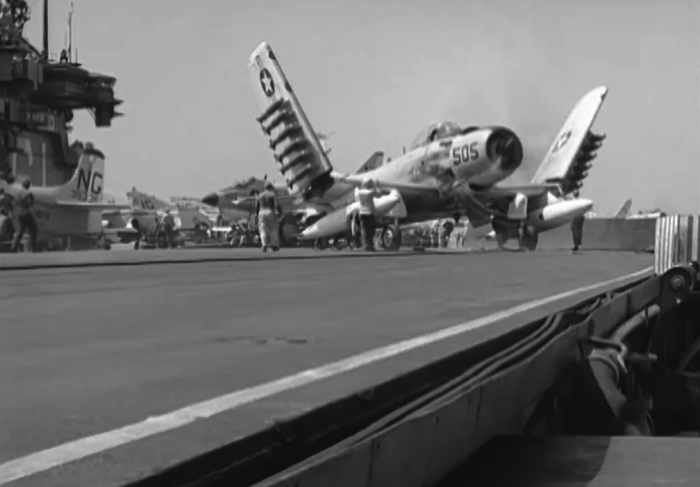
The Flaming Dart missions represented an important turning point for VA-95. What had begun during late 1964 as reconnaissance support and strikes over Laos was developing into direct attacks against North Vietnam. Only weeks later, VA-95 and Ranger became involved in the opening stages of Operation Rolling Thunder, including the March 1965 strike against the Phu Qui ammunition depot. Operation Flaming Dart therefore stands as one of VA-95’s earliest direct combat operations against targets inside North Vietnam and helped mark the Green Lizards’ transition into sustained Vietnam War combat.
Operational History of VA-95: Operation Rolling Thunder – 1965
In March 1965, Attack Squadron 95 (VA-95), the Green Lizards, entered a new phase of the Vietnam War when it participated in Operation Rolling Thunder, the sustained U.S. bombing campaign against North Vietnam. VA-95 was deployed aboard USS Ranger (CVA-61) with Carrier Air Wing 9 (CVW-9), operating with the U.S. Seventh Fleet’s Task Force 77 in the Gulf of Tonkin.
The squadron flew the Douglas A-1H and A-1J Skyraider, a rugged attack aircraft capable of carrying a heavy bomb load while remaining over the target area for long periods. On March 15, 1965, aircraft from Ranger and USS Hancock (CVA-19) carried out the U.S. Navy’s first Rolling Thunder strike, attacking the Phu Qui ammunition depot in North Vietnam.
VA-95’s official squadron history specifically records its participation in the Phu Qui strike. During this period, the Green Lizards also supported reconnaissance missions and attacked Communist supply routes and military targets as American air operations expanded over North Vietnam and Laos. Operation Rolling Thunder marked an important turning point for VA-95, moving the squadron from the limited strikes and reconnaissance support of 1964 into sustained combat operations against North Vietnam.
Operational History of VA-95: Operation End Sweep – February – July 1973
In 1973, Attack Squadron 95 (VA-95), the Green Lizards, returned to Southeast Asia during Operation End Sweep, the U.S. effort to clear American-laid mines from the waters and harbors of North Vietnam following the Paris Peace Accords. The newly reestablished VA-95 deployed aboard USS Coral Sea (CVA-43) from 9 March to 8 November 1973 as part of Carrier Air Wing 15 (CVW-15), flying the Grumman A-6A and A-6B Intruder and KA-6D tanker. Official Navy history specifically states that VA-95 provided support to Operation End Sweep during this first deployment of the third VA-95.
The actual mine-clearing mission was carried out primarily by Task Force 78 using Navy surface forces and specially equipped helicopters, including CH-53 Sea Stallions. The operation cleared the approaches to Haiphong and other North Vietnamese ports, was temporarily suspended in April, resumed in June, and officially ended on 18 July 1973.
For VA-95, Operation End Sweep was historically significant because it marked the Green Lizards’ first overseas deployment after the squadron was reestablished on 1 April 1972 and began more than two decades of A-6 Intruder operations that would eventually take VA-95 from Vietnam to combat in the Persian Gulf.
Operational History of VA-95: Operation Frequent Wind 29–30 April 1975
On April 29–30, 1975, Attack Squadron 95 (VA-95), the Green Lizards, took part in Operation Frequent Wind, the final evacuation of Americans and at-risk Vietnamese from Saigon as North Vietnamese forces closed on the city. VA-95 was deployed aboard USS Coral Sea (CVA-43) with Carrier Air Wing 15 (CVW-15), flying the Grumman A-6A Intruder and KA-6D tanker. Coral Sea and USS Enterprise operated with Task Force 77 in the South China Sea and provided carrier air cover for the helicopters conducting the evacuation.

Official Navy records list VA-95 as part of Coral Sea’s air wing during the operation. The Green Lizards did not fly the helicopters that carried evacuees from Saigon; instead, VA-95 formed part of the carrier strike and support force protecting the evacuation. Aircraft from Coral Sea and Enterprise flew 173 air-support sorties during the final two days, with A-6 Intruders among the aircraft orbiting the Saigon area.
No ordnance was dropped during these protective missions. Meanwhile, Task Force 76 helicopters evacuated more than 7,000 Americans and Vietnamese from Saigon. Operation Frequent Wind marked a historic moment for VA-95 and the U.S. Navy: the Green Lizards stood ready aboard Coral Sea as American carrier aviation helped protect the final evacuation and the Vietnam War came to an end.
Operational History of VA-95: SS Mayaguez Incident – May 15 1975
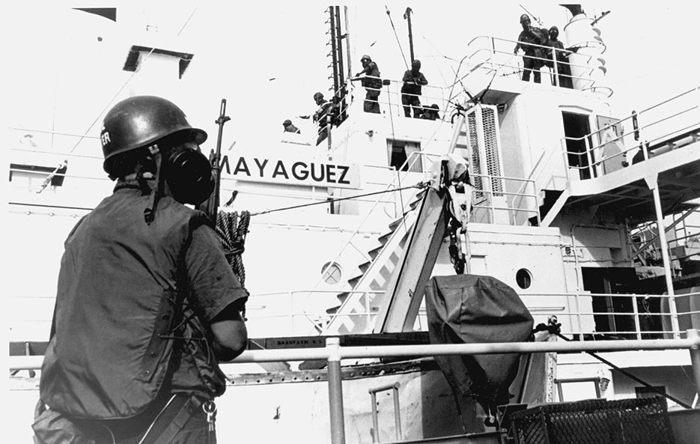
On May 15, 1975, Attack Squadron 95 (VA-95), the Green Lizards, went into combat during the SS Mayaguez Incident, one of the final U.S. military actions associated with the Vietnam War era. After Khmer Rouge forces seized the American merchant ship SS Mayaguez on May 12, USS Coral Sea (CVA-43) and Carrier Air Wing 15 (CVW-15) were ordered to support the recovery operation. VA-95 was aboard Coral Sea flying the Grumman A-6A Intruder and KA-6D tanker.
On May 15, Green Lizard crews flew combat sorties supporting the Marine assault on Koh Tang Island and participated in strikes against Cambodian military targets. Official Navy squadron history specifically records that VA-95 aircraft attacked the airfield and naval facility at Ream, Cambodia, while the squadron’s KA-6Ds provided aerial refueling for the combat sorties.
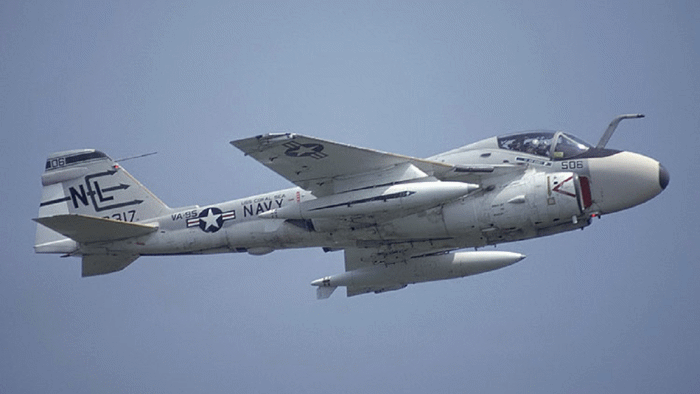
Coral Sea’s CVW-15 launched several strike packages against Ream Airfield, the Kompong Som area, port and naval facilities, petroleum storage, and other military targets intended to prevent Khmer Rouge forces from interfering with the recovery operation. The fighting was costly, particularly for the Marines and Air Force helicopter crews at Koh Tang, but all 40 members of the Mayaguez crew were recovered.
For VA-95, the Mayaguez Incident was especially significant: only two weeks after supporting Operation Frequent Wind and the evacuation of Saigon, the Green Lizards were back in combat, demonstrating the A-6 Intruder’s long-range, all-weather strike capability during the closing chapter of American military operations in Southeast Asia.
Operational History of VA-95: Operation Earnest Will – 1988
In 1988, Attack Squadron 95 (VA-95), the Green Lizards, supported Operation Earnest Will while deployed aboard USS Enterprise (CVN-65) with Carrier Air Wing 11 (CVW-11). Flying the Grumman A-6E Intruder and KA-6D tanker, VA-95 operated with Enterprise’s Battle Group Foxtrot in the North Arabian Sea and Gulf of Oman as U.S. naval forces protected reflagged Kuwaiti oil tankers moving through the Persian Gulf during the Iran-Iraq War.
The Green Lizards provided long-range, all-weather strike capability and supported surveillance and surface combat air patrol missions as American forces guarded shipping against Iranian mines, small attack craft, and other threats. The deployment reached its combat high point after USS Samuel B. Roberts (FFG-58) struck an Iranian mine on April 14, leading to Operation Praying Mantis on April 18, when VA-95 A-6Es attacked Iranian forces and helped disable the frigates Sahand and Sabalan.
Enterprise continued supporting Earnest Will after the battle, with its final Earnest Will mission of the deployment occurring on May 13, 1988. VA-95’s role in Earnest Will demonstrated the Green Lizards’ ability to protect U.S. interests and maritime operations while remaining ready to move quickly from deterrence to combat.
Operational History of VA-95: Operation Praying Mantis-April 18 1988
On April 18, 1988, Attack Squadron 95 (VA-95), the Green Lizards, played a major combat role in Operation Praying Mantis, the U.S. Navy’s retaliation against Iran after USS Samuel B. Roberts (FFG-58) struck an Iranian mine four days earlier. VA-95 was deployed aboard USS Enterprise (CVN-65) with Carrier Air Wing 11 (CVW-11), flying the Grumman A-6E Intruder as part of Battle Group Foxtrot.
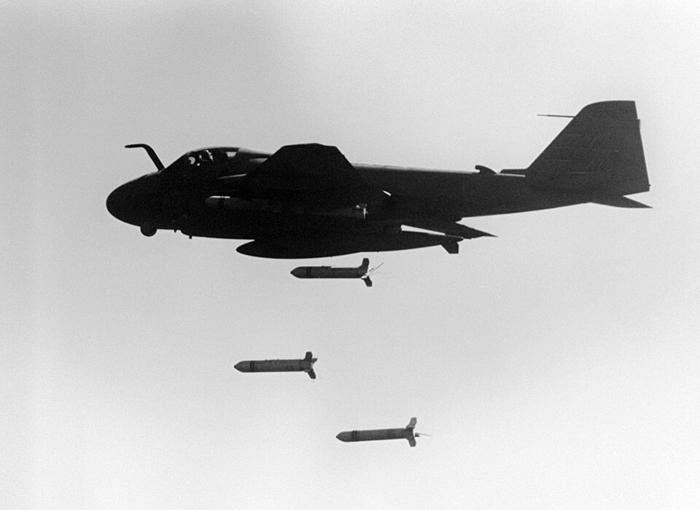
During the battle, VA-95 A-6Es attacked Iranian Boghammar speedboats with Mk 20 Rockeye cluster bombs, sinking one and damaging others. Later, two Green Lizard A-6Es flying surface combat air patrol for USS Joseph Strauss (DDG-16) encountered the Iranian frigate IRIS Sahand. After Sahand fired surface-to-air missiles at the Intruders, the VA-95 crews counterattacked with AGM-84 Harpoon missiles, AGM-123 Skipper weapons, and bombs.
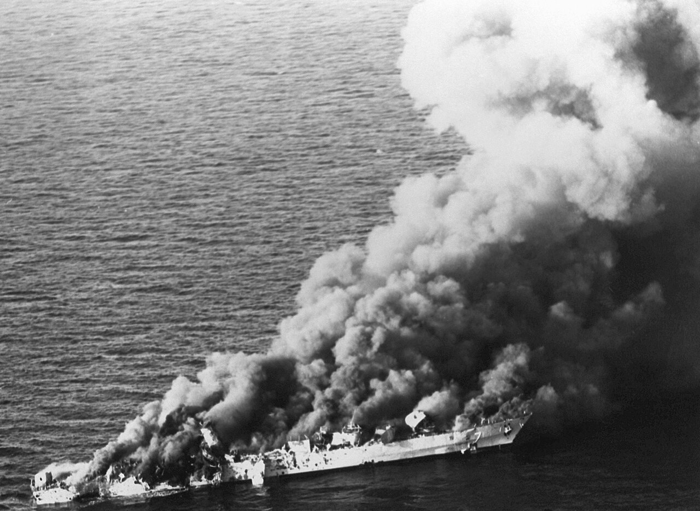
IRIS Sahand was struck repeatedly, caught fire, and eventually exploded and sank. Later that afternoon, the Iranian frigate IRIS Sabalan fired missiles at VA-95 aircraft. A Green Lizard A-6E responded by placing a 500-pound laser-guided bomb into the ship’s stack, severely damaging the frigate and leaving it dead in the water. U.S. commanders then ordered that Sabalan not be attacked further.
Operation Praying Mantis became one of the most important combat actions in VA-95 history and demonstrated the A-6E Intruder’s ability to locate, identify, and attack hostile surface ships in a heavily defended maritime environment.
Operational History of VA-95: Operation Fiery Vigil – June 1991
In June 1991, Attack Squadron 95 (VA-95), the Green Lizards, participated in Operation Fiery Vigil while deployed aboard USS Abraham Lincoln (CVN-72) with Carrier Air Wing 11 (CVW-11). VA-95 was flying the Grumman A-6E Intruder and KA-6D tanker during Abraham Lincoln’s maiden Western Pacific deployment, which began on May 28, 1991.
The carrier was originally heading toward the Arabian Gulf when the eruption of Mount Pinatubo, combined with Typhoon Yunya, caused widespread destruction around Naval Station Subic Bay, NAS Cubi Point, and Clark Air Base in the Philippines. Abraham Lincoln and its battle group were diverted to help with the emergency evacuation.
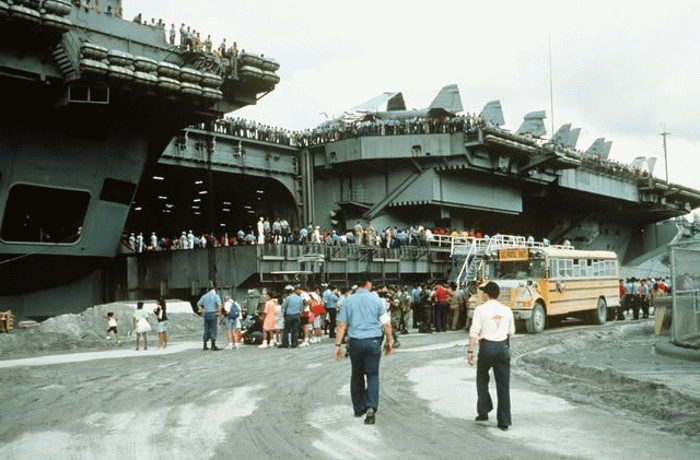
As part of CVW-11, VA-95 supported the carrier and the massive humanitarian effort while thousands of U.S. military personnel, dependents, and other evacuees were moved away from the disaster area. Abraham Lincoln alone transported 4,323 people from the affected bases to Cebu, while the larger 23-ship relief force helped move nearly 45,000 people.
Operation Fiery Vigil demonstrated a different side of VA-95’s mission. Instead of launching A-6Es for combat strikes, the Green Lizards and their fellow CVW-11 squadrons supported a major humanitarian operation during one of the largest peacetime military evacuations of its kind. After completing the mission, Abraham Lincoln continued to the Arabian Gulf, where CVW-11 conducted combat air patrol, reconnaissance, and support operations over Kuwait and Iraq during the post-Gulf War period.
Operational History of VA-95: Operation Continue Hope – October 12 – November 3, 1993
In October 1993, Attack Squadron 95 (VA-95), the Green Lizards, was called from the Arabian Gulf to the coast of Somalia as the crisis around Mogadishu intensified. VA-95 was deployed aboard USS Abraham Lincoln (CVN-72) with Carrier Air Wing 11 (CVW-11), flying the Grumman A-6E Intruder. Abraham Lincoln had been supporting Operation Southern Watch over Iraq when the carrier received orders to make a high-speed transit to Somalia following the deadly fighting in Mogadishu in early October for Operation Continue Hope. Official Navy records place Abraham Lincoln on station for Somalia operations from October 12 through November 3, 1993.
As part of CVW-11, VA-95 helped provide the carrier-based air presence supporting U.S. and United Nations forces ashore. Navy records state that CVW-11 flew patrols over Mogadishu and provided air support to United Nations operations while Abraham Lincoln remained off Somalia. The carrier’s presence gave commanders a powerful offshore aviation force that could respond quickly if American or coalition troops required assistance.
For the Green Lizards, Somalia demonstrated the flexibility of the A-6E Intruder and VA-95. During the same 1993 deployment, the squadron went from supporting Operation Southern Watch over Iraq to standing watch over Mogadishu during the U.S. and U.N. intervention in Somalia. VA-95 and CVW-11 remained on station until November 1993 before Abraham Lincoln resumed its journey home.
Operational History of VA-95: Operation Southern Watch – 1993 And 1995
Attack Squadron 95 (VA-95), the Green Lizards, participated in Operation Southern Watch during its final years of active service. Flying the Grumman A-6E Intruder with Carrier Air Wing 11 (CVW-11), VA-95 deployed aboard USS Abraham Lincoln (CVN-72) to the Arabian Gulf in 1993 and again in 1995. Operation Southern Watch enforced the no-fly zone over southern Iraq established after the 1991 Gulf War and helped contain Iraqi military activity in the region.
During Abraham Lincoln’s 1993 deployment, which began in June, CVW-11 flew thousands of missions into Iraq in support of Operation Southern Watch. VA-95’s A-6E Intruders contributed the air wing’s all-weather, long-range attack capability while carrier aircraft maintained a continuous American presence over the region. In October, Abraham Lincoln was ordered away from the Arabian Gulf to Somalia, where CVW-11 supported U.S. and United Nations operations around Mogadishu.
The Green Lizards returned to the Arabian Gulf aboard Abraham Lincoln in 1995 for another Southern Watch deployment. During this cruise, rising tensions with Iraq led to Operation Vigilant Sentinel, and Lincoln’s scheduled departure was delayed so that a continuous carrier battle group presence could be maintained in the region.
Operation Southern Watch became the final major operational chapter in VA-95 history. After more than two decades flying the A-6 Intruder, the Green Lizards returned from their final deployment in October 1995. VA-95 was officially disestablished on October 31, 1995, with its disestablishment ceremony held at NAS Whidbey Island on November 18.
Operational History of VA-95: Operation Operation Vigilant Sentinel – 1995
In 1995, Attack Squadron 95 (VA-95), the Green Lizards, participated in Operation Vigilant Sentinel during the squadron’s final deployment. VA-95 was embarked aboard USS Abraham Lincoln (CVN-72) with Carrier Air Wing 11 (CVW-11), flying the Grumman A-6E Intruder. The carrier deployed in April 1995 to the Arabian Gulf, where CVW-11 supported Operation Southern Watch and helped enforce the no-fly zone over southern Iraq. Official Abraham Lincoln records confirm that VA-95 and its A-6Es were part of the embarked air wing during the 1995 deployment.
In August 1995, tensions increased after senior Iraqi officials defected to Jordan and U.S. intelligence detected increased Iraqi military activity. Concern grew that Saddam Hussein might take military action against Jordan or Kuwait. In response, U.S. forces initiated Operation Vigilant Sentinel, moving additional forces and pre-positioned military equipment into the Gulf region as a warning against Iraqi aggression.
As part of Abraham Lincoln and CVW-11, VA-95 provided the battle group with the A-6E Intruder’s long-range, all-weather strike capability while American forces maintained a heightened state of readiness. Navy records specifically confirm that Abraham Lincoln supported both Southern Watch and Vigilant Sentinel during the 1995 deployment.
Once a Lizard, always a Lizard.

Want more Green Lizard articles like this? Subscribe to our VA-95 All Weather Attack newsletter today and get VA-95-focused news, announcements, and website updates delivered straight to your inbox.