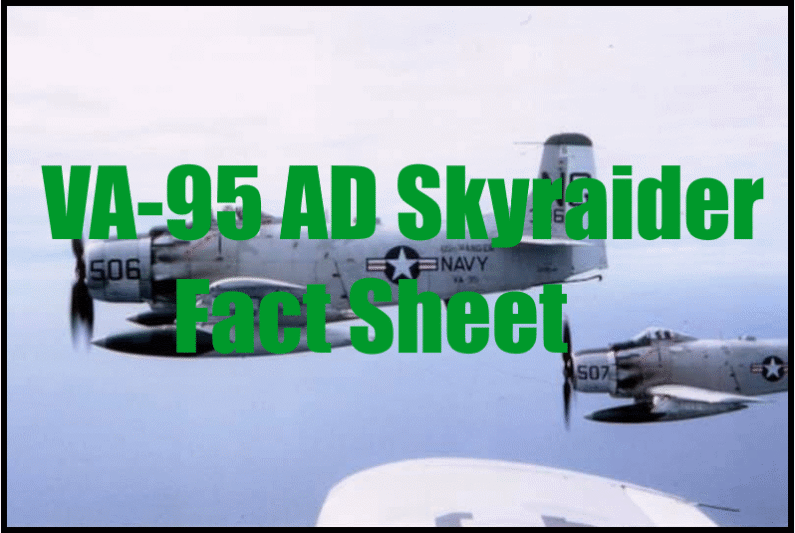
The AD Skyraider: The Legendary Navy Attack Aircraft That Refused to Quit
The Douglas A-1 Skyraider (formerly AD) was an American single-seat attack aircraft that saw service between the late 1940s and early 1980s. The Skyraider had a remarkably long and successful career; it became a piston-powered, propeller-driven anachronism in the jet age, and was nicknamed “Spad”, after the French World War I fighter.
The piston-engined AD Skyraider was designed during World War II to meet United States Navy requirements for a carrier-based, single-seat, long-range, high performance dive/torpedo bomber, to follow-on from earlier types such as the Helldiver and Avenger.[3] Designed by Ed Heinemann of the Douglas Aircraft Company, prototypes were ordered on 6 July 1944 as the XBT2D-1. The XBT2D-1 made its first flight on 18 March 1945 and in April 1945, the USN began evaluation of the aircraft at the Naval Air Test Center (NATC).[4] In December 1946, after a designation change to AD-1, delivery of the first production aircraft to a fleet squadron was made to VA-19A
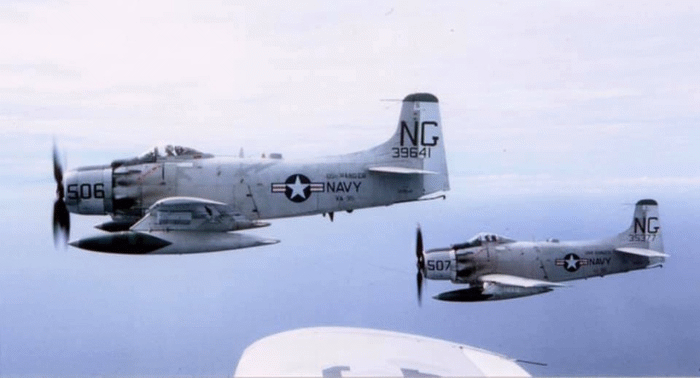
Few aircraft in the history of U.S. Naval Aviation earned the reputation, respect, and affection given to the Douglas AD Skyraider. Big, powerful, rugged, and remarkably versatile, the Skyraider arrived just as the age of the propeller-driven combat aircraft seemed to be ending. Instead of quickly becoming obsolete, however, the Skyraider proved that there was still plenty of fight left in a piston-powered airplane.
Known affectionately as the “Spad,” the Skyraider served through the turbulent years following World War II, fought in Korea and Vietnam, and performed missions ranging from carrier attack and close air support to airborne early warning and combat rescue support.
For VA-95 veterans, the Skyraider has a special place in squadron history. It was among the aircraft flown by squadrons carrying the VA-95 designation during the years between the propeller-driven attack era and the coming dominance of the jet.
Born During World War II
The AD Skyraider story began during the final years of World War II.
Douglas Aircraft Company designer Ed Heinemann and his team developed the airplane in response to the Navy’s need for a new carrier-based attack aircraft. The concept was straightforward: build a single-seat airplane capable of carrying a tremendous weapons load over a useful combat radius while remaining simple enough to operate from an aircraft carrier.
The prototype first flew in March 1945.
The timing meant that the aircraft arrived too late to participate in World War II. Had the war continued longer, the airplane might have joined the final attacks against Japan. Instead, the Skyraider entered a very different world.
Jet aircraft were appearing at a remarkable pace. Many observers believed the propeller-driven combat airplane had reached the end of the road. The Skyraider was about to prove them wrong.
A Big Airplane With a Big Engine
At the heart of the AD Skyraider was one of the most impressive piston engines ever installed in a production combat aircraft: the Wright R-3350 Duplex-Cyclone. This massive 18-cylinder radial engine produced roughly 2,700 horsepower, depending upon the particular model and installation. That power turned a huge four-bladed propeller and gave the Skyraider the muscle necessary to haul a tremendous assortment of weapons.
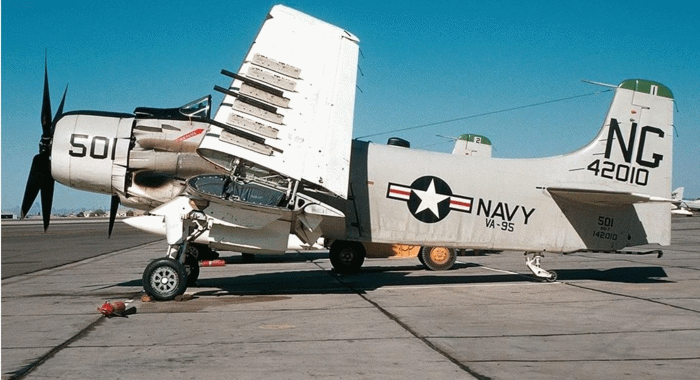
The airplane wasn’t small. Its wingspan was approximately 50 feet, and when loaded for combat, it was a substantial piece of machinery to launch from the relatively short flight deck of an aircraft carrier. Yet its large folding wings allowed it to be moved and stored aboard ship.
When the engine started, there was no mistaking it for anything else. The coughing and smoke of startup soon gave way to the unmistakable thunder of a large radial engine. For sailors standing nearby on the flight deck, the Skyraider wasn’t something you simply watched.
You felt it.
The AD Skyraider Goes to War in Korea
The Skyraider’s first major combat test came during the Korean War. Beginning in 1950, Navy and Marine Skyraiders flew from aircraft carriers against North Korean and Chinese forces.
The airplane proved exceptionally well suited to the conflict. Jets had speed, but speed wasn’t always what troops on the ground needed. The Skyraider could remain over a battlefield for an extended period, carry a heavy weapons load, operate at relatively low speeds, and deliver ordnance accurately against enemy positions.
Skyraiders attacked bridges, railroads, supply depots, vehicles, troop concentrations, artillery positions, and other targets.
One of the aircraft’s most impressive characteristics was its ability to absorb battle damage. Pilots sometimes returned to their carriers with aircraft riddled by enemy fire. The Skyraider wasn’t indestructible, and many aircraft and airmen were lost, but the AD earned a reputation as one tough airplane.
From AD to A-1
Older Navy veterans remember the airplane as the AD Skyraider. Younger veterans of the Vietnam era are more likely to recognize it as the A-1 Skyraider. They were the same aircraft family. The difference came from a change in the American military aircraft designation system. In 1962, the Department of Defense adopted a standardized aircraft designation system. The Navy’s AD designation was replaced with A-1.
Thus, aircraft such as the AD-6 became the A-1H, while other Skyraider variants received corresponding A-1 designations. Whatever was painted in the paperwork, sailors and pilots continued using a much simpler name:
the Spad.
The AD Skyraider went through seven versions, starting with the AD-1, then AD-2 and AD-3 with various minor improvements, then the AD-4 with a more powerful R-3350-26WA engine. The AD-5 was significantly widened, allowing two crew to sit side-by-side (this was not the first multiple-crew variant, the AD-1Q being a two-seater and the AD-3N a three-seater); it also came in a four-seat night-attack version, the AD-5N. The AD-6 was an improved AD-4B with improved low-level bombing equipment, and the final production version AD-7 was upgraded to a R-3350-26WB engine.
VA-95 and the AD Skyraider
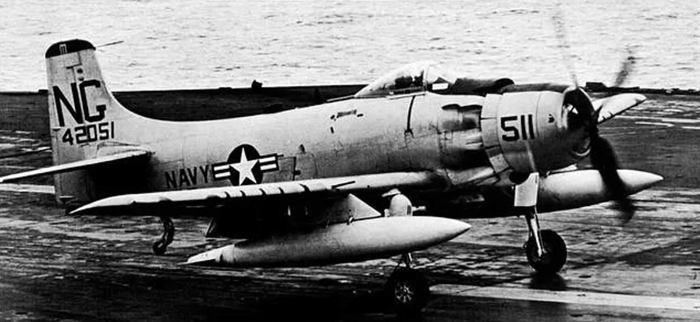
The AD Skyraider also occupies an important place in the history associated with Attack Squadron 95. The original squadron lineage that eventually received the VA-95 designation began during World War II as Torpedo Squadron Twenty (VT-20).
VT-20 flew the TBF/TBM Avenger in combat in the Pacific.
After the war, VT-20 became VA-10A in 1946 and then the first VA-95 in 1948. During this postwar period, the squadron transitioned into the AD Skyraider before being disestablished in 1949.
A separate squadron carrying the VA-95 designation was established in 1952. That VA-95 also became associated with the Skyraider before eventually moving into the jet age.
It is important when discussing VA-95 history to remember that Navy squadron lineage can get complicated. Squadrons carrying the same designation were not necessarily official continuations of one another. Nevertheless, the AD Skyraider forms an important chapter in the larger story of the sailors who wore the VA-95 designation.
An Airplane Designed Around the Mission
The AD Skyraider wasn’t beautiful in the sleek, futuristic sense of an early jet fighter. It looked like what it was: A working attack airplane.
Its enormous radial engine dominated the nose. A long fuselage stretched behind the cockpit, while broad wings provided plenty of room for weapons.
Those wings helped give the AD Skyraider another important advantage. It could fly relatively slowly. That might sound like a disadvantage in combat, but during close air support missions it could be extremely valuable.
A fast jet might roar over a battlefield in seconds. A AD Skyraider could stay around. It could circle, identify targets, coordinate with troops on the ground, make an attack, climb away, and come around again. That capability became especially valuable during the next major conflict in which the Skyraider fought.
The Spad Goes to Vietnam
By the time America became deeply involved in Vietnam, the AD Skyraider should have been obsolete. At least on paper. The aircraft’s basic design was approximately two decades old. Supersonic jets were now operating from American aircraft carriers. Missiles, radar, and increasingly sophisticated electronics were transforming aerial warfare.
Yet the old Spad went back to war.
U.S. Navy AD Skyraider flew attack missions during the early years of American combat operations in Southeast Asia. The aircraft’s ability to carry substantial ordnance and remain over the target continued to make it useful. Skyraiders also became legendary in another role with the U.S. Air Force:
Combat Search and Rescue.
A downed American pilot deep in hostile territory presented an enormous challenge. Rescue helicopters were vulnerable, particularly when approaching an area containing enemy troops and antiaircraft weapons. A-1 Skyraiders could accompany rescue forces, suppress enemy positions, and remain in the area for long periods.
These missions became associated with the famous call sign: Sandy.
For many American aviators who were shot down over Southeast Asia, hearing that a Sandy was overhead meant somebody was coming to get them.
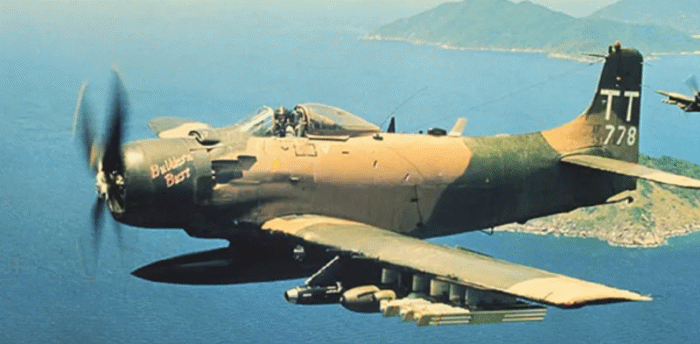
Few missions better demonstrated the AD Skyraider’s combination of endurance, firepower, maneuverability, and rugged construction.
Why the AD Skyraider Became a Legend
Hundreds of military aircraft have come and gone since World War II. Only a handful developed personalities of their own. The AD Skyraider was one of them.
Part of its appeal came from the contradiction it represented.
- It was a propeller-driven airplane fighting in the jet age.
- It was comparatively slow, yet incredibly useful.
- It was old-fashioned, yet capable of performing missions that newer aircraft sometimes struggled to accomplish as effectively.
- And above all, it was versatile.
The Skyraider family was adapted to perform numerous missions, including attack, electronic warfare, airborne early warning, night attack, antisubmarine duties, and other specialized roles.
It wasn’t necessarily the fastest airplane on the flight deck. It didn’t need to be.
It simply had to accomplish the mission. And for decades, it did.
Remembering the AD Skyraider
The Douglas AD/A-1 Skyraider earned its place in aviation history not because it was the fastest or most technologically advanced aircraft of its generation, but because it was rugged, dependable, heavily armed, remarkably adaptable, and capable of doing the job when the job needed to be done.
From the decks of American aircraft carriers off Korea to the dangerous skies over Vietnam, the Skyraider repeatedly demonstrated that an airplane shouldn’t be judged simply by how new it is. Sometimes the old bird still has plenty of fight left in her.
For the sailors and aviators who flew, maintained, armed, fueled, launched, recovered, and repaired the AD Skyraider, the airplane will always represent a remarkable period in Naval Aviation history. And for the generations associated with VA-95, the Skyraider remains another important link in a history that stretched from the piston-powered aircraft of World War II to the sophisticated attack aircraft of the Cold War.
The AD Skyraider was big. It was loud. It was tough. It carried almost everything you could hang underneath it.
And long after everyone thought the propeller-driven attack airplane had seen its last war, the old Spad kept right on fighting.
Long live the AD Skyraider.
It was operated by the United States Navy (USN), the United States Marine Corps (USMC) and the United States Air Force (USAF), and also saw service with the British Royal Navy, the French Air Force, the Air Force of the Republic of Vietnam (VNAF), and others. In U.S. service, it was finally replaced by the LTV A-7 Corsair II swept wing subsonic jet in the early 1970s.
The AD Skyraider Could Carry Almost Anything
One of the AD Skyraider’s greatest strengths was its ability to carry an extraordinary variety of ordnance. Under its wings and fuselage were numerous external stations capable of carrying bombs, rockets, fuel tanks, mines, gun pods, and other equipment.
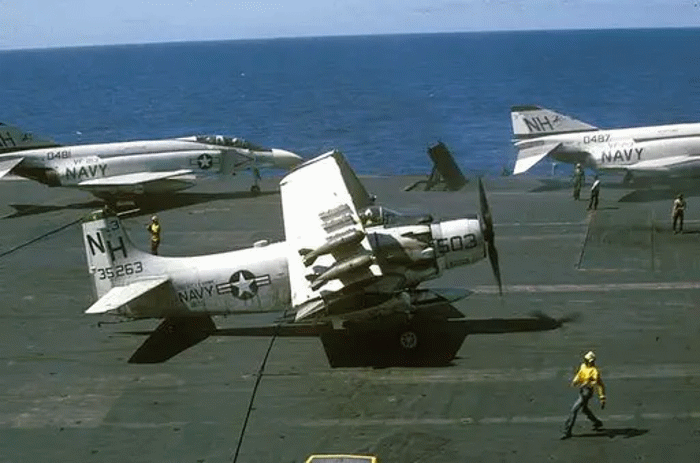
Depending upon the mission, a AD Skyraider might launch carrying conventional bombs, rockets, napalm tanks, depth charges, mines, or combinations of several weapons. The aircraft also carried built-in 20mm cannon.
Characteristics of the Douglas A-1 Skyraider
- Contractor: Douglas
- Crew: One Length: 38 ft 10 in (11.84 m)
- Wingspan: 50 ft 0¼ in (15.25 m)
- Height: 15 ft 8¼ in (4.78 m)
- Wing area: 400.3 ft² (37.19 m²)
- Empty weight: 11,968 lb (5,429 kg)
- Loaded weight: 18,106 lb (8,213 kg)
- Max. takeoff weight:v 25,000 lb (11,340 kg)
- Powerplant:v 1 × Wright R-3350-26WA radial engine, 2,700 hp (2,000 kW)
- Maximum speed: 322 mph (280 kn, 518 km/h) at 18,000 ft (5,500 m)
- Cruise speed:v 198 mph (172 kn, 319 km/h)
- Range: 1,316 mi (1,144 nmi, 2,115 km)
- Service ceiling: 28,500 ft (8,685 m)
- Rate of climb: 2,850 ft/min (14.5 m/s)
- Wing loading: 45 lb/ft² (220 kg/m²)Power/mass: 0.15 hp/lb (250 W/kg)
Armament of the Douglas A-1 Skyraider
The Skyraider could carry up to 8,000 lb (3,600 kg) of ordnance on 15 external hardpoints.
- Guns: 4 × 20 mm (0.79 in) M2 cannon
- Mark 81 (250 lb) bombs.
- Mark 82 (500 lb) bombs—including high-drag Snakeye variants with extending fins.
- Mark 83 (1,000 lb) bombs.
- World War II-era AN-M64 (500 lb) and AN-M65 (1,000 lb) demolition bombs.
- BLU-10/B and BLU-1/B fire bombs.
- 2.75-inch Folding-Fin Aerial Rockets (FFAR) in multi-tube pods like the LAU-3/A.
- 5-inch High-Velocity Aircraft Rockets (HVAR)
- SUU-11/A 7.62 mm minigun pods or 20 mm cannon pods.
- CBU-24 and CBU-25 cluster bomb units, as well as anti-personnel mine and fragmentation dispensers.
Once a Lizard, always a Lizard.

Want more Green Lizard articles like this? Subscribe to our VA-95 All Weather Attack newsletter today and get VA-95-focused news, announcements, and website updates delivered straight to your inbox.