
From The Beginning To The End
Starting with our early Torpedo Twenty days to the final VA-95 ending, we deployed on a carrier 31 times not counting workups or Pineapple cruises. We served on 14 aircraft carriers, spanning 7 separate aircraft carrier class types, including 7 different Essex carriers.
VA-95 Aircraft Carrier Deployments From 1944 Until 1995| Carrier Hull Number | Deployment Dates | Carrier Air Wing (CAG) | Aircraft Type |
|---|---|---|---|
| USS Enterprise CV-6 | Aug. 24–Dec. 6, 1944 | CVG-20 | TBM-1C Avenger |
| USS Lexington CV-16 | Dec. 11, 1944–Jan. 26, 1945 | CVG-20 | TBM-1C Avenger |
| USS Philippine Sea CVA-47 | Oct. 15–Nov. 20, 1946 | CVG-20 | TBM-1C Avenger |
| USS Philippine Sea CVA-47 | Mar. 27–May 5, 1947 | CVAG-9 | TBM-3E Avenger |
| USS Philippine Sea CVA-47 | Feb. 9–Jun. 26, 1948 | CVAG-9 | TBM-3E Avenger |
| USS Philippine Sea CVA-47 | Dec. 15, 1952–Aug. 14, 1953 | CVG-9 | AD-4 / AD-4NA Skyraider |
| USS Hornet CVA-12 | May 11–Dec. 12, 1954 | CVG-9 | AD-6 Skyraider |
| USS Oriskany CVA-34 | Feb. 11–Jun. 13, 1956 | CVG-9 | AD-6 Skyraider |
| USS Ticonderoga CVA-14 | Sep. 16, 1957–Apr. 25, 1958 | CVG-9 | AD-6 Skyraider |
| USS Ranger CVA-61 | Feb. 6–Aug. 30, 1960 | CVG-9 | AD-6 / AD-7 Skyraider |
| USS Ranger CVA-61 | Aug. 11, 1961–Mar. 8, 1962 | CVG-9 | AD-6 / AD-7 Skyraider |
| USS Ranger CVA-61 | Nov. 9, 1962–Jun. 14, 1963 | CVG-9 | AD-6 / AD-7 Skyraider |
| USS Ranger CVA-61 | Aug. 5, 1964–May 6, 1965 | CVG-9 | AD-6 / AD-7 Skyraider |
| USS Intrepid CVS-11 | Apr. 4–Nov. 21, 1966 | CVW-10 | A-4B Skyhawk |
| USS Shangri-La CVA-38 | Nov. 15, 1967–Aug. 4, 1968 | CVW-8 | A-4B Skyhawk |
| USS John F. Kennedy CVA-67 | Nov. 1–Dec. 17, 1968 | CVW-1 | A-4C Skyhawk |
| USS John F. Kennedy CVA-67 | Apr. 5–Dec. 21, 1969 | CVW-1 | A-4C Skyhawk |
| USS Coral Sea CVA 43 | March 1973 – November 1973 | CVW-15 | A-6A / KA-6D |
| USS Coral Sea CVA 43 | Dec. 1974 – Jul. 1975 | CVW-15 | A-6A / KA-6D |
| USS Coral Sea CVA 43 | February 1977 – October 1977 | CVW-15 | A-6A / KA-6D |
| USS America CV 66 | March 1979 – September 1979 | CVW-11 | A-6E / KA-6D |
| USS America CV 66 | April 1981 – November 1981 | CVW-11 | A-6E / KA-6D |
| USS Enterprise CVN-65 | September 1982 – April 1983 | CVW-11 | A-6E / KA-6D |
| USS Enterprise CVN-65 | May 1984 – December 1984 | CVW-11 | A-6E / KA-6D |
| USS Enterprise CVN-65 | January 1986 – August 1986 | CVW-11 | A-6E / KA-6D |
| USS Enterprise CVN-65 | January 1988 – July 1988 | CVW-11 | A-6E / KA-6D |
| USS Enterprise CVN-65 | September 1989 – March 1990 | CVW-11 | A-6E / KA-6D |
| USS Abraham Lincoln CVN-72 | September 1990 – November 1990 | CVW-11 | A-6E / KA-6D |
| USS Abraham Lincoln CVN-72 | May 1991 – November 1991 | CVW-11 | A-6E / KA-6D |
| USS Abraham Lincoln CVN-72 | June 1993 – December 1993 | CVW-11 | A-6E / KA-6D |
| USS Abraham Lincoln CVN-72 | April 1995 – October 1995 | CVW-11 | A-6E / KA-6D |
VA-95 Carrier Deployments: USS Enterprise CV-6
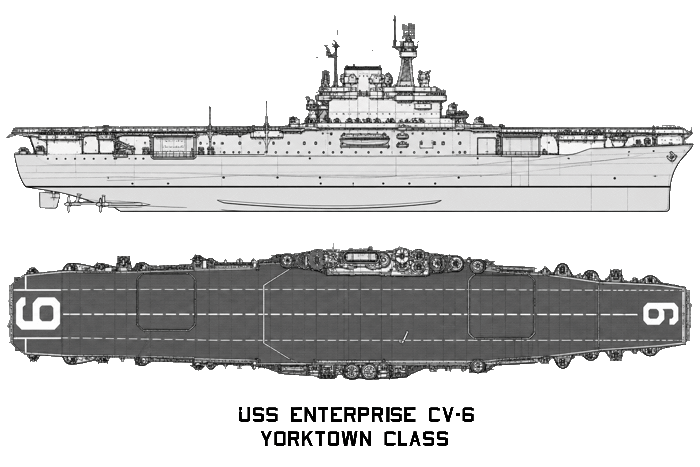
The USS Enterprise (CV-6), nicknamed the “Big E,” was a Yorktown-class aircraft carrier and one of the most famous American warships of World War II. Commissioned on May 12, 1938, Enterprise displaced about 19,800 tons, measured roughly 827 feet overall, and could reach approximately 33 knots. Her wartime air group could include around 80 aircraft, although the number and types changed as the war progressed. Enterprise fought across the Pacific from the opening months of the war through 1945, participating in the Doolittle Raid, Battle of Midway, Guadalcanal campaign, Battle of the Philippine Sea, Battle of Leyte Gulf, Iwo Jima, and Okinawa. By the end of World War II, Enterprise had earned 20 battle stars, making her the most decorated U.S. Navy warship of the conflict.
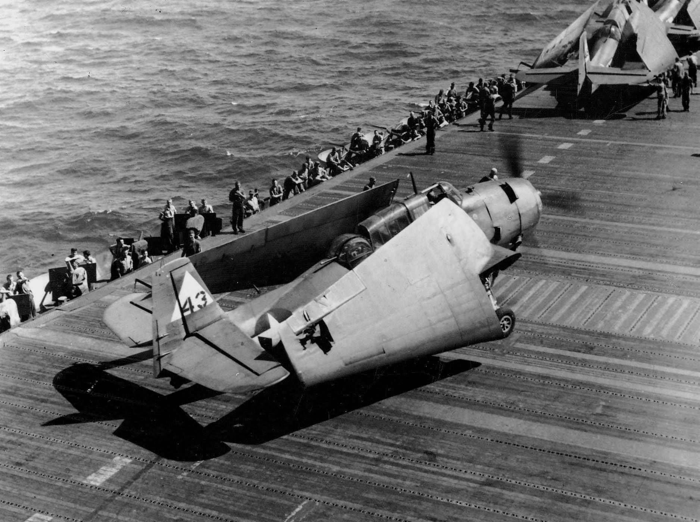
Torpedo Squadron Twenty (VT-20) brought its TBM-1C Avengers aboard USS Enterprise for its 1944 combat deployment and entered combat on September 1 with strikes against Japanese installations on Chichi Jima. During September, VT-20 attacked targets in the Palau Islands and supported the invasion of Peleliu. In October, its Avengers participated in strikes against Okinawa, Formosa, and Luzon as American forces prepared to invade the Philippines. The squadron’s most important action came on October 24, 1944, during the Battle of Leyte Gulf. VT-20’s TBM-1Cs attacked the powerful Japanese Center Force in the Sibuyan Sea and contributed to the attacks that sank the battleship Musashi. The following day, VT-20 joined strikes against the Japanese carrier force during the Battle off Cape Engaño. Eight VT-20 aviators received the Navy Cross for their actions against the Japanese surface force on October 24, and additional squadron personnel received Navy Crosses for the fighting on October 25.
The relationship between USS Enterprise CV-6 and VT-20 represents an important chapter in both American carrier aviation and the early history associated with the first VA-95 lineage. VT-20 had been established on October 15, 1943, and its combat experience aboard Enterprise helped build the squadron’s reputation during some of the most important naval operations of the Pacific War. In November 1944, VT-20 transferred from Enterprise to USS Lexington (CV-16) and continued combat operations into early 1945. After World War II, VT-20 was redesignated VA-10A on November 15, 1946, and then became the first VA-95 on August 12, 1948. The squadron was disestablished on November 30, 1949. For anyone researching USS Enterprise CV-6, VT-20, or VA-95 history, the Big E’s 1944 operations provide the combat-tested beginning of the squadron’s lineage.
VA-95 Carrier Deployments: USS Lexington CV-16
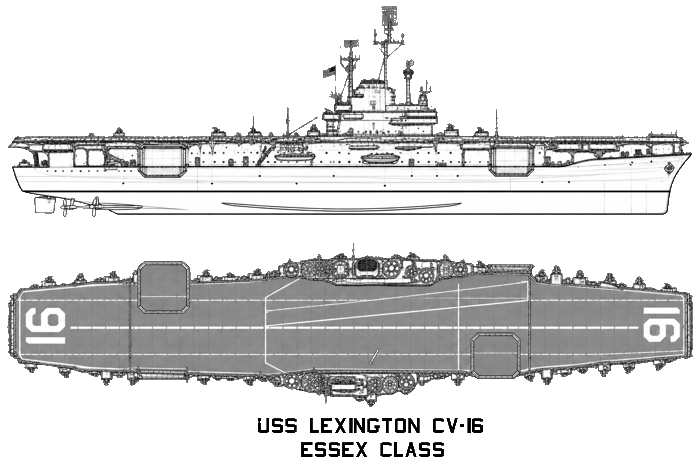
The USS Lexington (CV-16) was an Essex-class aircraft carrier that became one of the most famous American carriers of World War II. Commissioned on February 17, 1943, the ship was originally intended to be named Cabot, but was renamed Lexington after USS Lexington (CV-2) was lost during the Battle of the Coral Sea. During World War II, CV-16 displaced approximately 27,100 tons standard, measured about 872 feet overall, had a beam of roughly 93 feet at the waterline, and could reach a maximum speed of about 33 knots. Powered by eight boilers and four steam turbines driving four propeller shafts, Lexington could carry a large wartime air group of fighters, dive bombers, and torpedo bombers. The Japanese repeatedly reported Lexington sunk, only to have the carrier return to combat, helping earn her famous nickname, the “Blue Ghost.”
Torpedo Squadron Twenty (VT-20) transferred from USS Enterprise (CV-6) to USS Lexington in November 1944 and continued fighting with its TBM-1C Avenger torpedo bombers. From Lexington, VT-20 participated in operations supporting the continuing campaign in the Philippines, including strikes against Japanese airfields, shipping, and military installations on Luzon. In December 1944, the squadron took part in strikes connected with the American landings on Mindoro. In January 1945, Lexington and her aircraft entered the South China Sea, where carrier aircraft struck Japanese targets on Formosa, Luzon, French Indochina, Hong Kong, and other enemy-held areas. On January 12, VT-20 aircrew attacked a Japanese cruiser protecting a convoy off French Indochina; two squadron officers, LT James N. Howell Jr. and LTJG M. Throwbridge, later received Silver Stars for their actions. These missions came only weeks after VT-20 had fought in the Battle of Leyte Gulf from Enterprise, including the attacks on the Japanese battleship Musashi.
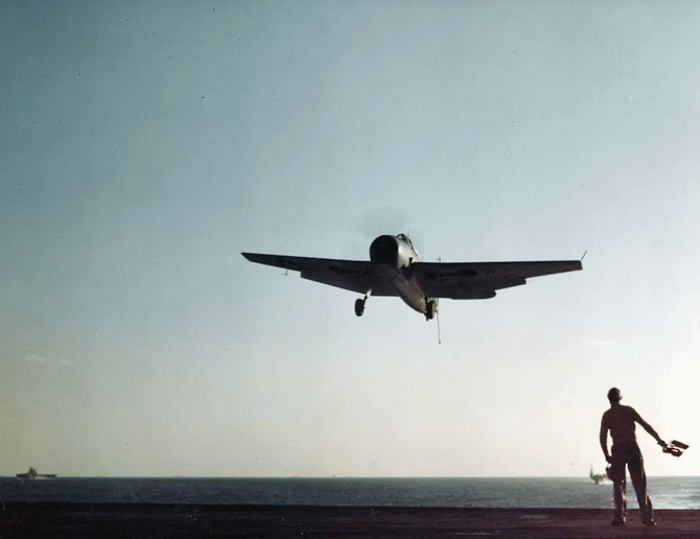
VT-20’s time aboard USS Lexington CV-16 was relatively short but combat-intensive. The squadron remained deployed into early February 1945, completing a wartime carrier tour that had taken its Avenger crews from Enterprise to Lexington and across some of the most dangerous areas of the western Pacific. Lexington herself continued fighting through the final months of World War II, participating in strikes against the Japanese home islands and supporting operations at Iwo Jima and Okinawa. By the end of the war, the carrier had earned 11 battle stars and survived repeated Japanese attacks. VT-20’s Lexington service is also an important part of VA-95 history.
VA-95 Carrier Deployments: USS Philippine Sea CV-47
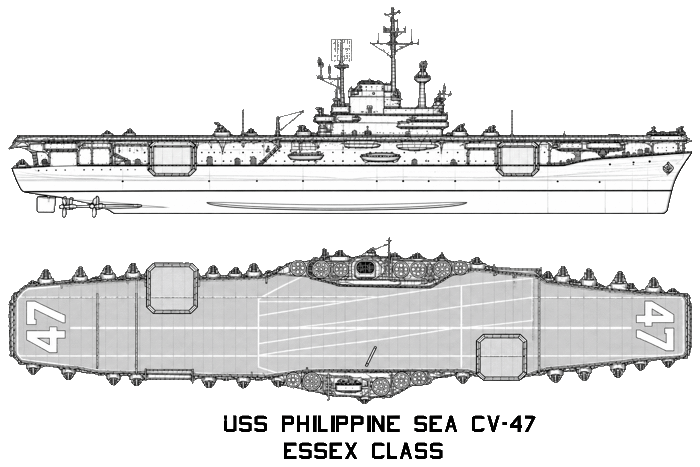
The USS Philippine Sea (CV-47) was one of 24 Essex-class aircraft carriers commissioned on May 11, 1946, too late to participate in World War II but just in time to become an important part of America’s postwar carrier force. Built by the Bethlehem Steel Company at Quincy, Massachusetts, Philippine Sea displaced approximately 27,100 tons standard, measured about 888 feet overall, had a waterline beam of approximately 93 feet, and could reach a maximum speed of roughly 33 knots. Her powerful steam-turbine propulsion system produced about 150,000 shaft horsepower and drove four propeller shafts. Like other Essex-class carriers, Philippine Sea could operate a large air group of fighters, attack aircraft, and specialized aircraft. Although best remembered for her later Korean War service, the carrier also played an important role in the transition between World War II naval aviation and the developing Cold War fleet.
The connection between USS Philippine Sea CV-47 and Attack Squadron 10A (VA-10A) began during this important postwar period. On November 15, 1946, VT-20 was redesignated VA-10A, continuing the same squadron lineage that had fought aboard USS Enterprise and USS Lexington during World War II. VA-10A continued flying the General Motors TBM-3E Avenger, an improved version of the famous Grumman-designed TBF/TBM torpedo bomber. Assigned to Carrier Air Group 9 (CVAG-9), VA-10A deployed aboard Philippine Sea to the Caribbean from March 27 to May 5, 1947. The squadron later made a much longer deployment aboard the carrier from February 9 to June 26, 1948, operating in the Atlantic and Mediterranean. There were no major combat missions involving VA-10A and Philippine Sea during these cruises because the United States was not engaged in a major shooting war. Instead, VA-10A conducted carrier qualifications, bombing and torpedo training, navigation exercises, fleet maneuvers, and other operations designed to maintain the combat readiness developed during World War II.
USS Philippine Sea was the only carrier on which the squadron made deployments while actually designated VA-10A.
The USS Philippine Sea and VA-10A deployments of 1947–1948 represent an important but sometimes overlooked chapter in the history of VA-95. The squadron’s TBM-3E Avengers belonged to a generation of carrier aircraft that had proven themselves during World War II, but jet aircraft and newer specialized attack planes were beginning to transform Naval Aviation. On August 12, 1948, VA-10A was redesignated VA-95, becoming the first U.S. Navy squadron to carry the VA-95 designation. The squadron subsequently began moving toward the powerful Douglas AD Skyraider, marking the end of its Avenger era. Philippine Sea would go on to achieve greater fame during the Korean War—including carrying the entirely separate Second VA-95 during its 1952–1953 combat deployment.
1952–1953 — Second VA-95: The newly established Second VA-95 deployed aboard USS Philippine Sea during the Korean War. Flying Douglas AD-4-series Skyraiders, VA-95 conducted combat operations against North Korean targets. Typical carrier attack missions during the deployment included strikes against transportation networks, supply routes and military installations, along with interdiction and support operations. This was the first combat deployment of the Second VA-95.
The squadron’s Korean War service earned significant recognition. VA-95 received the Republic of Korea Presidential Unit Citation for January 25–July 27, 1953, and a Navy Unit Commendation covering January 31–July 27, 1953, according to squadron historical records. The deployment ended on August 14, 1953, shortly after the Korean Armistice of July 27.
Carrier Hull No. Deployment Dates Aircraft Air Group
USS Philippine Sea CV-47 Mar. 27–May 5, 1947 TBM-3E Avenger CVAG-9
USS Philippine Sea CV-47 Feb. 9–Jun. 26, 1948 TBM-3E Avenger CVAG-9
USS Philippine Sea CV-47 Dec. 15 1952–Aug. 14, 1953 AD-4 Series Skyraider CVG-9
VA-95 Carrier Deployments: USS Hornet CV-12
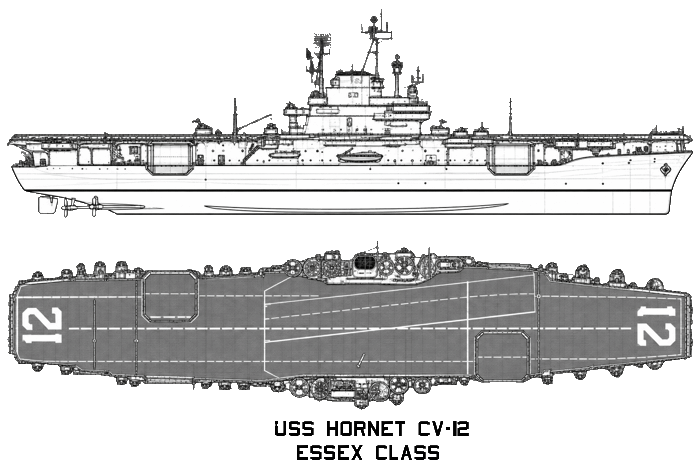
The USS Hornet (CV-12) was an Essex-class aircraft carrier and one of the most distinguished American carriers of the World War II and Cold War eras. Commissioned on November 29, 1943, Hornet displaced about 27,100 tons standard, measured approximately 872 feet overall, had a waterline beam of about 93 feet, and could reach a maximum speed of roughly 33 knots. Her machinery produced approximately 150,000 shaft horsepower through four propeller shafts. Originally designed to carry a large wartime air group of fighters, dive bombers, and torpedo bombers, Hornet fought extensively across the Pacific during World War II. She later underwent modernization that allowed her to continue operating increasingly capable naval aircraft during the Cold War. In 1952, she was redesignated CVA-12, identifying her as an attack aircraft carrier.
The connection between USS Hornet CVA-12 and VA-95 came during the early history of the Second VA-95, the unrelated squadron established on March 26, 1952. After completing its Korean War combat deployment aboard USS Philippine Sea in 1953, VA-95 returned to the Western Pacific aboard Hornet with Carrier Air Group 9 (CVG-9) in 1954. By this time, VA-95 had moved into the powerful Douglas AD Skyraider family, including the improved AD-6 that had begun entering the squadron in 1953. Unlike the previous Korean deployment, VA-95’s Hornet cruise did not involve major wartime combat. Its importance instead came from maintaining carrier readiness and American naval presence in the western Pacific during a tense period of the Cold War, when events in Korea, Communist China, Taiwan, and Indochina made the region strategically important.
The 1954 Hornet deployment came during a major transition in Asian history. The Korean Armistice was barely a year old, while the French war in Indochina was reaching its conclusion with the fall of Dien Bien Phu and the Geneva agreements. Tensions were also building between Communist China and the Nationalist government on Taiwan, leading into the First Taiwan Strait Crisis. Hornet and CVG-9 therefore represented more than routine training; they formed part of a mobile American naval force capable of responding quickly if another regional crisis developed. For the pilots, aircrew, plane captains, aviation machinist’s mates, ordnancemen, avionics technicians, and flight-deck crews of VA-95, the cruise provided valuable experience operating the heavy AD Skyraider from an Essex-class carrier. These operations helped prepare VA-95 for the increasingly demanding Cold War and combat missions that would follow during the 1960s.
VA-95 deployed aboard USS Hornet (CVA-12) from approximately May through December 1954 as part of Carrier Air Group 9 (CVG-9). The squadron’s principal attack aircraft during this period was the Douglas AD Skyraider, with the AD-6 representing the important advanced single-seat attack version entering VA-95 service during this era. The deployment took Hornet and her embarked air group to the Western Pacific, where the carrier conducted fleet exercises, training, readiness operations, and American presence missions rather than sustained combat operations. The Hornet cruise represented the Second VA-95’s next major carrier assignment following its 1952–1953 Korean War deployment aboard USS Philippine Sea. It also continued VA-95’s evolution into a highly capable carrier attack squadron—a path that would eventually take the unit from the AD Skyraider into the A-4 Skyhawk and ultimately into Vietnam War combat operations.
Carrier Hull No. Deployment Dates Aircraft Air Group
USS Hornet CV-12 May. 11–Dec. 12, 1954 AD-6 Skyraider CVG-9
VA-95 Carrier Deployments: USS Oriskany CV-34
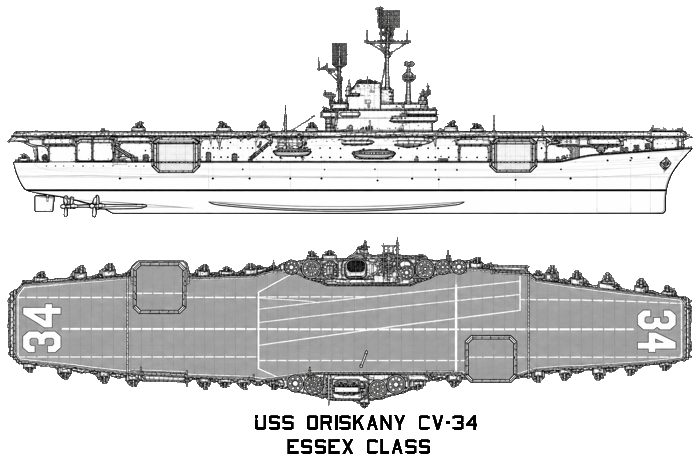
The USS Oriskany (CV-34) was an Essex-class aircraft carrier whose long career stretched from the early Cold War through the Vietnam War. Commissioned on September 25, 1950, Oriskany was approximately 888 feet long, with a waterline beam of about 93 feet, and displaced roughly 27,100 tons standard in her original configuration. Powered by eight boilers feeding four geared steam turbines, the carrier produced approximately 150,000 shaft horsepower and could reach speeds of about 33 knots. Oriskany was completed with improvements over the original wartime Essex design and was later extensively modernized with an angled flight deck, stronger catapults, improved arresting equipment, and other features needed for newer jet aircraft. Known affectionately as the “Mighty O,” Oriskany became especially famous for her later combat service off Vietnam.
The connection between USS Oriskany and VA-95 came during the history of the Second VA-95, the attack squadron established on March 26, 1952. After fighting in the Korean War from USS Philippine Sea and subsequently deploying aboard USS Hornet, VA-95 embarked aboard Oriskany with Carrier Air Group 9 (CVG-9) in February 1956. The squadron was operating the Douglas AD Skyraider, with the AD-6 serving as its principal single-seat attack aircraft during this period. The Skyraider gave VA-95 a remarkable combination of range, endurance, and weapons-carrying capability. Although this deployment did not produce the type of major combat missions VA-95 had flown during the Korean War, it was an important Cold War assignment. VA-95 maintained its ability to deliver conventional weapons from a carrier while conducting flight training, bombing exercises, navigation missions, carrier qualifications, and other fleet-readiness operations.
The 1956 Oriskany deployment took place during a period of growing tension throughout the Western Pacific. The Korean War had ended only three years earlier, Communist China and Nationalist China remained divided across the Taiwan Strait, and events throughout Southeast Asia were becoming increasingly important to American defense planning. Oriskany and CVG-9 provided the U.S. Seventh Fleet with a mobile striking force that could respond quickly if another crisis developed. For VA-95, the cruise also demonstrated why the AD Skyraider remained valuable even as jet aircraft became increasingly common aboard Navy carriers. The AD-6 could carry a heavy assortment of bombs, rockets, guns, and external fuel while remaining airborne for extended periods. The deployment gave VA-95’s pilots, maintenance crews, ordnancemen, plane captains, and flight-deck personnel additional experience that helped prepare the squadron for the changing world of carrier attack aviation.
Carrier Hull No. Deployment Dates Aircraft Air Group
USS Oriskany CV-34 Feb. 6–Jun. 13, 1956 AD-6 Skyraider CVG-9
VA-95 Carrier Deployments: USS Ticonderoga CV-14
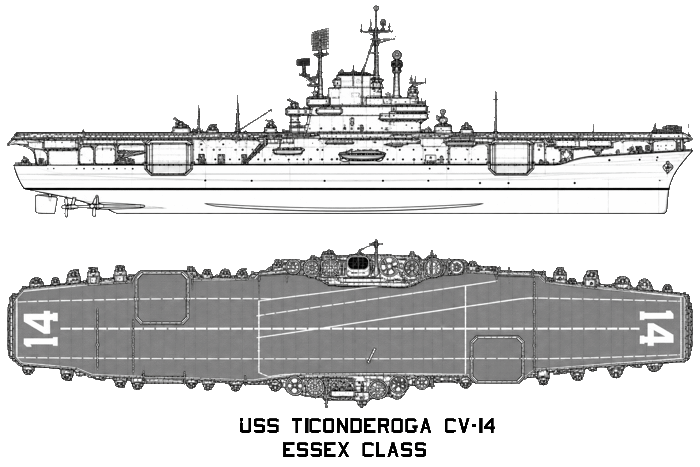
USS Ticonderoga (CV-14) was an Essex-class aircraft carrier commissioned on May 8, 1944, and a veteran of some of the final major campaigns of World War II. Built by Newport News Shipbuilding in Virginia, Ticonderoga was approximately 888 feet long after her postwar modernization, with a waterline beam of about 93 feet and a displacement that increased considerably from her original wartime configuration as new equipment was added. Her steam-turbine power plant developed approximately 150,000 shaft horsepower through four propeller shafts, giving the carrier a maximum speed of about 33 knots. Originally designated CV-14, she became CVA-14, an attack aircraft carrier, on October 1, 1952. Ticonderoga underwent extensive modernization during the 1950s, receiving equipment for operating newer aircraft and, by 1957, an angled flight deck and enclosed hurricane bow. These improvements transformed the World War II carrier into a more capable Cold War attack platform.
The Second VA-95 deployed aboard USS Ticonderoga with Carrier Air Group 9 (CVG-9) during the carrier’s first Western Pacific deployment following her latest modernization. Ticonderoga departed the San Francisco Bay area on September 16, 1957, stopped at Pearl Harbor, and reached Yokosuka, Japan, on October 15. During the following six months, the carrier operated throughout the Western Pacific, ranging from Japan to the Philippines. VA-95 was part of the embarked attack force during a period when American naval planners remained concerned about Communist China, Taiwan, Korea, and the growing political instability of Southeast Asia. No major wartime combat missions were flown by VA-95 during this cruise. Instead, the squadron maintained its attack readiness through carrier operations, bombing and weapons training, navigation exercises, flight qualifications, and exercises with other elements of the U.S. Seventh Fleet.
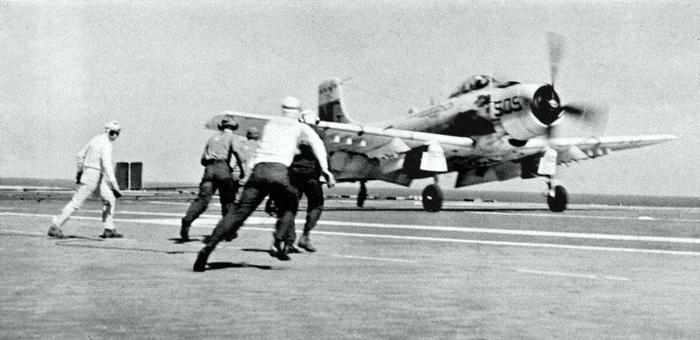
The 1957–1958 cruise represented an important milestone in both Ticonderoga and VA-95 history. Ticonderoga had emerged from modernization better prepared to operate the increasingly sophisticated aircraft entering Naval Aviation, while VA-95 was approaching the end of its long association with propeller-driven attack aircraft. The Douglas AD Skyraider remained an exceptionally useful carrier attack aircraft because of its heavy weapons load, long endurance, and ability to operate effectively from Essex-class carriers. During the deployment, Ticonderoga and other Seventh Fleet forces maintained an American presence in a region where tensions surrounding Taiwan and Communist China remained high.
Carrier Hull No. Deployment Dates Aircraft Air Group
USS Ticonderoga CV-14 Sep. 16, 1957–Apr. 25, 1958 AD-6 Skyraider CVG-9

VA-95 Carrier Deployments: USS Ranger CV-61
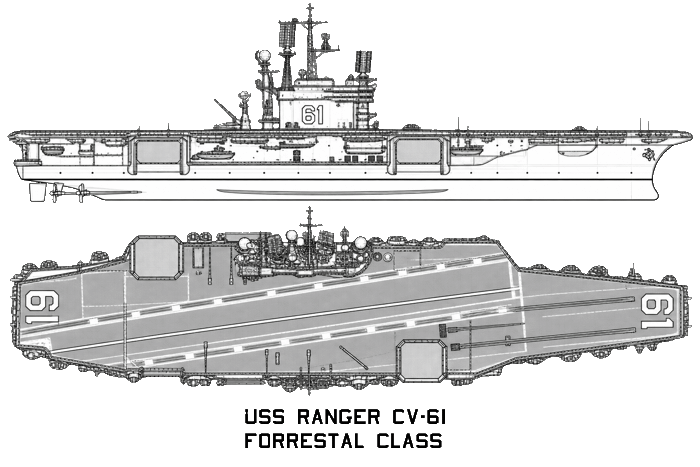
USS Ranger (CVA-61) was a Forrestal-class attack aircraft carrier and one of the first generation of large American carriers designed from the beginning for modern jet operations. Commissioned on August 10, 1957, Ranger displaced approximately 56,300 tons in the configuration listed by the Navy, measured about 1,046 feet long, had an extreme width approaching 250 feet, and could reach approximately 34 knots. Her steam propulsion plant drove four shafts and provided the speed needed to launch and recover increasingly heavy carrier aircraft. Ranger could operate more than 100 aircraft during her early years and became the first Forrestal-class carrier assigned to the Pacific. After arriving at Alameda, California, in August 1958, she spent her career as a Pacific Fleet carrier and became an important platform for U.S. Seventh Fleet operations throughout the Cold War and Vietnam War.
The Second VA-95 developed a particularly important relationship with USS Ranger, making four Western Pacific deployments aboard the carrier between 1960 and 1965. VA-95 operated with Carrier Air Group 9, later redesignated Carrier Air Wing 9, and initially flew the Douglas AD Skyraider. During Ranger’s August 1961–March 1962 deployment, the carrier participated in Operation Bandsaw, a major fleet exercise emphasizing offensive strikes, antiaircraft warfare, antisubmarine warfare, locating enemy surface forces, and avoiding detection. During the November 1962–June 1963 cruise, Ranger participated in Operation Pilot Light and other Seventh Fleet exercises. In May 1963, Ranger moved into the South China Sea in response to a developing crisis in Laos, placing VA-95 and the rest of the air group in position if American air power was required. These deployments gave VA-95 extensive experience operating its heavy Skyraiders from one of the Navy’s newest attack carriers.
The most important Ranger deployment for VA-95 began in August 1964 as the war in Southeast Asia was rapidly expanding. Ranger sailed for the Far East immediately after the Gulf of Tonkin crisis and subsequently became flagship of Fast Carrier Task Force 77. VA-95’s A-1 Skyraiders participated in operations connected with the growing conflict, including reconnaissance-support missions and strikes in Laos. By early 1965, Ranger was operating off Vietnam as American carrier air power became increasingly involved in combat. The carrier spent a then-record 59 continuous days on Yankee Station, and flight operations during portions of April were conducted around the clock. Ranger’s deployment therefore marked a major transition in VA-95 history: the squadron that had fought in Korea and spent much of the following decade conducting Cold War readiness missions was once again operating in a combat environment.
Carrier Hull No. Deployment Dates Aircraft Air Group
USS Ranger CV-61 Feb. 6–Aug. 30, 1960 CVG-9 AD-6/AD-7 Skyraider
USS Ranger CV-61 Aug. 11, 1961–Mar. 8, 1962 CVG-9 AD-6/AD-7 Skyraider
USS Ranger CV-61 Nov. 9, 1962–Jun. 14, 1963 CVG-9 AD-6/AD-7 Skyraider
USS Ranger CV-61 Aug. 5, 1964–May 6, 1965 CVG-9 AD-6/AD-7 Skyraider
VA-95 Carrier Deployments: USS Intrepid CV-11
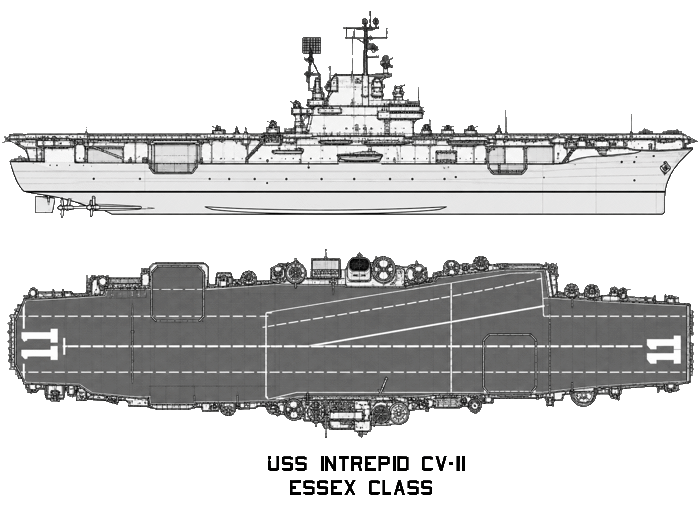
USS Intrepid (CV-11) was an Essex-class aircraft carrier commissioned on August 16, 1943, and a veteran of World War II, the Cold War, and Vietnam War. Originally built as a conventional straight-deck carrier, Intrepid was extensively modernized after World War II and eventually received an angled flight deck, steam catapults, improved arresting equipment, and other modifications needed to operate newer naval aircraft. The carrier measured approximately 872 feet in her original configuration and became longer following modernization, while her original waterline beam was about 93 feet. Her machinery produced approximately 150,000 shaft horsepower through four propeller shafts, giving Intrepid a maximum speed of about 33 knots. The carrier was redesignated CVA-11 in 1952 and later CVS-11 in 1961. Despite being classified as an antisubmarine warfare support carrier, Intrepid was called upon to serve as a light attack carrier during the Vietnam War.
The connection between USS Intrepid and VA-95 began during the Second VA-95’s transition from the propeller-driven A-1 Skyraider to the Douglas A-4 Skyhawk. VA-95 deployed aboard Intrepid in 1966 as part of Carrier Air Wing 10 (CVW-10), flying the A-4B Skyhawk. This represented a major technological change for the squadron. VA-95 had fought in Korea with AD Skyraiders and had continued flying the Skyraider during its early Vietnam operations from USS Ranger. From Intrepid, the squadron now took the compact jet-powered A-4B into combat over Southeast Asia. Intrepid’s air group conducted strikes against enemy positions, transportation networks, supply routes, and other military targets while supporting U.S. operations in Vietnam. The carrier also demonstrated the high tempo possible with its mixed Skyhawk and Skyraider air group. During the cruise, Intrepid launched nine A-4 Skyhawks and six A-1 Skyraiders loaded with bombs and rockets in only seven minutes, with intervals as short as 28 seconds between launches.
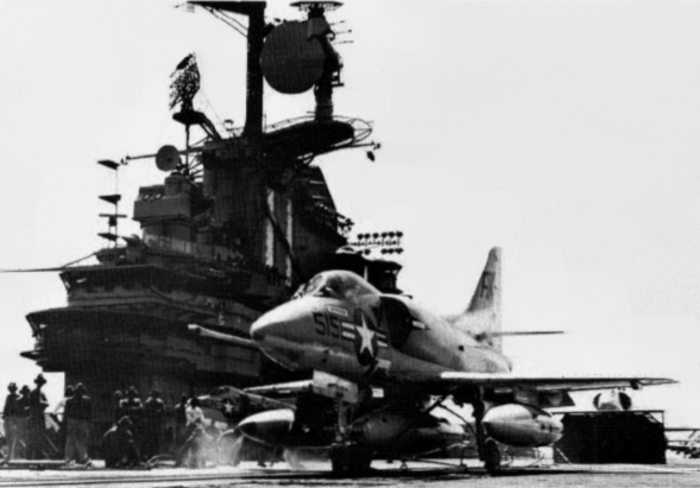
The 1966 Intrepid deployment was an important milestone in VA-95 history because it demonstrated that the squadron had successfully moved into the jet-powered attack era while remaining an experienced combat organization. Intrepid departed for the Western Pacific on April 4, 1966, and spent much of the deployment operating with the U.S. Seventh Fleet off Vietnam, including operations associated with Dixie Station and Yankee Station. The carrier’s aircraft conducted sustained combat missions while the ship periodically visited Subic Bay, Yokosuka, Sasebo, and Hong Kong for maintenance, supplies, and crew rest. Intrepid completed seven months of service with the Seventh Fleet before returning home.
Carrier Hull No. Deployment Dates Aircraft Air Group
USS Intrepid CV-11 Apr. 4–Nov. 21, 1966 CVW-10 A-4B Skyhawk
VA-95 Carrier Deployments: USS Shangri-La CV-38
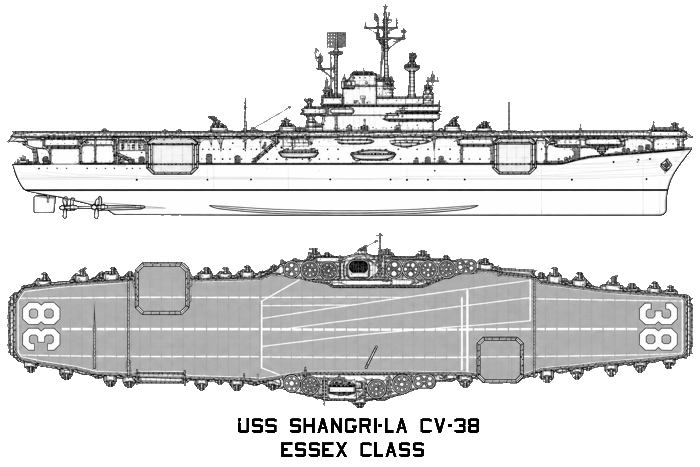
USS Shangri-La (CV-38) was an Essex-class aircraft carrier commissioned on September 15, 1944, and named in reference to President Franklin D. Roosevelt’s famous description of the supposed launching point for the 1942 Doolittle Raid. Built at Norfolk Navy Yard, Shangri-La entered combat during the closing months of World War II and later became an important Cold War attack carrier. In her original configuration, she displaced about 27,100 tons standard, measured approximately 888 feet overall, and had a waterline beam of about 93 feet. Her eight boilers and four geared steam turbines produced approximately 150,000 shaft horsepower through four propeller shafts, allowing a maximum speed of about 33 knots. During the 1950s, Shangri-La underwent major SCB-125 modernization, receiving an angled flight deck, enclosed hurricane bow, improved aircraft handling equipment, and other changes that allowed her to operate newer jet aircraft. She was redesignated CVA-38 in 1952 and became a familiar part of American carrier operations during the Cold War.
USS Shangri-La became part of VA-95 history when the Second VA-95 deployed aboard the carrier with Carrier Air Wing 8 (CVW-8) in November 1967. By this period VA-95 had transitioned from the Douglas A-1 Skyraider to the jet-powered Douglas A-4 Skyhawk, the aircraft that carried the squadron through the final years of its existence. Unlike VA-95’s previous combat deployment aboard USS Intrepid in 1966, the Shangri-La cruise was primarily a Mediterranean deployment with the U.S. Sixth Fleet rather than a Vietnam combat cruise. This was nevertheless an important assignment. The Mediterranean was one of the major Cold War confrontation zones, where U.S. and Soviet naval forces watched one another closely while American carriers remained ready to respond to political or military crises in Europe, North Africa, and the Middle East.
The 1967–1968 deployment came at a particularly tense time. The Arab-Israeli Six-Day War had ended only months before Shangri-La arrived in the Mediterranean, while the Soviet Navy was expanding its presence in the region. Shangri-La and CVW-8 therefore provided the Sixth Fleet with a powerful mobile air component capable of responding rapidly if another crisis developed.
Carrier Hull No. Deployment Dates Aircraft Air Group
USS Shangri-La CV-38 Nov. 15, 1967–Aug. 4, 1968 CVW-8 A-4B Skyhawk
VA-95 Carrier Deployments: USS John F. Kennedy CV-67
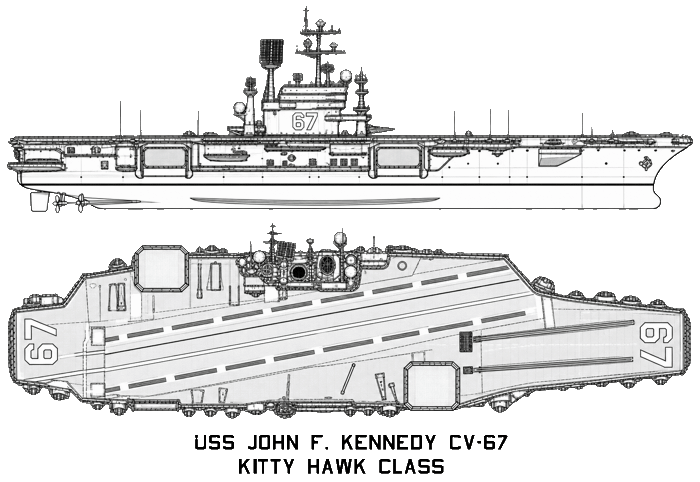
The USS John F. Kennedy (CVA-67) was a conventionally powered Kitty Hawk class aircraft carrier built by Newport News Shipbuilding and commissioned on September 7, 1968. Often called “Big John,” Kennedy was approximately 1,052 feet long, had a flight deck width of about 252 feet, displaced more than 60,000 tons at full load, and could reach speeds exceeding 30 knots. The carrier was powered by eight boilers supplying steam to four geared turbines connected to four propeller shafts. Although closely related to the Kitty Hawk-class carriers, John F. Kennedy incorporated enough design differences that she is sometimes described as a modified Kitty Hawk or a one-ship subclass. Her angled flight deck, steam catapults, large aircraft elevators, and modern aviation facilities allowed her to operate a powerful mixture of fighters, attack aircraft, reconnaissance planes, and support aircraft. Originally designated CVA-67 as an attack aircraft carrier, Kennedy was redesignated CV-67 in 1975.
USS John F. Kennedy became an important part of VA-95 history during the carrier’s first operational deployment. Kennedy departed Norfolk on April 14, 1969, for Mediterranean service with the U.S. Sixth Fleet, carrying Carrier Air Wing 1 (CVW-1). VA-95 was one of the attack squadrons assigned to the air wing, making this cruise particularly significant: an attack squadron established in 1952 was now operating from one of the Navy’s newest aircraft carriers. As Kennedy crossed the Atlantic, the carrier was already receiving attention from the Soviet Union. On April 20, Soviet Tu-95 Bear reconnaissance aircraft approached and photographed the ship, while Soviet naval vessels also monitored the carrier. Kennedy reported to the Sixth Fleet the following day. VA-95 subsequently participated in the demanding routine of Cold War carrier operations, including flight training, navigation, weapons practice, simulated attack missions, carrier qualifications, and multinational fleet exercises.
The 1969 deployment was especially important because it became the final major cruise of the Second VA-95. The squadron had been established on March 26, 1952, and had begun its history with the Grumman F6F-5 Hellcat before quickly moving into the Douglas AD Skyraider. VA-95 fought during the Korean War from USS Philippine Sea, operated Skyraiders from USS Hornet, USS Oriskany, USS Ticonderoga, and USS Ranger, and returned to combat during the Vietnam era. By the mid-1960s, VA-95 had transitioned to the Douglas A-4 Skyhawk, taking the jet-powered attack aircraft to sea aboard USS Intrepid, USS Shangri-La, and finally USS John F. Kennedy. The Kennedy cruise did not produce the major combat missions associated with VA-95’s Korean and Vietnam deployments, but it placed the squadron on the front line of the Cold War Mediterranean, where American and Soviet naval forces routinely observed one another and prepared for a conflict both sides hoped to avoid.
Carrier Hull No. Deployment Dates Aircraft Air Group
USS John F. Kennedy CVA-67 Nov. 1–Dec. 17, 1968 CVW-1 A-4C Skyhawk
USS John F. Kennedy CVA-67 Apr. 5–Dec. 21, 1969 CVW-1 A-4C Skyhawk
VA-95 Carrier Deployments: USS Coral Sea CV-43
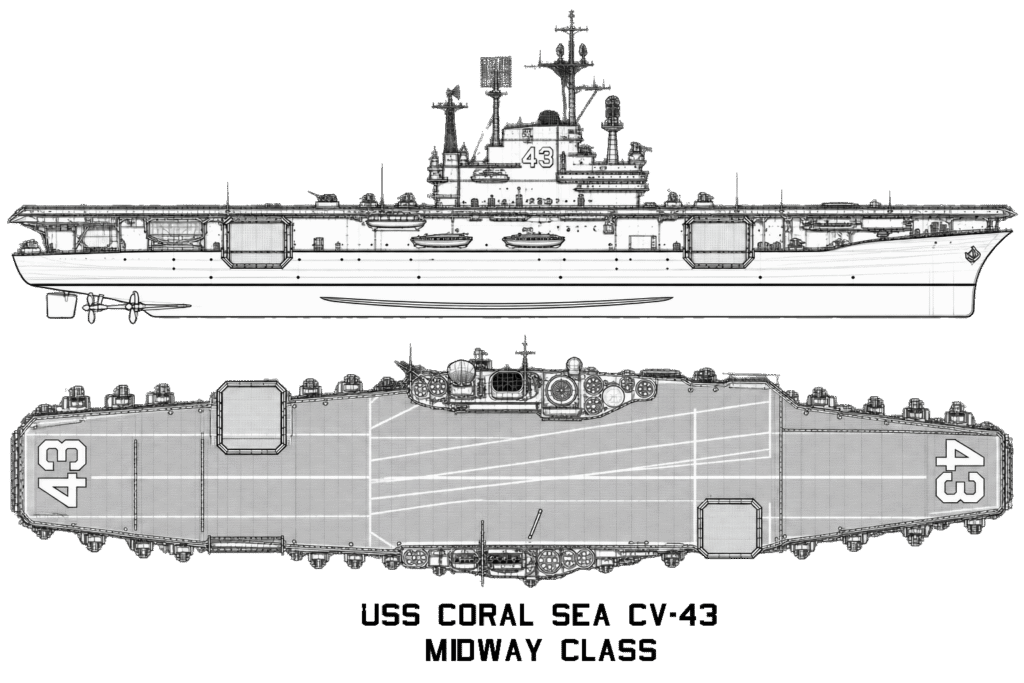
The USS Coral Sea (CV-43) was a Midway-class aircraft carrier and one of the largest American carriers constructed during World War II. Commissioned on October 1, 1947, Coral Sea was approximately 968 feet long following modernization, had a flight deck about 238 feet wide, displaced more than 60,000 tons at full load in her later configuration, and could reach approximately 33 knots. Her steam propulsion plant developed about 212,000 shaft horsepower and drove four propeller shafts. Originally commissioned as CVB-43, she became CVA-43 in 1952 and was redesignated CV-43 in 1975. Major postwar modernization gave Coral Sea an angled flight deck, steam catapults, improved arresting equipment, and other systems needed to operate modern jet aircraft. Nicknamed the “Ageless Warrior,” Coral Sea served through the Korean War era, Vietnam War, Cold War, and Persian Gulf operations before being decommissioned in 1990.
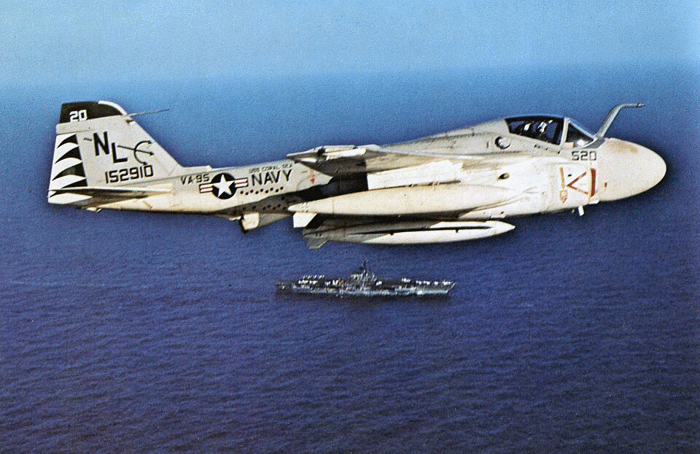
USS Coral Sea played an especially important role in the history of the Third VA-95, the Green Lizards, established at NAS Whidbey Island on April 1, 1972. Assigned to Carrier Air Wing 15 (CVW-15), VA-95 made its first deployment aboard Coral Sea in 1973 flying the Grumman A-6A Intruder, specialized A-6B, and KA-6D tanker. During that cruise, VA-95 supported Operation End Sweep, the effort to clear mines from North Vietnamese waters following the Paris Peace Accords. The squadron returned to Coral Sea for the historic 1974–1975 deployment. During Operation Frequent Wind on April 29–30, 1975, VA-95 Intruders flew armed escort missions over the Saigon area while helicopters evacuated Americans and endangered South Vietnamese as the city fell. Only two weeks later, Coral Sea was ordered toward Cambodia after Khmer Rouge forces seized the American merchant ship SS Mayaguez. On May 15, VA-95 A-6As participated in strikes against Cambodian military facilities, including targets around Ream, while KA-6D tankers supported the air operation. These missions placed the Green Lizards at the center of two of the final dramatic American military operations associated with the long conflict in Southeast Asia.
The Coral Sea years also marked VA-95’s transition from the early Intruder into the more capable A-6E. During the 1975 operations over South Vietnam and Cambodia, the squadron was still flying the A-6A rather than the A-6E—a distinction that is sometimes lost in later accounts of VA-95 history. The Green Lizards did not receive their first A-6E until February 4, 1976. When VA-95 returned to Coral Sea for its 1977 deployment, the squadron had entered the A-6E era while retaining the KA-6D aerial-refueling mission. The A-6E’s improved navigation and attack systems strengthened VA-95’s ability to conduct long-range, all-weather strikes from the carrier. These three Coral Sea cruises therefore covered a remarkable transition: VA-95 began its operational deployment history aboard the carrier, participated in the closing chapter of the Vietnam era, flew combat missions during the Mayaguez crisis, and then returned with the aircraft that would define the Green Lizards for the remainder of their existence.
Carrier Hull No. Deployment Dates Aircraft Air Group
USS Coral Sea CVA-43 Mar. 1973 – Nov. 1973 CVW-15 A-6A / KA-6D
USS Coral Sea CVA-43 Dec. 1974 – Jul. 1975 CVW-15 A-6A / KA-6D
USS Coral Sea CVA-43 Feb. 1977 – Oct. 1977 CVW-15 A-6A / KA-6D
VA-95 Carrier Deployments: USS America CV-66
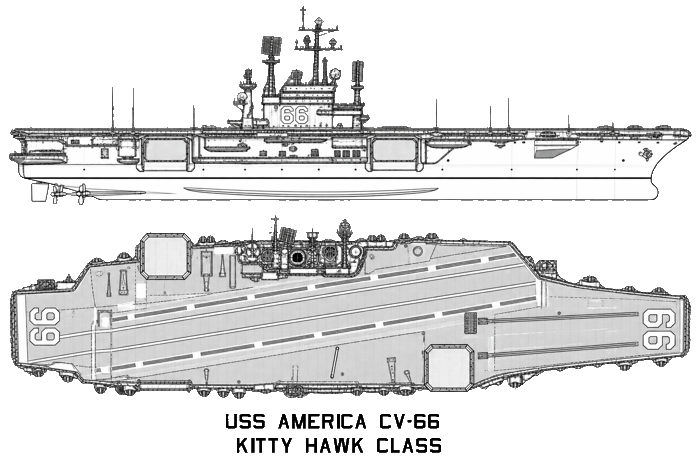
USS America (CV-66) was a Kitty Hawk-class aircraft carrier built by Newport News Shipbuilding and commissioned on January 23, 1965. Designed for high-tempo jet operations, America measured approximately 1,048 feet in overall length, had a flight deck roughly 248 feet across at its widest point, displaced more than 60,000 tons at full load, and could reach speeds exceeding 30 knots. Eight boilers supplied steam to four geared turbines producing approximately 280,000 shaft horsepower and driving four propeller shafts. Four steam catapults, an angled flight deck, four aircraft elevators, and modern arresting equipment allowed America to launch and recover a powerful combination of fighters, attack aircraft, reconnaissance planes, electronic-warfare aircraft, and support aircraft. Unlike the Navy’s emerging nuclear-powered carriers, America remained conventionally powered throughout her career, serving extensively in the Atlantic, Mediterranean, Indian Ocean, and Persian Gulf regions.
USS America became part of VA-95 history after the Green Lizards moved from Carrier Air Wing 15 to Carrier Air Wing 11 (CVW-11) Beginning a 16 year relationship with the air wing. VA-95 deployed aboard America in 1979 and again in 1981, operating the Grumman A-6E Intruder along with the KA-6D tanker capability associated with the Intruder community. The Green Lizards’ A-6Es gave CVW-11 a long-range, all-weather strike capability, while the KA-6D provided vital aerial refueling that extended the range and endurance of other carrier aircraft.
The America deployments also marked an important technological period for VA-95. By 1981, the squadron was operating the improved A-6E TRAM Intruder, equipped with the Target Recognition Attack Multi-Sensor system. TRAM combined advanced sensors with the Intruder’s already capable navigation and attack systems, improving the crew’s ability to detect, identify, track, and attack targets at night and in poor weather. Although VA-95 did not fight a major shooting war from America during these two deployments, the squadron maintained constant readiness for precisely that possibility. Its pilots and bombardier-navigators practiced long-range attack, low-level navigation, weapons delivery, and all-weather operations.
Carrier Hull No. Deployment Dates Aircraft Air Group
USS America CV 66 Mar. 1979 – Sep. 1979 CVW-11 A-6E/KA-6D
USS America CV 66 Apr. 1981 – Nov.1981 CVW-11 A-6E/KA-6D
VA-95 Carrier Deployments: USS Enterprise CVN-65
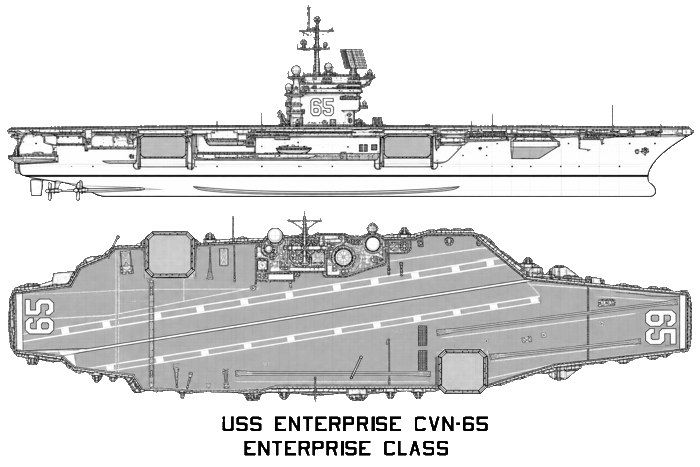
The USS Enterprise (CVN-65), famously known as the “Big E,” was the world’s first nuclear-powered Enterprise class aircraft carrier and the only one of it’s kind. The Enterprise is one of the most recognizable warships in U.S. Navy history. Commissioned on November 25, 1961, Enterprise measured approximately 1,123 feet long, had a flight deck about 252 feet wide, displaced more than 90,000 tons at full load in her later configuration, and could exceed 30 knots. Her most unusual engineering feature was a power plant consisting of eight nuclear reactors feeding four propulsion plants and four propeller shafts, giving the carrier exceptional endurance without the need to carry conventional propulsion fuel. Enterprise’s four steam catapults and massive flight deck allowed her to operate fighters, attack aircraft, reconnaissance aircraft, electronic-warfare aircraft, tankers, and support aircraft. During a career spanning more than half a century, Enterprise served in the Cuban Missile Crisis, Vietnam War, Cold War, operations in the Persian Gulf, and the wars that followed the September 11 attacks.
USS Enterprise became one of the most important carriers in the history of the Third VA-95 Green Lizards. Assigned to Carrier Air Wing 11 (CVW-11), VA-95 made five major deployments aboard Enterprise between 1982 and 1990, flying the Grumman A-6E Intruder. These cruises took the squadron throughout the Pacific and Indian Oceans and repeatedly placed it near areas of international tension. One memorable milestone came during the 1986 deployment, when Enterprise operated extensively in the western Pacific and Indian Ocean and became the first nuclear-powered aircraft carrier to transit the Suez Canal. The most important VA-95 Enterprise deployment, however, came in 1988. Enterprise deployed to waters near the Persian Gulf while American naval forces were protecting shipping during Operation Earnest Will missions. When USS Samuel B. Roberts struck an Iranian mine on April 14, 1988, the United States prepared a major naval response. Four days later on April 18th 1988, VA-95 went into combat during Operation Praying Mantis.
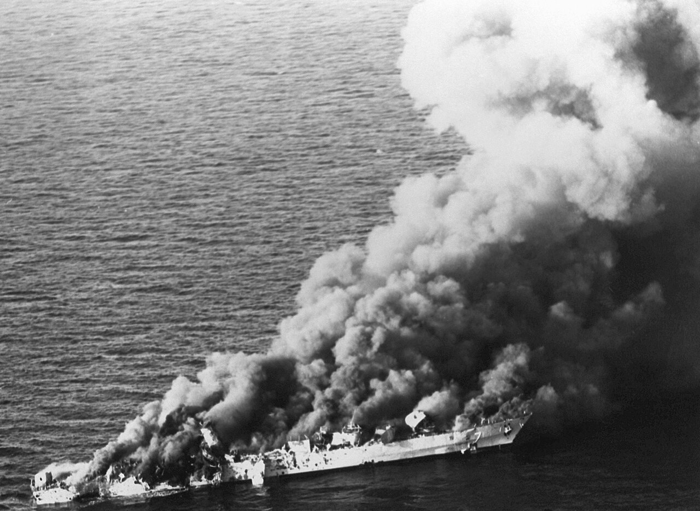
On April 18, 1988, VA-95 A-6E Intruders participated in one of the largest U.S. Navy surface engagements since World War II. Green Lizard Intruders attacked Iranian Revolutionary Guard Boghammar speedboats with Mk 20 Rockeye cluster bombs, destroying or damaging enemy craft. Later, two VA-95 A-6Es encountered the Iranian frigate Sahand. After IRIS Sahand fired on the American aircraft, the Intruders attacked with Harpoon anti-ship missiles and precision-guided weapons while USS Joseph Strauss also fired a Harpoon. IRIS Sahand was left burning and eventually sank. Another Iranian frigate, IRIS Sabalan, subsequently fired at VA-95 aircraft. A Green Lizard A-6E responded with a 500-pound laser-guided bomb that struck and disabled the ship. American commanders ordered that IRIS Sabalan not be attacked further, and the damaged frigate was later towed away. The battle demonstrated again, exactly what the A-6E had been designed to do: find and attack difficult targets at long range while operating from a carrier far from American shores. Several VA-95 aviators received the Distinguished Flying Cross for their actions during the battle, making Operation Praying Mantis one of the defining moments in Green Lizard history.
Carrier Hull No. Deployment Dates Aircraft Air Group
USS Enterprise CVN-65 Sep. 1982 – Apr. 1983 CVW-11 A-6E/KA-6D
USS Enterprise CVN-65 May 1984 – Dec. 1984 CVW-11 A-6E/KA-6D
USS Enterprise CVN-65 Jan. 1986 – Aug. 1986 CVW-11 A-6E/KA-6D
USS Enterprise CVN-65 Jan. 1988 – Jul. 1988 CVW-11 A-6E/KA-6D
USS Enterprise CVN-65 Sept. 1989 – Mar. 1990 CVW-11 A-6E/KA-6D
VA-95 Carrier Deployments: USS Abraham Lincoln CVN-72
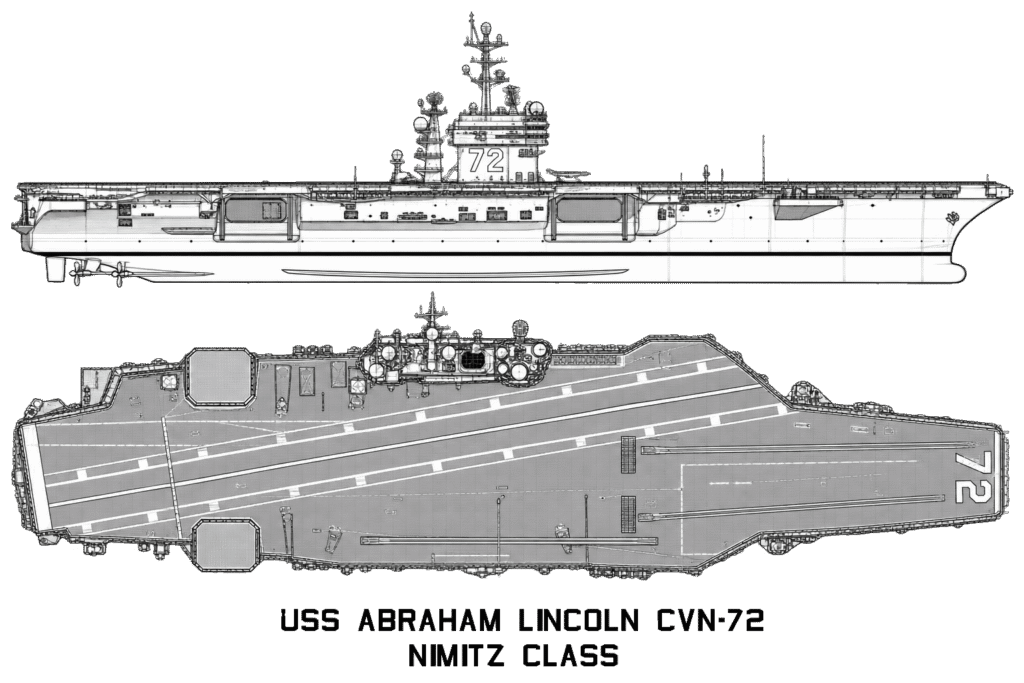
The USS Abraham Lincoln (CVN-72) is a Nimitz-class nuclear-powered aircraft carrier built by Newport News Shipbuilding and commissioned on November 11, 1989. Known throughout the fleet as “Abe,” the carrier is approximately 1,092 feet long, has a flight deck about 252 feet wide, and displaces roughly 100,000 tons at full load. Two nuclear reactors power four steam turbines connected to four propeller shafts, providing a maximum speed officially listed as more than 30 knots. Four steam catapults and four aircraft elevators support continuous launch and recovery operations from the angled flight deck. The ship was designed to operate an air wing of fighters, attack aircraft, electronic-warfare aircraft, airborne early-warning aircraft, helicopters, and support aircraft. Abraham Lincoln represented a major technological step forward from the older carriers from which VA-95 had previously operated and became the final aircraft carrier associated with the Green Lizards before the squadron’s disestablishment.
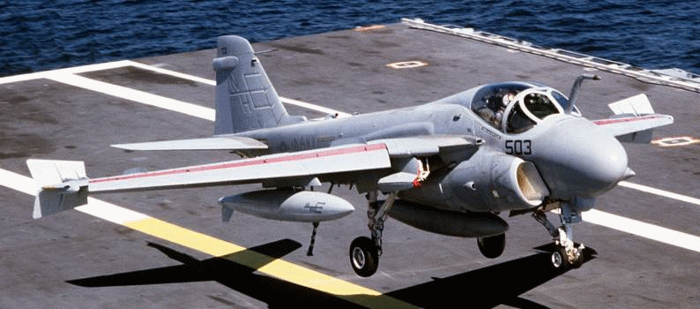
USS Abraham Lincoln became part of VA-95 history during the early 1990s when the Green Lizards and Carrier Air Wing 11 (CVW-11) transferred from USS Enterprise to the newer nuclear-powered carrier. VA-95 operated the Grumman A-6E Intruder, by then equipped with increasingly sophisticated navigation, attack, and precision-strike capabilities. The squadron participated in Abraham Lincoln’s early workups and then deployed aboard the carrier in 1991, 1993, and 1995. One of the most significant events of the 1991 cruise came after the eruption of Mount Pinatubo in the Philippines. Abraham Lincoln was diverted to support Operation Fiery Vigil, the evacuation of thousands of U.S. military personnel, dependents, and other evacuees from the affected area. Later cruises took the carrier and CVW-11 into the Persian Gulf and other strategically important regions during the unsettled years following Operation Desert Storm.
The Abraham Lincoln years represented both the peak and the end of VA-95’s A-6E era. During the 1993 and 1995 deployments, the Green Lizards provided CVW-11 with long-range, all-weather attack capability at a time when American carrier forces were enforcing post-Gulf War policies and maintaining a continuing presence in the Persian Gulf region. By then, however, the Navy was reducing the A-6 Intruder force as part of the post-Cold War drawdown. This decision placed VA-95 among the attack squadrons scheduled for elimination despite the Intruder’s proven ability to deliver heavy weapons over long distances in poor weather. The 1995 Abraham Lincoln cruise consequently became the Green Lizards’ final overseas deployment.
After returning home, VA-95 reached the end of more than two decades of service by the Third squadron to carry the VA-95 designation. The squadron was officially disestablished on October 31, 1995, with a disestablishment ceremony held on November 18, closing a chapter that had begun at NAS Whidbey Island on April 1, 1972.
Carrier Hull No. Deployment Dates Aircraft Air Group
USS Abraham Lincoln CVN-72 Sep.1990–Nov.1990 CVW-11 A-6E/KA-6D
USS Abraham Lincoln CVN-72 May 1991–Nov. 1991 CVW-11 A-6E/KA-6D
USS Abraham Lincoln CVN-72 Jun. 1993–Dec. 1993 CVW-11 A-6E/KA-6D
USS Abraham Lincoln CVN-72 Apr, 1995–Oct. 1995 CVW-11 A-6E/KA-6D
Once a Lizard, always a Lizard.

Want more Green Lizard articles like this? Subscribe to our VA-95 All Weather Attack newsletter today and get VA-95-focused news, announcements, and website updates delivered straight to your inbox.