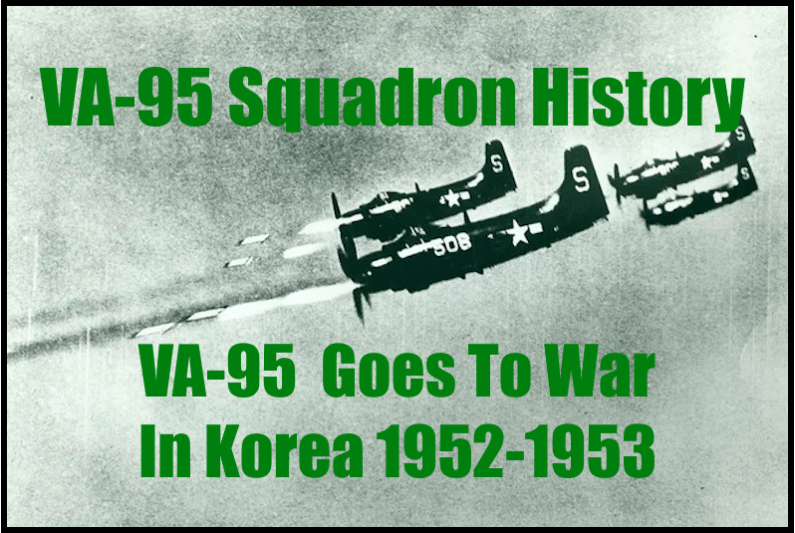
VA-95 In The Korean War began in the Korean War (1950–1953). The Korean War was a major Cold War conflict that began when North Korean forces invaded South Korea on June 25, 1950. United Nations forces, led by the United States, entered the war to defend South Korea, while China later intervened in support of North Korea. The fighting was intense and included large ground battles, air combat, and extensive naval operations along the Korean coast. U.S. Navy aircraft carriers played a major role by launching strikes against enemy troops, supply lines, transportation networks, and military positions. The war ended with an armistice on July 27, 1953, but no formal peace treaty was signed, leaving the Korean Peninsula divided near the 38th parallel.
The VA-95 history during the Korean War is a relatively short but important chapter in the story of Attack Squadron 95. Established while the war was already underway, the second squadron to carry the VA-95 designation quickly moved from organization and training to combat operations off the Korean Peninsula.
Attack Squadron 95 was established on March 26, 1952, at Naval Air Station Alameda, California. This was a new VA-95, not a reactivation of the earlier squadron whose lineage had begun with Torpedo Squadron Twenty during World War II and VA-10A in the interim..
Within nine months of its establishment, VA-95 was heading to war.
Assigned to Carrier Air Group Nine (CVG-9), VA-95 deployed aboard USS Philippine Sea (CVA-47) with the rugged Douglas AD Skyraider. The squadron’s Korean War deployment lasted from December 15, 1952, through August 14, 1953, carrying VA-95 through the final months of the conflict.
VA-95 In The Korean War: A New VA-95 Is Established During the Korean War In 1952
This is the start of the 2nd era of VA-95 which ran from the 26th of March 1952 and continued on to 1 April 1970
VA-95 Was Not Yet the Green Lizards. There is another historical detail worth noting. Veterans today strongly associate VA-95 with the name Green Lizards, but the squadron would not use that nickname until 1963.
The VA-95 that fought in Korea was established at NAS Alameda on March 26, 1952. The squadron initially received F6F-5 Hellcats in April 1952. The propeller-driven F6F-5 Hellcats served in an interim transition period before quickly adopting Douglas AD Skyraiders starting in May 1952
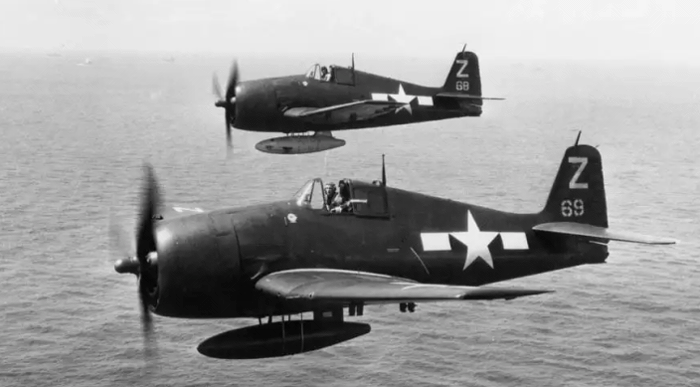
VA-95’s time with the F6F-5 was primarily for training and fleet transition rather than frontline combat deployment in the Korean theater.
VA-95 started recieving the Douglas AD-1 Skyraider in May. As VA-95 prepared for deployment, newer Skyraider variants arrived: the AD-4NA in July, AD-4 in September, and AD-4L in October 1952.
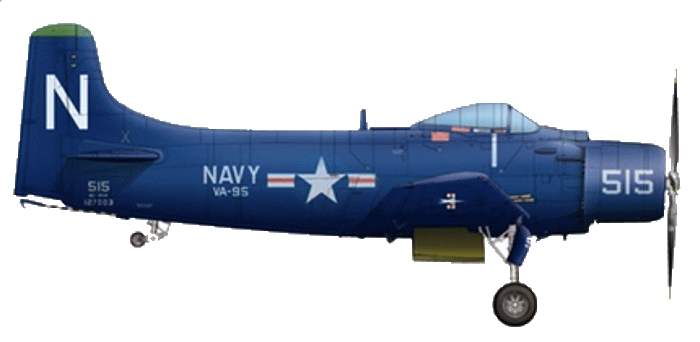
That rapid progression tells us something about the squadron’s first year.
VA-95 wasn’t being formed for routine peacetime operations. The United States was fighting a war, and the new squadron needed to become combat-ready quickly. Its primary weapon would be one of the toughest attack aircraft ever to operate from an American carrier.
VA-95 In The Korean War: The VA-95 Aircraft
The aircraft most closely associated with VA-95’s Korean combat deployment was the Douglas AD Skyraider. The squadron operated AD-4, AD-4L, and AD-4NA Skyraiders during its deployment aboard USS Philippine Sea. The AD was almost perfectly suited for the type of fighting taking place in Korea.
While jet fighters were becoming increasingly important, the piston-powered Skyraider offered several advantages for attack missions. It could carry a heavy load of bombs and rockets, remain over the battlefield for extended periods, and operate effectively at the lower speeds required for accurate attacks against ground targets.
The Skyraider was powered by the massive Wright R-3350 radial engine. Its combination of range, endurance, firepower, and rugged construction made the AD an effective carrier-based attack aircraft. VA-95’s ADs would be called upon to attack transportation networks, military positions, supply routes, vehicles, and other targets supporting enemy forces.
There was nothing elegant about the mission.
- Find the target.
- Put ordnance on it.
- Return to the carrier.
During our tour in Korea, VA-95 was employed in the close air support mission along the entire Korean front. VA-95 dropped almost 6,000,000 pounds of bombs on the enemy, inflicting damage on:
- 466 building destroyed
- 272 building damaged
- 3,485 yards of front line trench destroyed
- 900 yards of front line trench damaged
- and12 oxcarts
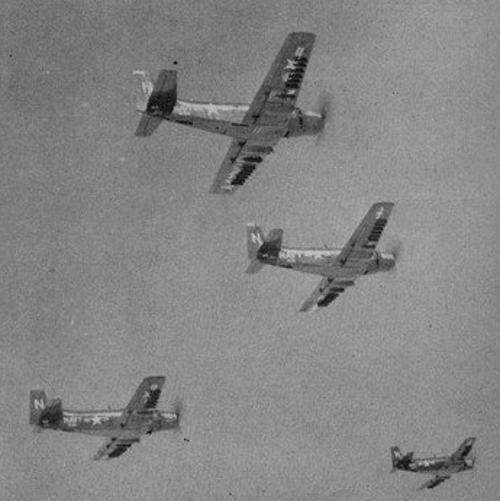
Unlike later periods of VA-95 history, the squadron made one combat carrier deployment during the Korean War from December 15, 1952 – August 14, 1953
The timing placed VA-95 in combat during the final seven months of active fighting. The Korean Armistice Agreement was signed on July 27, 1953, bringing the major fighting to an end. VA-95 remained deployed aboard Philippine Sea until August 14.
VA-95 In The Korean War: The USS Philippine Sea-VA-95’s Korean War Aircraft Carrier
The ship at the center of VA-95’s Korean War story was the USS Philippine Sea CV-47. Commissioned in 1946, the Philippine Sea was an Essex-class aircraft carrier. By the Korean War she had already accumulated considerable combat experience.
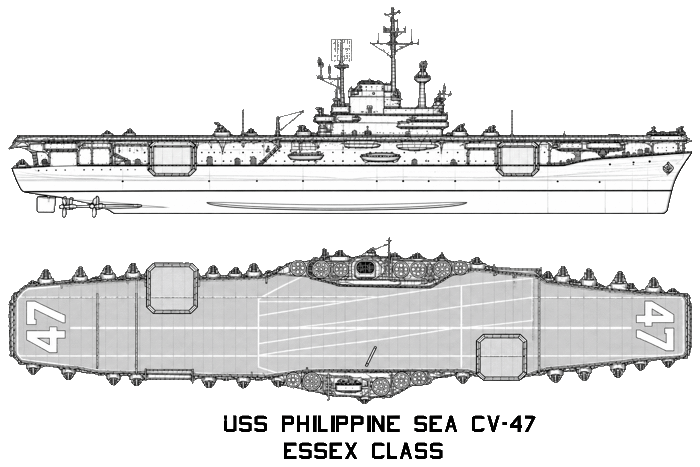
VA-95 embarked aboard Philippine Sea as part of Carrier Air Group Nine for the carrier’s 1952–1953 Korean deployment. The deployment began on December 15, 1952, and ended on August 14, 1953.
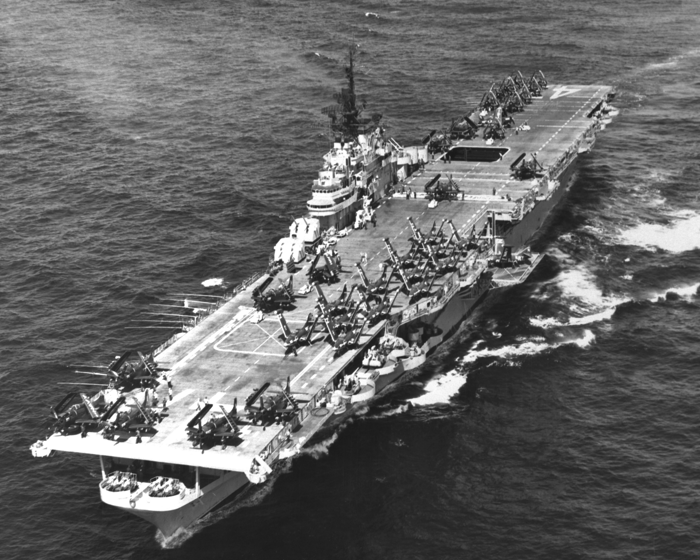
A U.S. Navy photograph taken on May 3, 1953, provides a remarkable snapshot of the carrier and its air group during the war. Among the aircraft visible on Philippine Sea’s flight deck are six VA-95 AD-4, AD-4NA, and AD-4L Skyraiders.
During Philippine Sea’s Korean deployment, the air group included fighter, attack, night/all-weather, reconnaissance, airborne early warning, and helicopter elements. Alongside VA-95’s Skyraiders were aircraft such as F9F Panthers, F4U Corsairs, specialized AD Skyraider variants, and helicopters. Contemporary Korean War order-of-battle records identify VA-95 aboard Philippine Sea with AD-4-series aircraft and the air group’s N tail code.
Together these squadrons gave the carrier a flexible striking force that could respond to different missions over Korea. For VA-95, the mission centered on attack. And the Skyraider was built for it.
VA-95 In The Korean War: Recognition for VA-95’s Korean Service
VA-95’s Korean combat service also brought unit recognition.
- Squadron records list the Korean Presidential Unit Citation for the period January 25 through July 27, 1953.
- Attack Squadron 95 (VA-95) earned the Republic of Korea Presidential Unit Citation for service performed as part of Carrier Air Group 9 (CVG-9) aboard the aircraft carrier USS Philippine Sea (CVA-47) during the final phases of the Korean
- They also list the Navy Unit Commendation for January 31 through July 27, 1953.
Those dates cover almost the entire combat portion of VA-95’s Korean deployment.
Veterans today strongly associate VA-95 with the name Green Lizards, but the squadron was not yet using that nickname during the Korean War.
The squadron’s knight’s helmet insignia was approved in January 1957, and the Skyknights nickname is associated with the 1957–1963 period. The Green Lizards name followed later, beginning in the 1960s.
So referring to the Korean War VA-95 simply as the Green Lizards can create a historical anachronism.
The sailors who fought from Philippine Sea helped build the squadron history that later generations of Green Lizards inherited, but the familiar Green Lizard identity had not yet developed..
VA-95 In The Korean War: The Commanding Officers
The available squadron histories identify the following officers as commanding VA-95 during the Korean War period.
LCDR Samuel B. Berrey — 1952–1953
Lieutenant Commander Samuel B. Berrey assumed command when VA-95 was established on March 26, 1952. He therefore led the squadron through its formation, training, transition into the Skyraider, and deployment aboard USS Philippine Sea.
Records from the Defense POW/MIA Accounting Agency identify CDR S. B. Berry/Berrey of VA-95 flying an AD-4, BuNo 128985, in an incident on June 7, 1953, during the Philippine Sea deployment; he was rescued.
LT L. Wilson — Acting Commanding Officer, 1953
Squadron command listings identify Lieutenant L. Wilson as acting commanding officer during part of 1953.
CDR David L. Berrey — 1953
Commander David L. Berrey is listed as assuming command during 1953. A more detailed secondary chronology places his assumption of command in approximately August 1953, around the end of the Korean deployment.
Because surviving online sources differ in the precision of these command dates, the safest historical listing is:
Period Commanding Officer
1952–1953 LCDR Samuel B. Berrey
1953 LT L. Wilson — Acting CO
1953 onward CDR David L. Berrey
This distinction is important when documenting VA-95 history: some sources provide only the year in which command changed, rather than the exact date.
Remembering VA-95 in Korea
The Korean War chapter of VA-95 history lasted only a small portion of the squadron’s overall existence, but it established an important combat tradition. VA-95 went from being established at NAS Alameda in March 1952 to deploying aboard an aircraft carrier headed for war before the end of that same year. Its sailors and pilots operated the powerful AD Skyraider from USS Philippine Sea, fought through the final months of the Korean War, and earned unit recognition for their service.
Later generations would fly newer Skyraiders, A-4 Skyhawks, and eventually the A-6 Intruder. They would serve aboard different carriers and fight in different parts of the world.
But the sailors of VA-95 who went to Korea in 1952–1953 helped establish the combat reputation that became part of the squadron’s larger story. For today’s VA-95 veterans, their Korean War predecessors deserve to be remembered as an important early chapter in the history behind the number 95.
After Korea: VA-95 Continued With the AD Skyraider
The Korean Armistice didn’t end VA-95. The squadron remained active and continued operating versions of the Skyraider. In October 1953, VA-95 began receiving the improved AD-6 Skyraider, later redesignated the A-1H.
To the VA-95 sailors and aviators who served aboard USS Philippine Sea during the Korean War: Fair winds, following seas, and thank you for your service.
Once a Lizard, always a Lizard.

Want more Green Lizard articles like this? Subscribe to our VA-95 All Weather Attack newsletter today and get VA-95-focused news, announcements, and website updates delivered straight to your inbox.