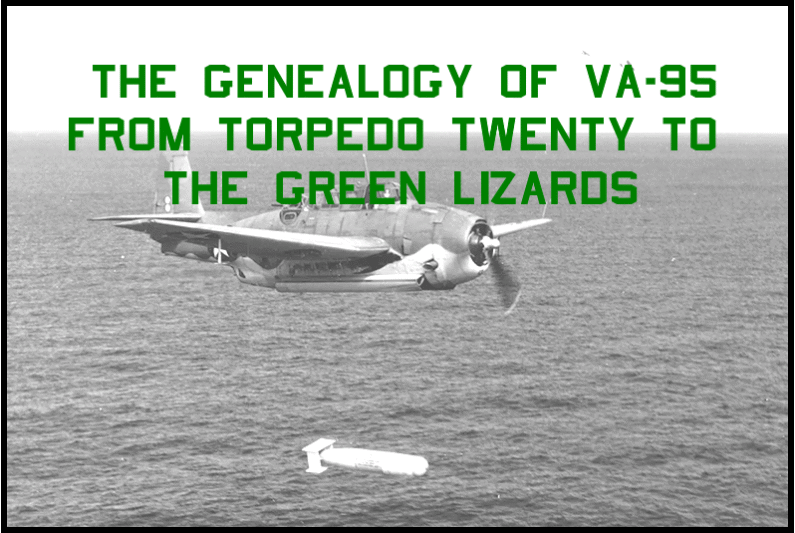
History of VA-95: From Avengers to Intruders

Taken together, the history of VA-95 story spans an extraordinary period in American naval aviation. It begins with young sailors and aviators taking TBM Avengers into battle against the Imperial Japanese Navy.
It passes through the era of the Skyraider and Skyhawk. And it ends with Green Lizard crews flying sophisticated A-6 Intruders from nuclear-powered aircraft carriers.
Behind those aircraft were thousands of sailors—pilots, bombardier/navigators, plane captains, aviation electricians (AE), structural mechanics (AMS, AMH and AME), ordnancemen (AO), avionics technicians (AT), fire control (AQ) engine mechanics (AD), support personnel (PR, AZ, AK, HM) and countless others—who kept the squadrons flying.
The official Navy records correctly treat the three VA-95s as separate squadrons. But viewed as naval aviation history, they each share something important. They carried the same number and they performed the Navy’s attack mission.
And they contributed to a tradition that stretched from the Pacific battles of World War II to combat operations in the Persian Gulf.
- VT-20 Vultures.
- VT-10A Vultures.
- VA-95 Skyknights.
- VA-95 Green Lizards.
Different squadrons. Different aircraft. Different generations of sailors. But all are part of the remarkable history behind the name:
ATTACK SQUADRON NINETY-FIVE.
The history of VA-95 behind the name Attack Squadron Ninety-Five—reaches back to the carrier battles of World War II. Over the decades, three different U.S. Navy squadrons would carry the VA-95 designation. Although these squadrons were separate official lineages, together they tell a remarkable story of Navy attack aviation—from the propeller-driven TBM Avenger of World War II to the F6F-5 Hellcat, A-1 Skyraider, A-4 Skyhawk, and eventually the legendary A-6 Intruder.
The story begins in 1943 with Torpedo Squadron Twenty—VT-20.
History of VA-95: 1943-Torpedo Squadron Twenty Is Born
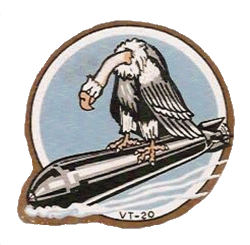
Torpedo Squadron Twenty (VT-20) was established on October 15, 1943, at Naval Air Station San Diego, California.
The squadron became known as the Vultures and flew the Grumman TBF/TBM Avenger, one of America’s most important carrier-based torpedo bombers of World War II.
By August 1944, VT-20 was aboard the legendary aircraft carrier USS Enterprise (CV-6) and heading into combat in the Pacific.
The Vultures entered combat on September 1, 1944, striking Japanese installations on Chichi Jima in the Bonin Islands. That was only the beginning.
During the following months, VT-20 participated in strikes against the Palau Islands, Peleliu, Okinawa, Formosa, Luzon and the Philippines as American forces continued their advance toward Japan.
History of VA-95: VT-20 at Leyte Gulf
One of the most important chapters in VT-20 history came during the Battle of Leyte Gulf in October 1944. VT-20 Avengers participated in attacks against the Japanese fleet during one of the largest naval battles in history.
On October 25, squadron aircraft took part in attacks against the Japanese carrier force during the Battle of Cape Engaño. Four Japanese aircraft carriers were sunk during the engagement. Several VT-20 aviators received the Navy Cross for their actions against the Japanese fleet.
The squadron continued fighting through the Philippines campaign, including strikes against Japanese forces around Ormoc Bay and Luzon. In November 1944, VT-20 transferred from USS Enterprise to USS Lexington (CV-16) and continued combat operations.
During January 1945, its Avengers struck targets on Luzon, Formosa, Hong Kong, Okinawa, the South China Sea and the coast of French Indochina.By the time VT-20 returned to the United States in February 1945, the Vultures had established a combat record worthy of remembrance.
History of VA-95: 1946-VT-20 Becomes VA-10A
With World War II over, the Navy reorganized its aviation squadrons. On November 15, 1946, Torpedo Squadron Twenty was redesignated:
VT-20 → VA-10A
The squadron was now officially Attack Squadron Ten A. This seemingly simple change represented something much larger happening throughout naval aviation.
The traditional distinction between torpedo and bombing squadrons was changing. The Navy was moving toward the broader concept of the carrier-based attack squadron. The aircraft, weapons and missions were changing—but the job remained essentially the same: Take the fight from the carrier to the enemy.
1948: The First VA-95
Another redesignation occurred on August 12, 1948. Attack Squadron Ten A became:
VA-10A → VA-95
For the first time, the designation Attack Squadron Ninety-Five appeared in the United States Navy. The squadron transitioned into the powerful Douglas AD/A-1 Skyraider, affectionately known throughout naval aviation as the “Spad.” The Skyraider represented the next generation of carrier attack aircraft.
It could carry a tremendous weapons load, remain over the battlefield for long periods and absorb an impressive amount of punishment. Unfortunately, this first chapter of VA-95 history was short.
The original VA-95 was disestablished on November 30, 1949. Its official lineage ended there.
1952: A Second VA-95 In The Korean War
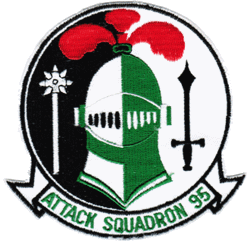
On March 26, 1952, the Navy established another Attack Squadron Ninety-Five. Despite carrying the same designation, this was officially a new squadron, not a reactivation of the original VT-20/VA-10A/VA-95 lineage.
This second VA-95 became associated with the nickname Skyknights flying the AD/A-1 Skyraider and later the A-4 Skyhawk.
VA-95 departed for Korea aboard the Essex-class USS Philippine Sea (CVA-47) on December 15, 1952, as part of Carrier Air Group Nine (CVG-9), the predecessor of today’s Carrier Air Wing Nine. Official Navy history confirms that CVG-9 conducted combat operations during the closing months of the Korean War. Operating with Seventh Fleet carrier forces, principally Task Force 77, VA-95’s Skyraiders carried out close air support and interdiction missions against Communist forces.
Targets included front-line positions, trenches, supply routes, transportation networks, buildings, vehicles, and other military targets supporting North Korean and Chinese forces. USS Philippine Sea’s air group also conducted intensive round-the-clock sorties supporting United Nations troops as fighting continued during the armistice negotiations.
VA-95 remained aboard Philippine Sea through the signing of the Korean Armistice on July 27, 1953, and returned to Alameda when the deployment ended on August 14, 1953. The 1952–53 cruise was VA-95’s only carrier combat deployment of the Korean War and established the newly formed squadron as a combat-tested Navy attack unit.
VA-95 During the Cold War 1954–1961
Between 1954 and 1961, Attack Squadron 95 (VA-95) moved from its Korean War combat experience into a demanding period of Cold War carrier operations in the Western Pacific. During these years the squadron was assigned to Carrier Air Group 9 (CVG-9) and primarily flew the Douglas AD-6 and later AD-7 Skyraider. VA-95 deployed aboard four different attack carriers:
- USS Hornet (CVA-12) from 11 May to 12 December 1954,
- USS Oriskany (CVA-34) from 11 February to 13 June 1956,
- USS Ticonderoga (CVA-14) from 16 September 1957 to 25 April 1958, and
- USS Ranger (CVA-61) from 6 February to 30 August 1960 and again beginning 11 August 1961.
These were not combat deployments like Korea or the squadron’s later Vietnam cruises. Instead, VA-95 operated with U.S. Seventh Fleet carrier forces, maintaining a strong American naval presence during a period of tension involving Communist China, Taiwan, Korea, and Southeast Asia. The 1954 Hornet cruise was notable as an around-the-world deployment, while the Oriskany and Ticonderoga cruises concentrated on Western Pacific operations and fleet readiness.
During these deployments, VA-95 practiced carrier strikes, conventional bombing, rocket attacks, navigation, close air support procedures, and other exercises designed to keep the squadron combat-ready. The move to USS Ranger in 1960 was especially important because it placed VA-95 aboard a modern Forrestal-class supercarrier and began a long association between VA-95, CVG-9, and Ranger. By the start of the squadron’s second Ranger cruise on 11 August 1961, VA-95 was operating the AD-6/AD-7 family, with the AD-7 becoming its principal Skyraider.
This 1954 to 1961 period helped turn VA-95 from a Korean War combat squadron into an experienced Cold War attack unit and prepared its pilots, maintainers, ordnancemen, and flight-deck crews for the Southeast Asian operations that would eventually lead VA-95 into the Vietnam War.
VA-95 Goes To War In Vietnam With The Douglas AD Skyraider 1961–1965.
Between 1961 and 1965, Attack Squadron 95 (VA-95) transitioned from Cold War readiness operations in the Western Pacific to combat over Southeast Asia. Throughout this period, VA-95 deployed aboard USS Ranger (CVA-61) as part of Carrier Air Group 9 (CVG-9), later Carrier Air Wing 9 (CVW-9), operating the Douglas AD-6/AD-7 Skyraider, redesignated A-1H/A-1J under the 1962 tri-service aircraft designation system. VA-95’s 11 August 1961–8 March 1962 WestPac deployment was primarily a deterrence and training cruise; Ranger participated in Operation Bandsaw, a major fleet exercise designed to practice offensive strikes, air defense, antisubmarine warfare, and attacks against mobile naval forces.
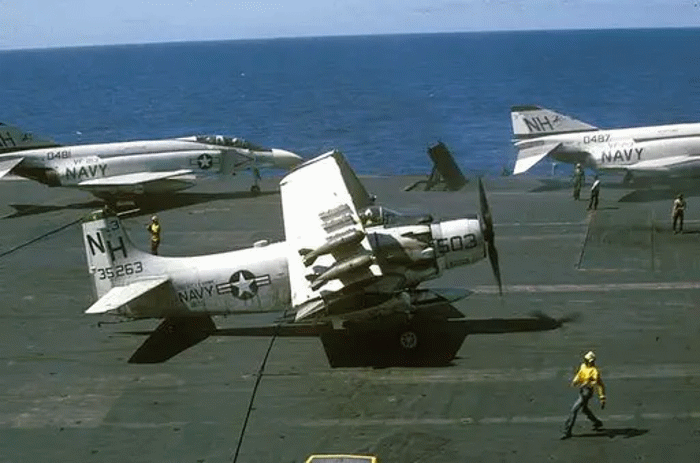
In 1963 VA-95 adopted the Green Lizards nickname and identity. During its early Vietnam-era operations, including its 1964–65 USS Ranger deployment, VA-95 was already the Green Lizards.
VA-95 returned aboard Ranger for the 9 November 1962–14 June 1963 WestPac deployment. In May 1963, Ranger moved into the South China Sea during the crisis in Laos, standing ready to support U.S. Yankee Team Operations after Pathet Lao advances threatened neutralist forces. The squadron’s most important deployment of this period began 5 August 1964 and ended 6 May 1965, again aboard Ranger with CVW-9. This became VA-95’s first major Vietnam combat cruise. Following the Gulf of Tonkin crisis, Ranger joined Seventh Fleet’s Fast Carrier Task Force 77 and operated extensively from Yankee Station.
VA-95’s A-1 Skyraiders supported photographic reconnaissance missions, attacked targets and lines of communication in Laos, and entered direct combat operations against North Vietnam. On 7 February 1965, VA-95 participated in Operation Flaming Dart I, the retaliatory strikes ordered after the Viet Cong attack at Pleiku. The squadron subsequently participated in Operation Flaming Dart II and the opening stages of Operation Rolling Thunder, striking military targets and transportation routes in North Vietnam and Laos. Ranger ultimately spent a then-record 59 consecutive days on Yankee Station, marking the point when VA-95 moved from Cold War contingency operations into sustained Vietnam War combat
VA-95 Goes To War In Vietnam With The Douglas A-4 Skyhawk 1966
Between 1966 and 1969, Attack Squadron 95 (VA-95), the Green Lizards, moved fully into the jet age and continued its Vietnam War service before shifting to Mediterranean and Cold War operations. VA-95 made its key Vietnam combat deployment from 4 April to 21 November 1966 aboard USS Intrepid (CVS-11) as part of Carrier Air Wing 10 (CVW-10), flying the Douglas A-4B Skyhawk.
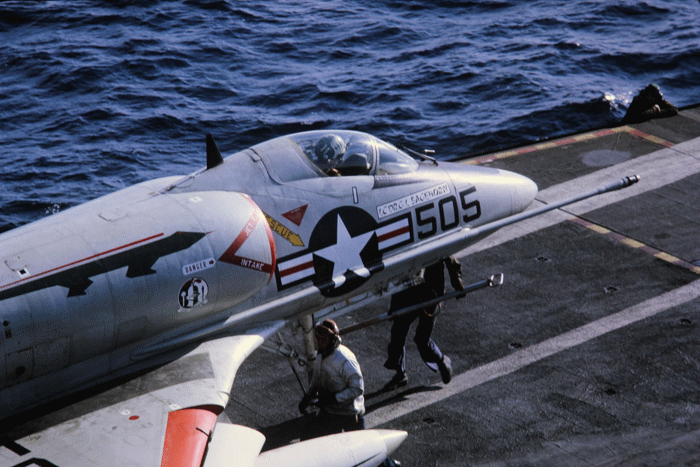
Operating with the U.S. Seventh Fleet and its carrier forces off Vietnam, including operations from Dixie Station and Yankee Statio, VA-95 flew attack missions against enemy positions, supply routes, transportation networks, and other military targets in North and South Vietnam as part of the wider Rolling Thunder air campaign. The 1966 cruise was especially important because it marked VA-95’s transition from the propeller-driven A-1 Skyraider used during its 1964–65 USS Ranger combat cruise to the jet-powered A-4 Skyhawk.
VA-95 Leaves the Vietnam War
After returning from Vietnam, VA-95 joined Carrier Air Wing 8 (CVW-8) aboard USS Shangri-La (CV-38) for a Mediterranean deployment from 15 November 1967 to 4 August 1968, still flying the A-4B. This was a Sixth Fleet Cold War deployment rather than a Vietnam combat cruise. VA-95 then transitioned to the A-4C Skyhawk and joined Carrier Air Wing 1 (CVW-1) aboard the new USS John F. Kennedy (CVA-67). The squadron participated in Kennedy’s short 1 November–17 December 1968 deployment and its major Mediterranean deployment from 5 April to 21 December 1969. These Kennedy cruises were also Sixth Fleet operations rather than Vietnam deployments. Thus, when documenting VA-95’s Vietnam War record during 1966–69, the 1966 Intrepid cruise is the squadron’s principal combat deployment; the later Shangri-La and John F. Kennedy cruises belong to its broader Cold War history.
The squadron served during the Korean War era, continued operating in the Vietnam War and through the increasingly tense years of the Cold War. During the 1960s, the name that would eventually become synonymous with VA-95 began to appear: The Green Lizards.
The second VA-95 remained active until 1970, when it was disestablished. Once again, VA-95 disappeared from the Navy’s active squadron roster. But not for long.
1972: The Green Lizards Return
On April 1, 1972, a third VA-95 squadron was established on 1 April 1972 at NAS Whidbey Island, Washington. This was another new squadron rather than a continuation of the two previous official lineages.
This VA-95 would become the squadron most closely remembered as the: GREEN LIZARDS. And its airplane would become one of the most recognizable attack aircraft ever to operate from an American aircraft carrier. The third Attack Squadron 95 (VA-95), the Green Lizards, returned to active service and became part of the final chapter of U.S. operations in Southeast Asia.
The Grumman A-6 Intruder
The Intruder was a very different machine from the TBM Avengers that had carried VT-20 into combat nearly three decades earlier. The A-6 was designed to penetrate enemy defenses at low altitude and deliver heavy weapons loads accurately in darkness and bad weather. Its two-man crew consisted of a pilot and bombardier/navigator working together with sophisticated navigation and attack systems. The Intruder gave the Green Lizards a true all-weather strike capability.
VA-95 and the Vietnam War, 1973–1975
VA-95 made its first Western Pacific deployment aboard USS Coral Sea (CVA-43) from 9 March to 8 November 1973 with CVW-15, flying the Grumman A-6A Intruder, specialized A-6B Intruder, and KA-6D tanker. During this cruise, VA-95 supported Operation End Sweep, the removal of mines from North Vietnamese waters following the Paris Peace Accords. The Green Lizards returned to Coral Sea and CVW-15 for a second deployment from 5 December 1974 to 2 July 1975, again operating A-6A/A-6B Intruders and KA-6D tankers.
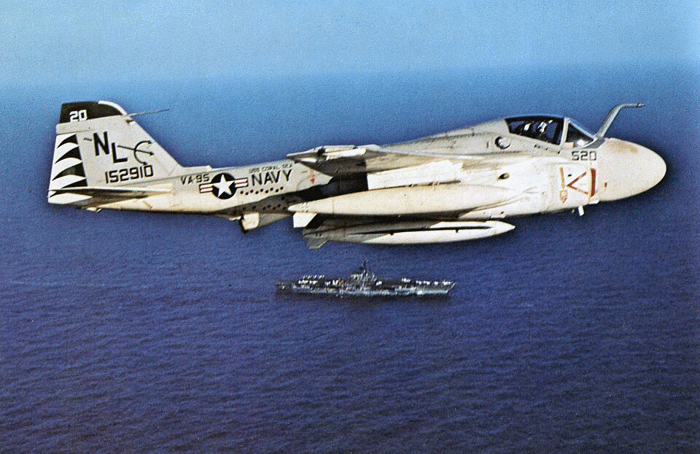
This cruise placed VA-95 at the center of the final American operations associated with the Vietnam era. Coral Sea stood by during Operation Eagle Pull, the evacuation of Phnom Penh, Cambodia, on 12 April 1975, and then moved off South Vietnam for Operation Frequent Wind on 29–30 April, when CVW-15 aircraft provided air cover for helicopters evacuating Americans and South Vietnamese from Saigon. VA-95 received the Humanitarian Service Medal for 29 Apr 1975 – 30 Apr 1975 for its participation in Operation Frequent Wind
Only two weeks later, Coral Sea was ordered to the Gulf of Thailand during the SS Mayaguez crisis. On 15 May 1975, CVW-15 launched combat strikes against Khmer Rouge military targets on the Cambodian mainland while U.S. forces attempted to recover the captured merchant ship and its crew. Navy history identifies VA-95 as having ten A-6A all-weather attack aircraft in CVW-15 during the operation; Coral Sea’s first strike package included Intruders along with A-7E Corsair IIs and F-4N Phantoms.
VA-95’s 1973–75 service covered Operation End Sweep, the final evacuation period in Southeast Asia, Operation Frequent Wind, and the Mayaguez operation, giving the newly reestablished Green Lizards an important role in the closing years of America’s military involvement in the south east Asia region.
VA-95 During the Cold War, 1976–1987
Between 1976 and 1987, Attack Squadron 95 (VA-95), the Green Lizards, developed into one of the Navy’s experienced all-weather attack squadrons and completed its transition from the A-6A to the more capable Grumman A-6E Intruder. VA-95 received its first A-6E in 1976 and continued operating the KA-6D tanker.
The squadron returned to USS Coral Sea (CVA-43) with Carrier Air Wing 15 (CVW-15) for a Western Pacific deployment from 15 February to 5 October 1977. VA-95 then transferred to Carrier Air Wing 11 (CVW-11), beginning a long association that continued through the remainder of the squadron’s history.
The Green Lizards deployed aboard USS America (CV-66) from 13 March to 22 September 1979 and again from 14 April to 12 November 1981, operating in the Mediterranean and, during the 1981 cruise, the Indian Ocean as tensions in the Middle East remained high. VA-95 next moved with CVW-11 to USS Enterprise (CVN-65, deploying from 1 September 1982 to 28 April 1983. VA-95 received the Humanitarian Service Medal for 23 Oct 1982 for its participation in the rescue of Vietnamese refugees (“boat people”) in the South China Sea.
The Green Lizards then deployed again on 30 May to 20 December 1984, and 15 January to 12 August 1986.
These cruises took the Green Lizards throughout the Northern Pacific, Western Pacific and Indian Ocean and involved major fleet exercises, long-range strike training, Cold War surveillance encounters, and operations designed to demonstrate American naval power near Soviet forces and other potential trouble spots.
Enterprise’s 1986 deployment became an around-the-world cruise, operating in the Western Pacific, Indian Ocean, Red Sea and Mediterranean before returning to the United States. CVW-11 records the cruise as generating about 23,000 flight hours and 9,000 arrested landings. VA-95 also embarked aboard Enterprise for a NORPAC deployment from 25 October to 24 November 1987.
Throughout this period, its A-6Es gave the carrier air wing a long-range, day/night and all-weather attack capability, while its KA-6Ds provided aerial refueling for other carrier aircraft. The years 1976–87 instead represented a period of intensive Cold War readiness that prepared VA-95 for the combat operations that followed in 1988, when its A-6Es would play a major role in Operation Praying Mantis against Iran.
History of VA-95 Goes To War Against Iran
There is an interesting historical symmetry in the VA-95 story. The original VT-20 had gone to war from the deck of the famous USS Enterprise (CV-6) during World War II. More than four decades later, the Green Lizards of VA-95 would also go into combat from an aircraft carrier named Enterprise—this time the nuclear-powered USS Enterprise (CVN-65).
In 1988, Attack Squadron 95 (VA-95), the Green Lizards, made one of the most important combat deployments in the squadron’s history. VA-95 deployed aboard USS Enterprise (CVN-65) from 5 January to 3 July 1988 as part of Carrier Air Wing 11 (CVW-11), flying the Grumman A-6E TRAM Intruder and KA-6D tanker. Enterprise operated as the centerpiece of Battle Group Foxtrot, commanded by Rear Admiral Guy Zeller, Commander Cruiser-Destroyer Group Three.
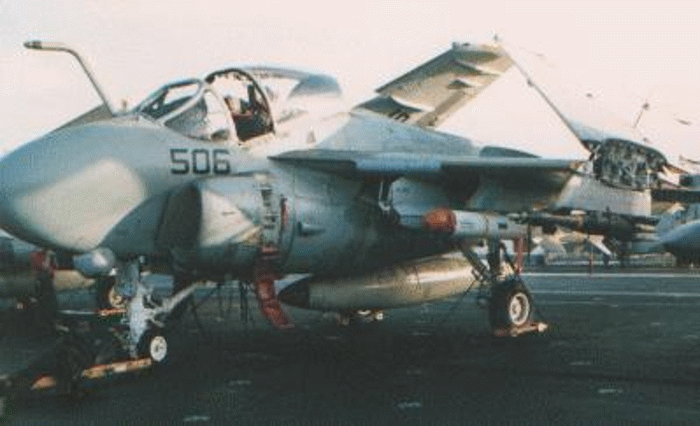
The battle group deployed to the North Arabian Sea and Gulf of Oman in support of Operation Earnest Will, the American effort to protect reflagged Kuwaiti oil tankers and maintain freedom of navigation during the Iran-Iraq War. After USS Samuel B. Roberts (FFG-58) struck an Iranian mine on 14 April, the United States launched Operation Praying Mantis on 18 April 1988. VA-95 A-6Es became heavily involved in the fighting. Green Lizard Intruders attacked Iranian Revolutionary Guard Boghammar speedboats with Mk 20 Rockeye cluster bombs, destroying one and damaging another. Later, VA-95 A-6Es engaged the Iranian frigate IRIS Sahand after the ship fired surface-to-air missiles at the aircraft.
Additional attacks followed, and the badly damaged frigate eventually sank. Later that day, the Iranian frigate IRIS Sabalan fired at VA-95 aircraft. A Green Lizard A-6E responded with a laser-guided bomb that severely damaged and immobilized the frigate. Higher command then ordered that Sabalan not be attacked further.
VA-95 continued supporting Earnest Will and Persian Gulf operations after the battle, including surface-action-group support and surveillance around the Strait of Hormuz. Enterprise completed its final Earnest Will mission of the deployment on 13 May and departed the region later that month. Several VA-95 personnel received combat recognition for their actions, and Rear Admiral Anthony Less visited Enterprise on 10 May to present Combat Action Awards to Green Lizards who had distinguished themselves during Praying Mantis.
History of VA-95 from 1989 To The End In 1995
Between 1989 and 1995, Attack Squadron 95 (VA-95), the Green Lizards, entered the final chapter of its history while continuing to provide Carrier Air Wing 11 (CVW-11) with long-range, all-weather attack and aerial-refueling capability.
VA-95 began the period aboard USS Enterprise (CVN-65), deploying from September 1989 to March 1990 with CVW-11 and flying the Grumman A-6E Intruder and KA-6D tanker. During this cruise, Enterprise operated with Battle Group Foxtrot and participated in major exercises including PACEX 89, ANNUALEX 89, and Valiant Blitz 90. In December 1989, CVW-11 and Battle Group Foxtrot joined USS Midway and Battle Group Alpha near the Philippines for Operation Classic Resolve, providing American military support during the attempted coup against the Philippine government.
VA-95 and CVW-11 then transferred to the new nuclear-powered USS Abraham Lincoln (CVN-72), taking part in the carrier’s September–November 1990 transit around South America to its new Pacific homeport. The Green Lizards made their first major Abraham Lincoln overseas deployment from May to November 1991. While heading toward the Arabian Gulf, the carrier was diverted to the Philippines for Operation Fiery Vigil following the eruption of Mount Pinatubo, helping evacuate U.S. military dependents and other people from the Subic Bay area. Abraham Lincoln then continued to the Arabian Gulf, where its air wing supported post-Desert Storm operations over Kuwait and Iraq.
VA-95 returned aboard Abraham Lincoln from June to December 1993, by which time the squadron was operating upgraded A-6E aircraft, including the A-6E SWIP configuration. During this deployment, CVW-11 flew thousands of missions supporting Operation Southern Watch and enforcing the no-fly zone over southern Iraq. In October, Abraham Lincoln was ordered from the Arabian Gulf to Somalia, where CVW-11 provided air support and force protection for U.S. and United Nations forces during Operation Restore Hope/Continue Hope.
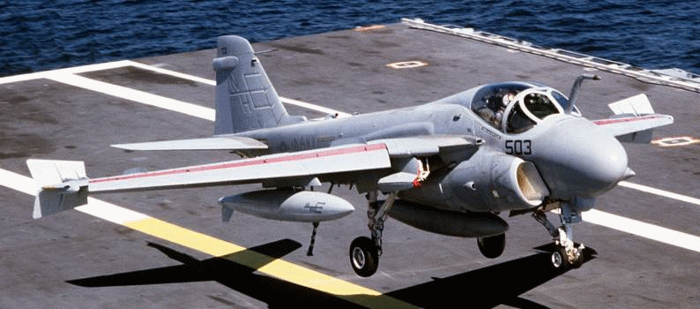
VA-95’s final deployment began in April 1995 aboard Abraham Lincoln with CVW-11. The carrier returned to the Arabian Gulf, where the Green Lizards supported Operation Southern Watch and Operation Vigilant Sentinel while maintaining the Intruder’s traditional long-range strike mission. When Abraham Lincoln returned in October 1995, VA-95’s operational career was essentially over.
The Green Lizards were disestablished on 31 October 1995 as the Navy continued retiring the A-6 Intruder and reducing its dedicated attack-squadron force. The 1989–95 period therefore carried VA-95 from the closing days of the Cold War through humanitarian operations in the Philippines, post-Gulf War operations over Iraq, operations off Somalia, and finally the retirement of one of the Navy’s most experienced A-6 squadrons.
1995 marked the end of an era. After more than fifty years since VT-20’s Avengers first went into combat over the Pacific until VA-95 was disestablished in October of 1995.
The VA-95 Family Tree
The history can be viewed as three distinct chapters:
FIRST VA-95
October 15, 1943
Torpedo Squadron Twenty (VT-20)
↓
November 15, 1946
Attack Squadron Ten A (VA-10A)
↓
August 12, 1948
Attack Squadron Ninety-Five (VA-95)
↓
November 30, 1949
Disestablished
SECOND VA-95
March 26, 1952
Attack Squadron Ninety-Five (VA-95) established
↓
Skyknights / Green Lizards era
↓
1970
Disestablished
THIRD VA-95
April 1, 1972
Attack Squadron Ninety-Five (VA-95) established
↓
Green Lizards
↓
Grumman A-6 Intruder era
↓
Combat in Operation Praying Mantis — 1988
↓
1995
Disestablished
Once a Lizard, always a Lizard.

Want more Green Lizard articles like this? Subscribe to our VA-95 All Weather Attack newsletter today and get VA-95-focused news, announcements, and website update delivered straight to your inbox.